Home Page:
Quantum Study Bible
Click on this menu icon  (after clicking on Quantum Study Bible) for a selection of Books, Topics, Charts, and Timelines)
Revision Date:
Classification: TOPIC EL, ELA, ELOHA, AYIL YEHOVA
The Relationship of the Various Forms of the Names of GOD
“EL” AS A SHORTENED FORM OF “AYIL”
Subject: In Daniel 2 the name of God is ‘ĕlâ
- ‘ĕlâ Strong’s h426 meaning: The authentic God or a mimic god (idol)
A Root Word corresponding to…‘ĕlôha - ‘ĕlôha h433, which is from the Root Word ēl
- ēl אֵל h410 (singular male noun meaning God, the one true God, Yehovah).
A Root Word corresponding to…‘ayil meaning ram, post, mighty (men), trees, lintel, oak all of which are descriptions of Jesus.
The Corresponding Meanings of AYIL to JESUS
ayil h352 אַיִל (below) 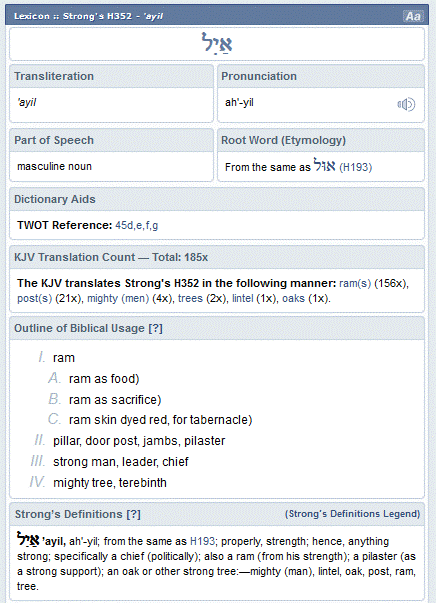
I. A Ram
- A Ram with its head caught in the thorns (like a crown of thorns) as a sacrifice substitute for Abraham’s promised son, Isaac, is: A Passover male Lamb as a sacrifice
- The Ram’s skin, dyed red (prophetically symbolic for Jesus’ blood), was used for the tabernacle.
II a. A pillar literally means “a witness” because pillars were written on with hieroglyphic writings telling a story.
Revelation 1:5 and from Jesus Christ, the faithful witness (pillar), the firstborn from the dead, and the ruler over the kings of the earth. To Him who loved us and washed us from our sins in His own blood,
II b. The doorposts in Egypt were painted with blood so that the Angel of Death would “Pass Over” their house – from there comes the phrase “The Passover” lamb and the Jewish feast of “Passover”. The blood painted on the doorposts’ lintel was symbolic of Jesus’ blood on the wood of the cross, and the doors with the blood were the only way to deliverance, life, and salvation.
III. Jesus is the Chief Cornerstone, the Mighty Man of God.
IV. The Terebinth Tree is an Oak, literally called a Teaching Tree, and “A Holy Seed”, which, when “cut down”, will be “resurrected” with new branches regrowing from the stump. The new branches are called a “Remnant of the Original,” also known as a “tenth remnant” or a “tithe”.
OTHER NAMES OF GOD: Yahweh is the same name of God as Yehova/Yehovah/Jehova. These are known as the “Tetragrammaton” spelled with four Hebrew letters commonly transliterated into English as YHWH (Yahweh) or YHVH (Yᵊhōvâ).
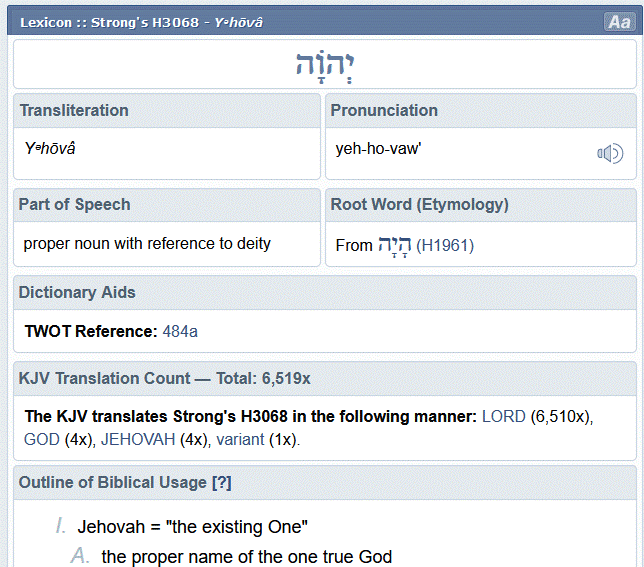
Literally “haya, haya” or “I AM that I AM”
The Tetragrammaton, the four-letter sacred name of God in the Hebrew Bible, is written using the following Hebrew letters (read from right to left):
- י — Yod (or Yud)
- ה — He (or Hey)
- ו — Waw (or Vav)
- ה — He (or Hey)
Together, they form the name, HEY, VAV, HEY, YUD
God’s Name as Adonai
The Hebrew word for God, consisting of the four letters hey, vav, yod, hey, transliterated as YHWH, became pronounced as Adonai in substitution for the original pronunciation of Yᵊhōvâ (Yehovah) forbidden since the 2nd or 3rd century BC to avoid unintentionally using God’s Name in blasphemy.
What’s the Difference between El, Elohei, and Eloha, and their relationship to the Tetragrammaton “Yehova”?
- When the first two letters of the Tetragrammaton are added to El, the resulting word is Elohei (א-להי).
- When the last two letters of the Tetragrammaton are added to El, the resultant is Eloah (א-לוה).
II Samuel 22 ēl IS Yᵊhōvâ !
Job Chapter 9
The Ancient Pictographs “Hieroglyphics”, for the ancient Tetragrammaton “Yehova” and their Prophecy of Jesus.
The ancient Hebrew Letters for Yehova:
The ancient letters looked like this: 


What are special about these four letters? As in the Ox head and Yoke to spell “El”, These four letters also have their own representation:
- BEHOLD! (Something supernatural-awestruck)…also drawn as
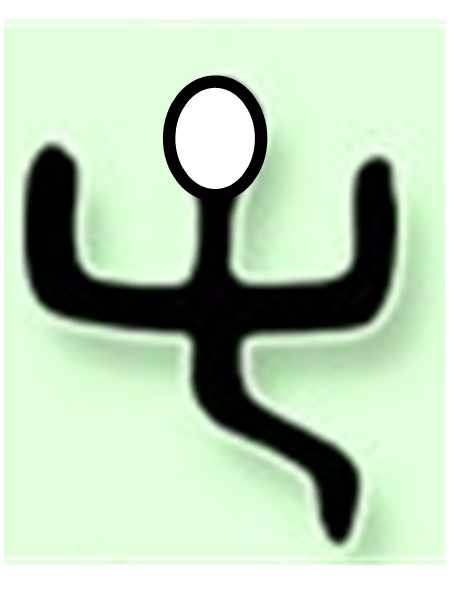
- PEG or NAIL
- BEHOLD! (Something supernatural-awestruck)…also drawn as
- HAND OR ARM
Together, these four letters produce a sentence: Behold! Nail. Behold! Hand.
Another interesting notation is that “Behold,” looks as though a man is praising God in this pictograph …
While the latter version is like a Man on a cross with both feet nailed together in this pictograph. (The man crucified on the Shroud of Turin, said to be the burial cloth of Jesus, shows both feet nailed together.)
The Understanding of God as “EL”
The ancient letters for God are an Oxhead (the English letter “A”) and a Yoke (the English letter “L”) with the understanding that God, as an Ox, yokes Himself to man, and as a burden bearer, carries man’s burden.
Alef: Oxhead
(English “A” turned upside down)

Alef (English “A” turned upside down)
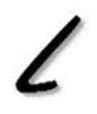
Lamed: Yoke
(English “L” = Staff or Yoke)
 Quantum Study Bible