
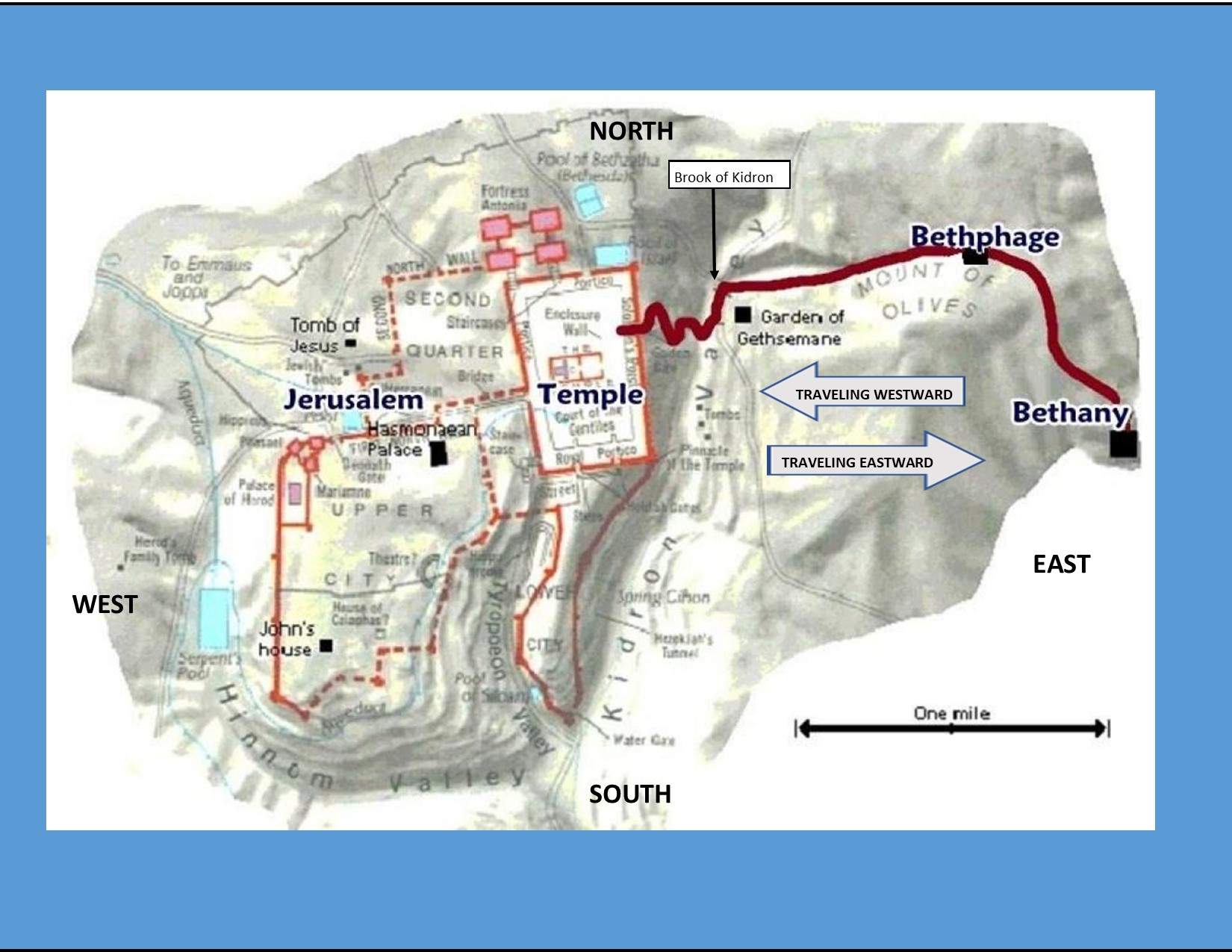
Jesus spent His last days in Bethany over the ridge of the Mount of Olives away from the city. Bethphage sits at the top of Mt. Olive.
It was in Bethany that Jesus had raised Lazarus from the dead.
During the last days of Jesus’ life he crossed over the brook of Kidron, back and forth, going from Bethany to Jerusalem and teaching in the temple.
To travel from Jerusalem to Bethany is a Sabbath Day’s journey, or about two miles. Jesus rode into Jerusalem on a Sabbath Day as they threw palm leaves in His path, welcoming Him as their King and Messiah. It was the same day the Priests were selecting a Passover lamb for Passover.
For three days they inspected the Passover lamb for spot or blemish. For those same three days Jesus taught in the temple as He was also inspected for spot or blemish in His teachings.
Two days before Passover, Monday evening, Jesus ate at Simon the leper’s house, where Simon (called Simon the leper), a Pharisee, was displeased that Mary Magdalene was present because she was a “sinner”. Mary then broke a bottle of costly herbs and spices and anointed Jesus for His death. Jesus had told the disciples many times He would be arrested and killed but they didn’t comprehend it; However, Mary Magdalene did. She cried as she washed His feet with her tears and dried them with her hair.
The following night would be His last supper and Jesus’ arrest. All night He was interrogated, then, before the end of that day He was crucified and buried, the same day the Passover lamb was slaughtered at twilight.
At twilight began the next Jewish day, the Passover Celebration, when the lamb was eaten, a Holy Convocation, a High Day Sabbath, which is why the legs of the crucified had to be broken and removed from the crosses. The grave had opened its mouth to swallow Jesus at the same time the Passover lamb was being eaten.
Interestingly enough, the Pharisees who had Jesus arrested at night, those who took Him to Pilate at the Gentile Pratorium, refused to go into the trial, because they did not want to be “unclean” for the Passover, not understanding that the Passover Lamb was already in the Pratorium.
Below the Roman calendar: On Nisan 10 the Jews were instructed through Moses to select the Passover lamb and to kill it on Nisan 14.

More specific: Below shows how the Jewish and Roman days overlap since for Jews, the day begins in the evening at twilight (the evening and the day are one day until twilight when the day begins again.) This is a tool for understanding differences in some of the scriptures for the “day” even though they are actually the same where they overlap.
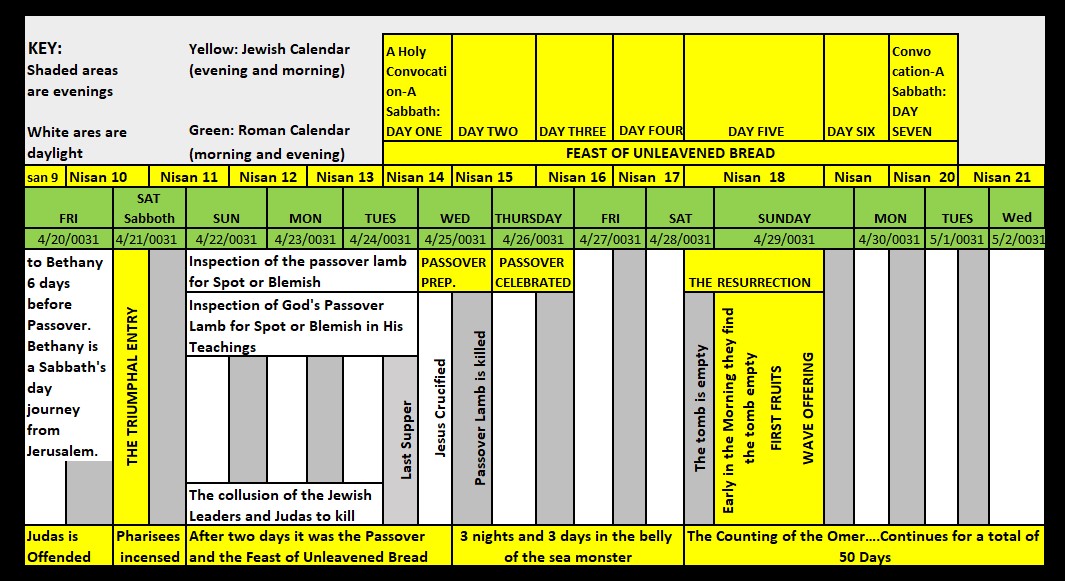
The Jews were also instructed to celebrate First Fruits on the first day of the week after Passover. That would be the same day Jesus was resurrected. Between the time Jesus was crucified and resurrected, He spent three days and three nights in Sheol. Immediately after His resurrection, certain tombs of the saints were opened, and they went into the city, as illustrated by the Jewish Feast called the Wave Offering. The Wave Offering is the celebration of a harvest, or resurrection: This is the First Fruits.
[Six days before Passover is somewhat confusing. It is either Passover preparation or Passover celebration. It could be on a Thursday or Friday on the Jewish Calendar]
 Quantum Study Bible