
Words in italic type have been added for clarity. They are not found in the original Hebrew or Aramaic.
- Tears are the physical manifestation of the emotional soul.
- The Son is the physical manifestation of the invisible Godhead.
Nehemiah 8
- “Spring is coming, because He is coming. And when the Resurrection returns, joy will overflow its earthly banks and drown our griefs forever.” ~The Gospel Coalition
Ezra Reads and Explains the Law
Nehemiah 8:1 Now all the people gathered together as one man in the open square that was in front of the Water Gate; and they told Ezra the scribe to bring the Book of the Law of Moses, which the Lord (Yᵊhōvâ) had commanded Israel.
- Note: The Hebrew word for “one” is ‘eḥāḏ H259. It is critical to get a full understanding of this word. It is defined as “one” (as in the number one), BUT it is always and only used in the sense of unity – ie “all the people are as one.” The reason for this importance is that it is the identical Hebrew word used in Deuteronomy 6:4 “Hear, O Israel: The Lord our God, the Lord is one!”
While Deuteronomy 6:4 is used to argue against the Trinity, it actually defends the Trinity as being and acting in unity as “One”; one in character, one in agreement, and one in purpose.
Nehemiah 8:2 So Ezra the priest brought the Law before the assembly of men and women and all who could hear with understanding on the first day of the seventh month (Tishri 1).
- The first day of the seventh month is the Feast of Trumpets and the beginning of the ten High Holy Days.
- Why did God give the Hebrews designated feasts, some of which seem to be frivolous? The answer is that they all point to the prophecy of the Messiah, God’s agenda for mankind, leading up to end days.
All the Spring Feasts were fulfilled by Jesus at His first advent to earth, which leaves one to speculate “What do the Autumn Feasts Signify that are not yet fulfilled?” Below is a chart that seems to match future prophecies in scriptures not yet fulfilled specifically of end-time events. - As a pattern, The High Holy Days are ten days of affliction for the Jews, but for the bride of Christ the Feast of Trumpets reflects the prophecy of the Rapture and Resurrection, while the Day of Atonement reflects the return of Christ. Seven days between the two “book ends” would represent the Seven-Year Tribulation for the Jews and the world. A strong argument for such a pattern is Daniel’s 1,335 mysterious days. See: TOPIC: The Mystery of Daniel’s 1,335 Days. However, the Jews at the time did not understand the significance of these feast but celebrated in obedience and faith of the instructions which came directly from God.
Nehemiah 8:3 Then he read from it in the open square that was in front of the Water Gate from morning (Lit. from the light) until midday, before the men and women and those who could understand; and the ears of all the people were attentive to the Book of the Law.
Nehemiah 8:4 So Ezra the scribe stood on a platform of wood which they had made for the purpose; and beside him, at his right hand, stood Mattithiah, Shema, Anaiah, Urijah, Hilkiah, and Maaseiah; and at his left hand Pedaiah, Mishael, Malchijah, Hashum, Hashbadana, Zechariah, and Meshullam.
Nehemiah 8:5 And Ezra opened the book in the sight of all the people, for he was standing above all the people; and when he opened it, all the people stood up. 6 And Ezra blessed the Lord (Yᵊhōvâ), the great God (‘ĕlōhîm).
Then all the people answered, “Amen, Amen!” while lifting up their hands. And they bowed their heads and worshiped the Lord (Yᵊhōvâ) with their faces to the ground.
Nehemiah 8:7 Also Jeshua, Bani, Sherebiah, Jamin, Akkub, Shabbethai, Hodijah, Maaseiah, Kelita, Azariah, Jozabad, Hanan, Pelaiah, and the Levites, helped the people to understand the Law; and the people stood in their place.
Nehemiah 8:8 So they read distinctly from the book, in the Law of God (‘ĕlōhîm); and they gave the sense, and helped them to understand the reading.
Nehemiah 8:9 And Nehemiah, who was the governor (Heb. Tirshatha), Ezra the priest and scribe, and the Levites who taught the people said to all the people, “ This day (Tishri 1) is holy to the Lord (Yᵊhōvâ) your God (‘ĕlōhîm); do not mourn nor weep.” For all the people wept, when they heard the words of the Law.
- Tishri 1 was for the Feast of Trumpets.
- “All the people wept”: The Word of God (Jesus) revealed the soul of the Father.
Nehemiah 8:10 Then he said to them, “Go your way, eat the fat, drink the sweet, and send portions to those for whom nothing is prepared; for this day is holy to our Lord (‘ăḏōnāy). Do not sorrow, for the joy of the Lord (Yᵊhōvâ) is your strength.”
- It is the time of turning sorrow to joy for the living faithful and, if the pattern is correct, also the time of rapturous life being raised from death.
Nehemiah 8:11 So the Levites quieted all the people, saying, “Be still, for the day is holy; do not be grieved.”
Nehemiah 8:12 And all the people went their way to eat and drink, to send portions and rejoice greatly, because they understood the words that were declared to them.
- When Jesus taught, the people did not understand the words that were declared to them.
The Feast of Tabernacles
Nehemiah 8:13 Now on the second day the heads of the fathers’ houses of all the people, with the priests and Levites, were gathered to Ezra the scribe, in order to understand the words of the Law.
- They gathered on Tishri 2, albeit for being taught about the Feast of Booths that was to be celebrated on Tishri 15.
Nehemiah 8:14 And they found written in the Law, which the Lord (Yᵊhōvâ) had commanded by Moses, that the children of Israel should dwell in booths (Temporary shelters) during the feast of the seventh month (Sukkot, the Feast of Booths),
Nehemiah 8:15 and that they should announce and proclaim in all their cities and in Jerusalem, saying, “Go out to the mountain, and bring olive branches, branches of oil trees, myrtle branches, palm branches, and branches of leafy trees, to make booths, as it is written.”
Nehemiah 8:16 Then the people went out and brought them and made themselves booths, each one on the roof of his house, or in their courtyards or the courts of the house of God (‘ĕlōhîm), and in the open square of the Water Gate and in the open square of the Gate of Ephraim.
Nehemiah 8:17 So the whole assembly of those who had returned from the captivity made booths (Temporary shelters) and sat under the booths; for since the days of Joshua the son of Nun until that day the children of Israel had not done so. And there was very great gladness.
- Joshua brought the Hebrews into the promised land after Moses and Aaron died. Not even during the days of King Saul or King David was the Feast of Booths kept or since then until the time Ezra read from the book of the law.
Nehemiah 8:18 Also day by day, from the first day until the last day, he read from the Book of the Law of God (‘ĕlōhîm). And they (also) kept the feast seven days; and on the eighth day there was a sacred assembly, according to the prescribed manner.
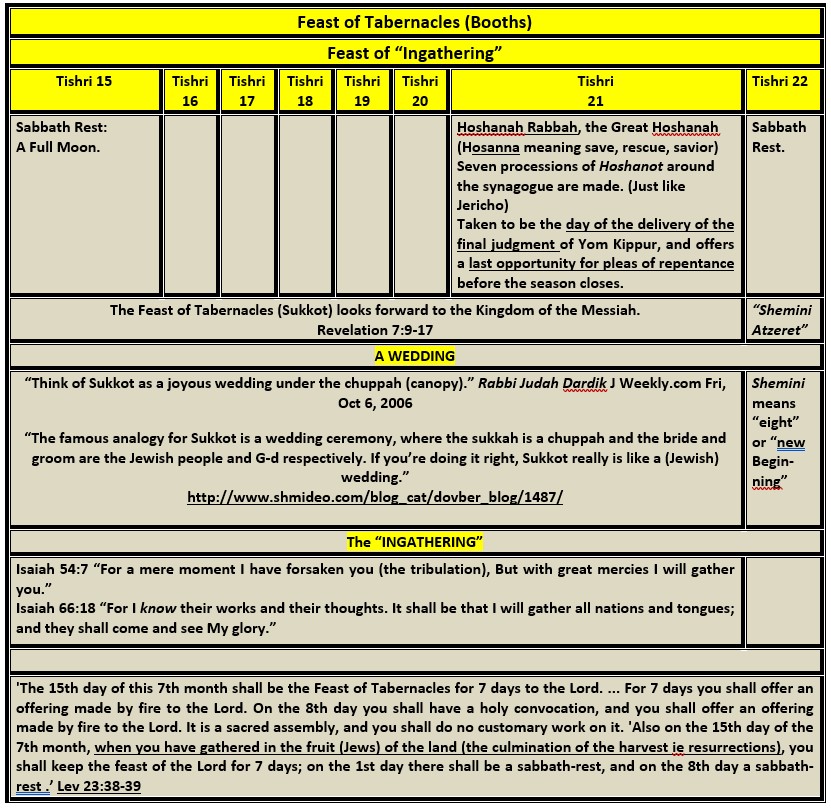
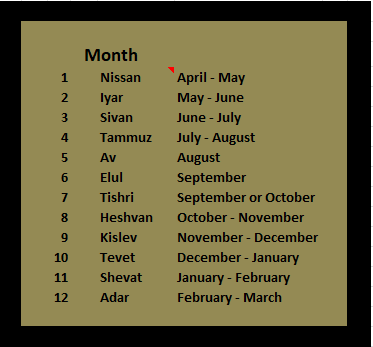
- Note: The High Holy days are from Tishri 1st to Tishri 10th, then, the Feast of Booths begins on the 15th and continues through the 22nd with the 8th day being the 23rd.
 Quantum Study Bible