
Words in italic type have been added for clarity. They are not found in the original Hebrew or Aramaic.
I Kings 13
What should I learn from this chapter?
The Northern Kingdom of Israel lasted from 931 BC to 722 BC = 209 years
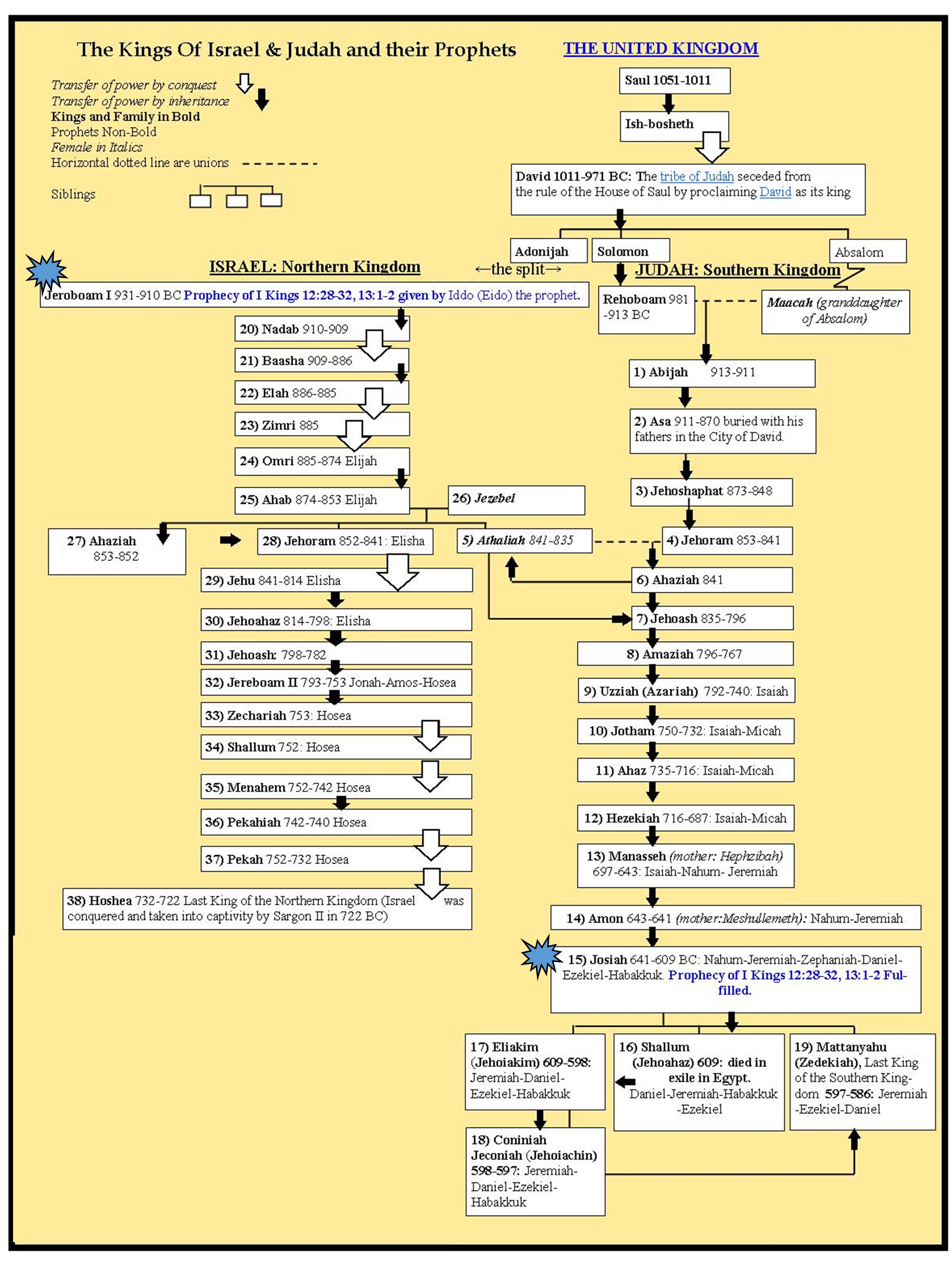
- The prophet in I Kings 13:2 called “A man of God” is most likely Iddo the prophet.
- “Now the rest of the acts of Solomon, first and last, are they not written in the book of Nathan the prophet, and in the prophecy of Ahijah the Shilonite, and in the visions of Iddo the seer against Jeroboam the son of Nebat?” II Chronicles 9:29
- The Story of the Prophet Iddo (also called the Midrash of the Prophet Iddo and Visions of Iddo the Seer) is a lost work mentioned in the Bible, attributed to the biblical prophet Iddo who lived at the time of King Rehoboam when the kingdom split into Israel and Judah.
- “Now the rest of the acts of Solomon, first and last, are they not written in the book of Nathan the prophet, and in the prophecy of Ahijah the Shilonite, and in the visions of Iddo the seer against Jeroboam the son of Nebat?” II Chronicles 9:29
- The reference to the book is described at II Chronicles 9:29, relating to the acts of Solomon: It is also described in II Chronicles 12:15, relating to acts of Rehoboam: “Now the acts of Rehoboam, first and last, are they not written in the book of Shemaiah the prophet, and of Iddo the seer concerning genealogies? And there were wars between Rehoboam and Jeroboam continually.” The book is also described at II Chronicles 13:22, relating to the acts of Abijah: “And the rest of the acts of Abijah, and his ways, and his sayings, are written in the story of the prophet Iddo.”
- Nehemiah 12:16 and Zechariah 1:1 tell us Zechariah the Prophet was a son of Iddo. Zechariah the Prophet is the author of the book of Zechariah in the Old Testament.
The Message of the Man of God
I Kings 13:1 And behold, a man (Iddo the Prophet?) of God (‘ĕlōhîm) went from Judah to Bethel by the word of the Lord (Yᵊhōvâ) (at the Lord’s command), and Jeroboam stood by the altar to burn incense.
- Bethel is the place Jeroboam built a golden calf to be worshiped.
I Kings 13:2 Then he (the prophet) of God (‘ĕlōhîm) cried out against the altar by the word of the Lord (Yᵊhōvâ) (at the Lord’s command), and said, “O altar, altar! Thus says the Lord (Yᵊhōvâ): ‘Behold, a child, Josiah by name, shall be born to the house of David; and on you he shall sacrifice the priests of the high places who burn incense on you, and men’s bones shall be burned on you.’ ”
The prophecy took place close to the beginning of Jeroboam’s reign 929 BC.
His prophecy was fulfilled in 622 BC, 302 years AFTER the prophecy was given. See II Kings 23.
In the eighteenth year of King Josiah’s rule, he insisted on the exclusive worship of Yahweh and outlawed all other forms of worship. (See II Kin 23:13 He tore down what Solomon had built.) Josiah destroyed the living quarters for male prostitutes, which were in the Temple. (II Kin 23:7) He destroyed foreign pagan objects related to the worship of Baal, Ashterah (or Asherah), “and all the hosts of the heavens”. (II Kin 23:5) He had the living pagan priests executed. He had the bones of dead pagan priests exhumed from their graves and burned on their altars, which was viewed as an extreme act of desecration against the pagan deities by their adherents. (II Kings 23:16-19) He even destroyed altars and images of pagan deities in cities of the tribes of Manasseh, Ephraim, ‘and Simeon, as far as Naphtali’ [II Chronicles 34:6-7], which were outside of Judah. II King 23: 17-18 The king (Josiah) asked, “What is that tombstone I see?”
The people of the city said, “It marks the tomb of the man of God who came from Judah and pronounced against the altar of Bethel the very things you have done to it.” “Leave it alone,” he said. “Don’t let anyone disturb his bones.” So they spared his bones … those of the prophet who had come from Samaria. The question is this…did Josiah, knowing about this prophecy and having the same name, believe he was the one in the prophecy and then set out to fulfill it? Or did he simply fulfilled it some 300 years later as God had predicted? As interesting as it is to speculate… The reality is this: God predicted it, the prophet prophesied it, Josiah did it, and the prophecy was fulfilled exactly as God said it would be!
I Kings 13:3 And he gave a sign the same day, saying, “This is the sign which the Lord (Yᵊhōvâ) has spoken: Surely the altar shall split apart, and the ashes on it shall be poured out.”
- The altar was split apart, a picture of how the kingdom had been split apart.
I Kings 13:4 So it came to pass when King Jeroboam heard the saying of the man (Iddo?) of God (‘ĕlōhîm), who cried out against the altar in Bethel, that he stretched out his hand from the altar, saying, “Arrest him!” Then his hand, which he stretched out toward him, withered, so that he could not pull it back to himself.
- The Antichrist will have a blind right eye and a withered arm. Like the Antichrist, Jeroboam had no respect for the God of Abraham, Isaac, and Jacob.
- Zechariah 11:17 “Woe to the worthless shepherd, Who leaves the flock! A sword shall be against his arm And against his right eye; His arm shall completely wither, And his right eye shall be totally blinded.”
I Kings 13:5 The altar also was split apart, and the ashes poured out from the altar, according to the sign which the man (Iddo?) of God (ĕlōhîm) had given by the word of the Lord (Yᵊhōvâ).
- Ashes are symbolic of mourning and destruction. They take the place of anointing on the head. God is giving Jeroboam a message.
I Kings 13:6 Then the king answered and said to the man (Iddo?) of God (ĕlōhîm), “Please entreat the favor of the Lord your God (Yᵊhōvâ ‘ĕlōhîm), and pray for me, that my hand may be restored to me.”
So the man (Iddo?) of God (ĕlōhîm) entreated the Lord (Yᵊhōvâ), and the king’s hand was restored to him, and became as before.
I Kings 13:7 Then the king (Jeroboam) said to the man (Iddo?) of God (‘ĕlōhîm), “Come home with me and refresh yourself, and I will give you a reward.”
- A highly suspicious offer by Jeroboam. He is angry about the altar being destroyed, this prophet confronting him, and his arm being withered. He wants the prophet arrested but that didn’t work. If the prophet were to go with Jeroboam he would most likely find himself in danger.
I Kings 13:8 But the man (Iddo?) of God (‘ĕlōhîm) said to the king, “If you were to give me half your house, I would not go in with you; nor would I eat bread nor drink water in this place.
I Kings 13:9 For so it was commanded me by the word of the Lord (Yᵊhōvâ), saying, ‘You shall not eat bread, nor drink water, nor return by the same way you came.’ ”
- God told the prophet to save his life. The commands are all directed at avoiding danger by Jeroboam.
I Kings 13:10 So he (the man – Iddo?) of God ‘ĕlōhîm went another way and did not return by the way he came to Bethel.
Death of the Man of God
I Kings 13:11 Now an old prophet (Ahijah?) dwelt in Bethel, and his sons (Lit. son) came and told him all the works that the man (Iddo?) of God (‘ĕlōhîm) had done that day in Bethel; they also told their father the words which he had spoken to the king.
- Note: The old prophet is in Bethel, the same place where Jeroboam built the altar.
I Kings 13:12 And their father (Ahijah?) said to them, “Which way did he go?” For his sons had seen (showed him) which way the man (Iddo?) of God (‘ĕlōhîm) went who came from Judah.
I Kings 13:13 Then he (Ahijah?) said to his sons, “Saddle the donkey for me.” So they saddled the donkey for him; and he rode on it,
I Kings 13:14 and went after the man (Iddo?) of God (‘ĕlōhîm), and found him sitting under an oak (terebinth tree). Then he (Ahijah?) said to him, “Are you the man (Iddo?) of God (‘ĕlōhîm) who came from Judah?”
- The oak is terebinth tree, also called a teaching tree, and a holy seed, both of which refer to the Messiah. It is also symbolic of a remnant. (Isaiah 6:13)
- The terebinth tree appears in scripture at significant moments, including the announcement of the promised son to Abram and Sara (Genesis 18:1), and Absalom’s hair hanging him in the terebinth tree (II Samuel 18:10).
And he said, “I am.”
I Kings 13:15 Then he (Ahijah?) said to him, “Come home with me and eat bread.”
I Kings 13:16 And he (Iddo?) said, “I cannot return with you nor go in with you; neither can I eat bread nor drink water with you in this place.
I Kings 13:17 For I have been told by (Lit. a command came to me by) the word of the Lord (Yᵊhōvâ), ‘You (Iddo?) shall not eat bread nor drink water there, nor return by going the way you came.’ ”
I Kings 13:18 He (Ahijah?) said to him (Iddo?), “I too am a prophet as you are, and an angel spoke to me by the word of the Lord (‘ĕlōhîm), saying, ‘Bring him back with you to your house, that he may eat bread and drink water.’ ” (He was lying to him.)
I Kings 13:19 So he went back with him, and ate bread in his (Ahijah’s?) house, and drank water.
I Kings 13:20 Now it happened, as they sat at the table, that the word of the Lord (Yᵊhōvâ) came to the prophet (Ahijah?) who had brought him (Iddo?) back;
I Kings 13:21 and he (Ahijah?) cried out to the man (Iddo?) of God (‘ĕlōhîm) who came from Judah, saying, “Thus says the Lord (Yᵊhōvâ): ‘Because you have disobeyed the word of the Lord (Yᵊhōvâ), and have not kept the commandment which the Lord your God (Yᵊhōvâ ‘ĕlōhîm) commanded you,
I Kings 13:22 but you came back, ate bread, and drank water in the place of which the Lord said to you, “Eat no bread and drink no water,” your corpse shall not come to the tomb of your fathers.’ ”
I Kings 13:23 So it was, after he had eaten bread and after he had drunk, that he (Ahijah?) saddled the donkey for him, the prophet (Iddo?) whom he had brought back.
I Kings 13:24 When he (Iddo?) was gone, a lion met him (Iddo?) on the road and killed him. And his corpse was thrown on the road, and the (same) donkey stood by it. The lion also stood by the corpse.
I Kings 13:25 And there, men passed by and saw the corpse (Iddo?) thrown on the road, and the lion standing by the corpse. Then they went and told it in the city where the old prophet (Ahiyah?) dwelt.
I Kings 13:26 Now when the prophet (Ahiyah?) who had brought him (Iddo?) back from the way heard it, he said, “It is the man (Iddo?) of God (‘ĕlōhîm) who was disobedient to the word of the Lord (Yᵊhōvâ). Therefore the Lord (Yᵊhōvâ) has delivered him to the lion, which has torn him and killed him, according to the word of the Lord (Yᵊhōvâ) which He spoke to him.”
I Kings 13:27 And he (Ahiyah?) spoke to his sons, saying, “Saddle the donkey for me.” So they saddled it.
I Kings 13:28 Then he (Ahiyah?) went and found his (Iddo?) corpse thrown on the road, and the donkey and the lion standing by the corpse. The lion had not eaten the corpse nor torn the donkey.
I Kings 13:29 And the prophet (Ahiyah?) took up the corpse of the man (Iddo?) of God (‘ĕlōhîm), laid it on the donkey, and brought it back. So the old prophet (Ahiyah?) came to the city to mourn, and to bury him.
I Kings 13:30 Then he (Ahiyah?) laid the corpse in his own tomb; and they mourned over him, saying, “Alas, my brother!”
I Kings 13:31 So it was, after he (Ahiyah?) had buried him, (Iddo?) that he spoke to his sons, saying, “When I am dead, then bury me in the tomb where the man (Iddo?) of God (‘ĕlōhîm) is buried; lay my bones beside his bones.
I Kings 13:32 For the saying (Lit. word) which he (Ahiyah?) cried out by the word of the Lord (Yᵊhōvâ) against the altar in Bethel, and against all the shrines (Lit. houses) on the high places which are in the cities of Samaria, will surely come to pass.”
I Kings 13:33 After this event Jeroboam did not turn from his evil way, but again he made priests from every class of people for the high places; whoever wished, he consecrated him, and he (that person) became one of the priests of the high places.
I Kings 13:34 And this thing was the sin of the house of Jeroboam, so as to exterminate and destroy it from the face of the earth.
{1 of 2} I Kings 13 – “An Old Prophet and His Ass” [Boil, Boil]
{2 of 2} I Kings 13 – “O Altar, O Altar!” [Called Out By Name]
 Quantum Study Bible