
Words in italic type have been added for clarity. They are not found in the original Hebrew or Aramaic.
- Also see {1 of 2} BIBLE: II Kings 8 History
II Kings 8
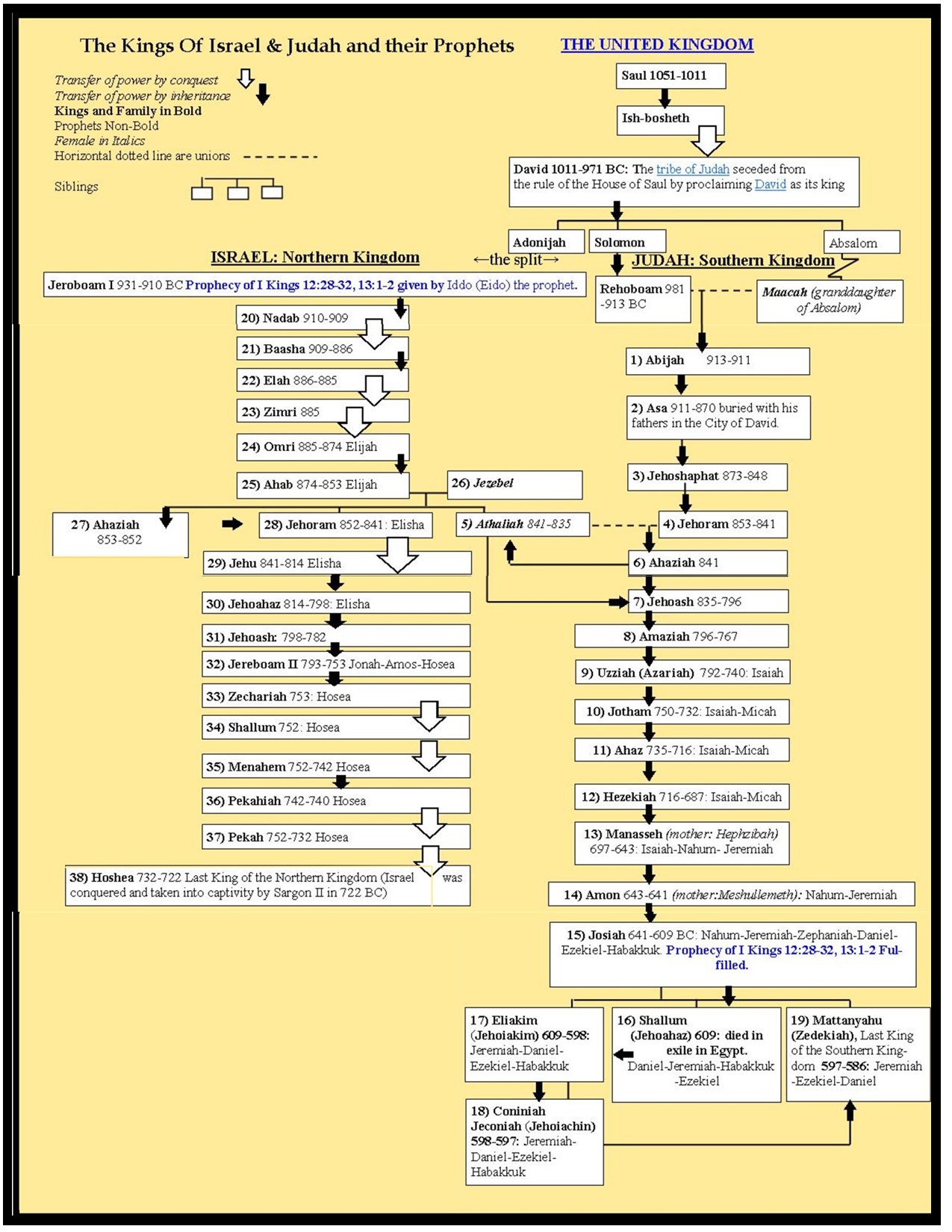
Below: Chart of the Kings of Ancient Israel and Judah and their Prophets
The King Restores the Shunammite’s Land
II Kings 8:1 Then Elisha spoke to the woman whose son he had restored to life, saying, “Arise and go, you and your household, and stay wherever you can; for the Lord (Yᵊhōvâ) has called for a famine, and furthermore, it will come upon the land for seven years.”
II Kings 8:2 So the woman arose and did according to the saying of the man of God (‘ĕlōhîm), and she went with her household and dwelt in the land of the Philistines seven years.
- See Jacob’s trouble. A famine in the land for seven years.
- Genesis 41:29-30 Indeed seven years of great plenty will come throughout all the land of Egypt; but after them seven years of famine will arise, and all the plenty will be forgotten in the land of Egypt; and the famine will deplete the land.
- Genesis 41:29-30 Indeed seven years of great plenty will come throughout all the land of Egypt; but after them seven years of famine will arise, and all the plenty will be forgotten in the land of Egypt; and the famine will deplete the land.
- The future tribulation will have a seven year famine. The future tribulation is called “Jacob’s trouble.”
- Jeremiah 30:7 Alas! For that day is great, So that none is like it; And it is the time of Jacob’s trouble, But he shall be saved out of it.
- Amos 8:11 “Behold, the days are coming,” says the Lord God, “That I will send a famine on the land, Not a famine of bread, Nor a thirst for water, But of hearing the words of the Lord.
- Matthew 24:21 For then there will be great tribulation, such as has not been since the beginning of the world until this time, no, nor ever shall be.
- The woman of this verse was saved out of it which is what happens when God displays His wrath of men, just as He did with Noah.
- Conclusion: A famine is a judgment from God. Seven is the completion of the point by which the famine was given.
II Kings 8:3 It came to pass, at the end of seven years, that the woman returned from the land of the Philistines; and she went to make an appeal to the king for her house and for her land.
- The purpose of the famine of the Shunammite woman is not only the judgment of the sin on the land, but it is a pattern after the famine during the coming seven year tribulation. When the remnant of Jews at the end of the seven years return to God, then Jesus, as God, returns to them. He sets up HIs kingdom on earth. In that day the Kings of kings will say to the Jews ” “Restore all that was hers, and all the proceeds of the field from the day that she left the land until now.”
- The Shunammite woman represents the Jewish nation.
- Whenever there is an unnamed person in scripture it seems to indicate the working of the Holy Spirit.
II Kings 8:4 Then the king talked with Gehazi, the servant of the man of God (‘ĕlōhîm), saying, “Tell me, please, all the great things Elisha has done.”
II Kings 8:5 Now it happened, as he was telling the king how he had restored the dead to life, that there was the woman whose son he had restored to life, appealing to the king for her house and for her land. And Gehazi said, “My lord, O king, this is the woman, and this is her son whom Elisha restored to life.”
II Kings 8:6 And when the king asked the woman, she told him.
Perfect Timing:
Was it a coincidence this miraculous timing? God works on our behalf. There are no coincidences. It was no coincident when the king of Persia opened the book of remembrance, when he could not sleep, to discover Mordecai was to be favored, hence leading to events that would keep the Jews from being annihilated. (Read the book of Esther)
Romans 8:28 And we know that all things work together for good to those who love God, to those who are the called according to His purpose.
So the king appointed a certain officer for her, saying, “Restore all that was hers, and all the proceeds of the field from the day that she left the land until now.”
Death of Ben-Hadad
II Kings 8:7 Then Elisha went to Damascus, and Ben-Hadad (885-865 BC) king of Syria was sick; and it was told him, saying, “The man of God (‘ĕlōhîm) has come here.”
II Kings 8:8 And the king said to Hazael, “Take a present in your hand, and go to meet the man of God (‘ĕlōhîm), and inquire of the Lord (Yᵊhōvâ) by him, saying, ‘Shall I recover from this disease?’ ”
II Kings 8:9 So Hazael went to meet him and took a present with him, of every good thing of Damascus, forty camel-loads; and he came and stood before him, and said, “Your son Ben-Hadad king of Syria has sent me to you, saying, ‘Shall I recover from this disease?’ ”
II Kings 8:10 And Elisha said to him, “Go, say to him, ‘You shall certainly recover.’ However the Lord (Yᵊhōvâ) has shown me that he will really die.”
II Kings 8:11 Then he (Elisha) set his countenance (fixed his gaze) in a stare (toward Hazael because God (‘ĕlōhîm) had revealed what he would do) until he was ashamed (Elisha stared at Hazael in condemnation); and (then) the man of God (‘ĕlōhîm) (Elisha) wept.
II Kings 8:12 And Hazael said, “Why is my lord weeping?”
He answered, “Because I know the evil that you will do to the children of Israel: Their strongholds you will set on fire, and their young men you will kill with the sword; and you will dash their children, and rip open their women with child.”
II Kings 8:13 So Hazael said, “But what is your servant—a dog, that he should do this gross thing?”
And Elisha answered, “The Lord (Yᵊhōvâ) has shown me that you will become king over Syria.”
II Kings 8:14 Then he departed from Elisha, and came to his master, who said to him, “What did Elisha say to you?” And he answered, “He told me you would surely recover.”
II Kings 8:15 But it happened on the next day that he took a thick cloth and dipped it in water, and spread it over his face so that he (Ben-Hadad) died; and Hazael reigned in his place.
Jehoram Reigns in Judah
II Kings 8:16 Now in the fifth year of Joram (aka Jehoram king of Israel) the son of Ahab, king of Israel, Jehoshaphat having been king of Judah, Jehoram (king of Judah) the son of Jehoshaphat began to reign as king (Co-regent with his father) of Judah.
II Kings 8:17 He was thirty-two years old when he (Jehoram) became king, and he reigned eight years in Jerusalem.
II Kings 8:18 And he walked in the way of the kings of Israel, just as the house of Ahab had done, for the daughter of Ahab (Atahliah) was his (Jehoram’s) wife; and he did evil in the sight of the Lord (Yᵊhōvâ).
II Kings 8:19 Yet the Lord (Yᵊhōvâ) would not destroy Judah, for the sake of His servant David, as He promised him to give a lamp (Jesus who will one day reign in Jerusalem at His second advent) to him and his sons forever.
- Jesus is of the lineage of King David. A lamp is a Light.
- John 8:12 Then Jesus spoke to them again, saying, “I am the light of the world. He who follows Me shall not walk in darkness, but have the light of life.”
- John 9:5 As long as I am in the world, I am the light of the world.”
II Kings 8:20 In his days Edom revolted against Judah’s authority, and made a king over themselves.
II Kings 8:21 So Joram (aka Jehoram, v16) went to Zair, and all his chariots with him. Then he rose by night and attacked the Edomites who had surrounded him and the captains of the chariots; and the troops fled to their tents.
II Kings 8:22 Thus Edom has been in revolt against Judah’s authority to this day. And Libnah revolted at that time.
II Kings 8:23 Now the rest of the acts of Joram, and all that he did, are they not written in the book of the chronicles of the kings of Judah?
II Kings 8:24 So Joram rested with his fathers (Died and joined his ancestors), and was buried with his fathers in the City of David. Then Ahaziah #6 (aka or Azariah or Jehoahaz) his son reigned in his place.
Ahaziah Reigns in Judah
 Quantum Study Bible