

Words in italic type have been added for clarity. They are not found in the original Hebrew or Aramaic.
II Kings 25
The Fall and Captivity of Judah
II Kings 25:1 Now it came to pass in the ninth year of his (Zedekiah’s) reign, in the tenth month (Tevet 10, 589 BC), on the tenth day of the month, that Nebuchadnezzar king of Babylon and all his army came against Jerusalem and encamped against it; and they built a siege wall against it all around. 2 So the city was besieged until the eleventh year of King Zedekiah.
- In 589 BC Nebuchadnezzar set up his siege.
- In 588 BC The Babylonians briefly abandon their siege of Jerusalem in order to deal with Hophra at the border of Judah.
- 587 BC: Zedekiah’s 11th year would be the 19th year of Nebuchadnezzar (by Jewish reckoning).
II Kings 25:3 By the ninth day of the fourth month (Tammuz 9) the famine had become so severe in the city that there was no food for the people of the land.
II Kings 25:4 Then the city wall was broken through, and all the men of war fled at night by way of the gate between two walls, which was by the king’s garden, even though the Chaldeans were still encamped all around against the city. And the king (Lit. he) went by way of the plain (Or Arabah, the Jordan Valley) . 5 But the army of the Chaldeans pursued the king, and they overtook him in the plains of Jericho. All his army was scattered from him.
II Kings 25:6 So they took the king and brought him up to the king of Babylon at Riblah, and they pronounced judgment on him. 7 Then they killed the sons of Zedekiah before his eyes, put out the eyes of (blinded) Zedekiah, bound him with bronze fetters, and took him to Babylon.
The following two prophecies were debated among the people as to which one was correct since they seemed to contradict each other. As it turned out, both were correct.
- Jeremiah 34:2 “Thus says the LORD, the God of Israel: ‘Go and speak to Zedekiah king of Judah and tell him, “Thus says the LORD: ‘Behold, I will give this city into the hand of the king of Babylon, and he shall burn it with fire. 3 And you shall not escape from his hand, but shall surely be taken and delivered into his hand; your eyes shall see the eyes of the king of Babylon, he shall speak with you face to face, and you shall go to Babylon.’”’ 4 Yet hear the word of the LORD, O Zedekiah king of Judah! Thus says the LORD concerning you: ‘You shall not die by the sword. 5 You shall die in peace
- Ezekiel 12:12 And the prince who is among them shall bear his belongings on his shoulder at twilight and go out. They shall dig through the wall to carry them out through it. He shall cover his face, so that he cannot see the ground with his eyes. 13 I will also spread My net over him, and he shall be caught in My snare. I will bring him to Babylon, to the land of the Chaldeans; yet he shall not see it, though he shall die there.
II Kings 25:8 And in the fifth month (7th Av), on the seventh day of the month (which was the nineteenth year of King Nebuchadnezzar king of Babylon), Nebuzaradan the captain of the guard, a servant of the king of Babylon, came to Jerusalem. 9 He burned the house of the Lord (On the 9th of Av) and the king’s house; all the houses of Jerusalem, that is, all the houses of the great, he burned with fire. 10 And all the army of the Chaldeans who were with the captain of the guard broke down the walls of Jerusalem all around.
On 9th AV 587 BC Solomon’s temple was destroyed by Nebuchadnezzar the King of Babylon.
On 9th AV 70 AD Herod’s temple was destroyed by Vespasian the King of Rome whose son was Titus and who also became King (or Caesar).
The same month on the same day, but a difference of 657 years.
II Kings 25:11 Then Nebuzaradan the captain of the guard carried away captive the rest of the people who remained in the city and the defectors who had deserted to the king of Babylon, with the rest of the multitude. 12 But the captain of the guard left some of the poor of the land as vinedressers and farmers. 13 The bronze pillars that were in the house of the Lord (Yᵊhōvâ), and the carts and the bronze Sea that were in the house of the Lord (Yᵊhōvâ), the Chaldeans broke in pieces, and carried their bronze to Babylon. 14 They also took away the pots, the shovels, the trimmers, the spoons, and all the bronze utensils with which the priests ministered. 15 The firepans and the basins, the things of solid gold and solid silver, the captain of the guard took away. 16 The two pillars, one Sea, and the carts, which Solomon had made for the house of the Lord (Yᵊhōvâ), the bronze of all these articles was beyond measure. 17 The height of one pillar was eighteen cubits (About 27 feet), and the capital on it was of bronze. The height of the capital was three cubits, and the network and pomegranates all around the capital were all of bronze. The second pillar was the same, with a network.
II Kings 25:18 And the captain of the guard took Seraiah the chief priest, Zephaniah the second priest, and the three doorkeepers. 19 He also took out of the city an officer who had charge of the men of war, five men of the king’s close associates (Lit. those seeing the king’s face) who were found in the city, the chief recruiting officer of the army, who mustered the people of the land, and sixty men of the people of the land who were found in the city.
II Kings 25:20 So Nebuzaradan, captain of the guard, took these and brought them to the king of Babylon at Riblah. 21 Then the king of Babylon struck them and put them to death at Riblah in the land of Hamath. Thus Judah was carried away captive from its own land.
Gedaliah Made Governor of Judah
II Kings 25:22 Then he made Gedaliah the son of Ahikam, the son of Shaphan, governor over the people who remained in the land of Judah, whom Nebuchadnezzar king of Babylon had left.
II Kings 25:23 Now when all the captains of the armies, they and their men, heard that the king of Babylon had made Gedaliah governor, they came to Gedaliah at Mizpah—Ishmael the son of Nethaniah, Johanan the son of Careah, Seraiah the son of Tanhumeth the Netophathite, and Jaazaniah (Jezaniah, Jer. 40:8) the son of a Maachathite, they and their men. 24 And Gedaliah took an oath before them and their men, and said to them, “Do not be afraid of the servants of the Chaldeans. Dwell in the land and serve the king of Babylon, and it shall be well with you.”
II Kings 25:25 But it happened in the seventh month that Ishmael the son of Nethaniah, the son of Elishama, of the royal family, came with ten men and struck and killed Gedaliah, the Jews, as well as the Chaldeans who were with him at Mizpah. 26 And all the people, small and great, and the captains of the armies, arose and went to Egypt; for they were afraid of the Chaldeans.
Jehoiachin Released from Prison
II Kings 25:27 Now it came to pass in the thirty-seventh year of the captivity of Jehoiachin king of Judah, in the twelfth month, on the twenty-seventh day of the month, that Evil-Merodach (Lit. Man of Marduk) king of Babylon, in the year that he began to reign, released Jehoiachin king of Judah from prison.
II Kings 25:28 He spoke kindly to him, and gave him a more prominent seat than those of the kings who were with him in Babylon. 29 So Jehoiachin changed from his prison garments, and he ate bread (Food) regularly before the king all the days of his life. 30 And as for his provisions (Lit. allowance), there was a regular ration (Lit. allowance) given him by the king, a portion for each day, all the days of his life.
- Why was Jehoiachin released from prison and treated well?
- Speculative:
- Nebuchadnezzar had died making Evil-Merodach, his son-in-law as the king of succession.
- Jehoiachin realized the validity of Jeremiah’s prophecies of 70 years. He verbalized his desire to keep God’s word of 70 years.
- Evil-Merodach may have trusted Jehoiachin to have his best interest at heart when it came to palace intrigue.
- Non-speculative:
- As it turned out Evil-Merodach was murdered by his brother-in-law Nergal-sharezer.
- Who was Nergal-sharezer? He sat in the Middle Gate after Jerusalem was taken and was one of the soldiers who released Jeremiah from prison.
- Jeremiah 39:1 In the ninth year of Zedekiah king of Judah, in the tenth month, Nebuchadnezzar king of Babylon and all his army came against Jerusalem, and besieged it. 2 In the eleventh year of Zedekiah, in the fourth month, on the ninth day of the month, the city was penetrated. 3 Then all the princes of the king of Babylon came in and sat in the Middle Gate: Nergal-Sharezer, Samgar-Nebo, Sarsechim, Rabsaris, Nergal-Sarezer, Rabmag, with the rest of the princes of the king of Babylon.
- Jeremiah 39:13 So Nebuzaradan the captain of the guard sent Nebushasban, Rabsaris, Nergal-Sharezer, Rabmag, and all the king of Babylon’s chief officers; 14 then they sent someone to take Jeremiah from the court of the prison, and committed him to Gedaliah the son of Ahikam, the son of Shaphan, that he should take him home. So he dwelt among the people.
- Speculative:
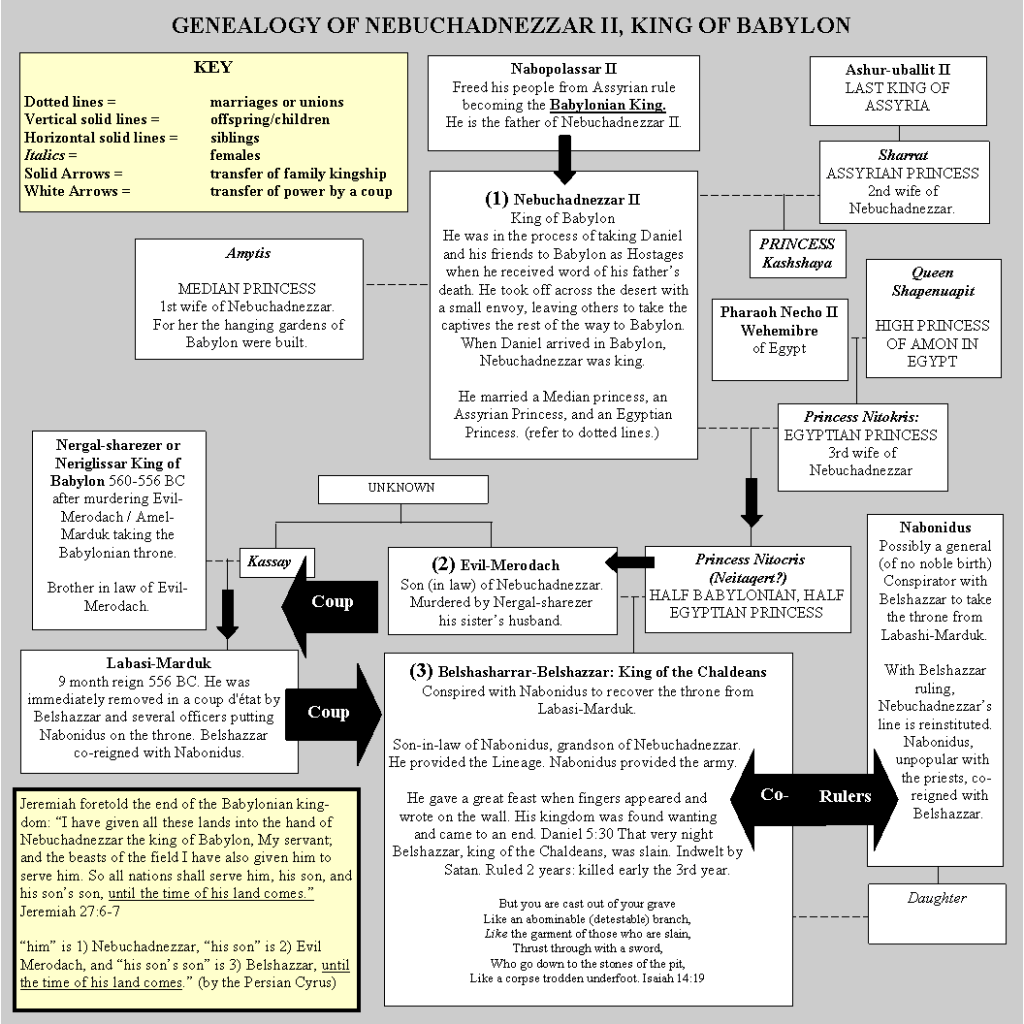
- Jeremiah foretold the end of the Babylonian Kingdom (described in Daniel chapter 5. See note in yellow box at bottom left hand of chart above.)
- Isaiah 14:19 speaks not only of Belshazzar’s party in Daniel 5 but is also a prophecy of the coming Antichrist as indicated by its description of the fall of Lucifer/Satan tying the spirit of Belshazzar to the spirit of the Antichrist.
 Quantum Study Bible