
Words in italic type have been added for clarity. They are not found in the original Hebrew or Aramaic.
Genesis 11
The Tower of Babel
Genesis 11:1 Now the whole earth had one language and one speech.
Genesis 11:2 And it came to pass, as they journeyed from the east, that they found a plain in the land of Shinar, and they dwelt there.
Genesis 11:3 Then they said to one another, “Come, let us make bricks and bake them thoroughly.” They had brick for stone, and they had asphalt for mortar.
- Man makes bricks. God makes stones.
Genesis 11:4 And they said, “Come, let us build ourselves a city, and a tower whose top is in the heavens; let us make a name for ourselves, lest we be scattered abroad over the face of the whole earth.”
- The tower whose top is in the heavens is astrology worship.
- Nimrod “the hunter” is part of the demonic zodiac.
- There is a theory that the people were in fear of another flood and the tower would save them.
- They wanted to make a name for themselves…not for God.
Genesis 11:5 But the Lord (Yᵊhōvâ) came down to see the city and the tower which the sons of men had built.
Genesis 11:6 And the Lord (Yᵊhōvâ) said, “Indeed the people are one and they all have one language, and this is what they begin to do; now nothing that they propose to do will be withheld from them.
- Evil men influence other men. Then those men become evil.
Genesis 11:7 Come, let Us go down and there confuse their language, that they may not understand one another’s speech.”
- Note: “Us” is referring to the Lord Yᵊhōvâ.
Genesis 11:8 So the Lord (Yᵊhōvâ) scattered them abroad from there over the face of all the earth, and they ceased building the city.
- That which they feared God did to them.
Genesis 11:9 Therefore its name is called Babel, because there the Lord (Yᵊhōvâ) confused the language of all the earth; and from there the Lord (Yᵊhōvâ) scattered them abroad over the face of all the earth.
- An Extra-Biblical Account
- From The Project Getenberg eBook of The Chaldean Account of Genesis, by George Smith and A. H. (Archibald Henry) Sayce – Chapter 10 Fragments of Miscellaneous Texts.
“Both Alexander Polyhistor and Abydenus state that the building of the Tower of Babel was known to Babylonian history, Babel, in fact, being the native form of the name which the Greeks changed into Babylon.- Lucius Cornelius Alexander Polyhistor was a Greek scholar who was enslaved by the Romans during the Mithridatic War and taken to Rome as a tutor. After his release, he continued to live in Italy as a Roman citizen. He was so productive as a writer that he earned the surname Polyhistor.
- Abydenus, a Greek historian, was the author of an History of the Chaldeans and Assyrians, of which some fragments are preserved by Eusebius in his Praeparatio Evangelica, and by Cyril in his work against Julian.
The preserved fragment below belongs to a tablet containing from four to six columns of writing, of which four portions remain. The principal part is the beginning of Column I. (Paragraph 164)
- The writing on the fragment:
- 1. …. them the father ….
- 2. the thought of his heart was evil,
- 3. …. he the father of all the gods had repudiated;
- 4. the thought of his heart was evil,
- 5. …. of Babylon he hastens to the submission (?),
- 6. [small] and great he confounded (on) the mound.
- 7. …. of Babylon he hastens to the submission,
- 8. [small] and great he confounded (on) the mound.
- 9. Their walls all the day he founded;
- 10. for their destruction (punishment) in the night
- 11. …. he did not leave a remainder.
- 12. In his anger also (his) secret counsel he pours out:
- 13. [to] confound (their) speeches he set his face.
- 14. He gave the command, he made strange their counsel
- 15. …. the going he inspected it.
- 16. …. he took (selected) a shrine.
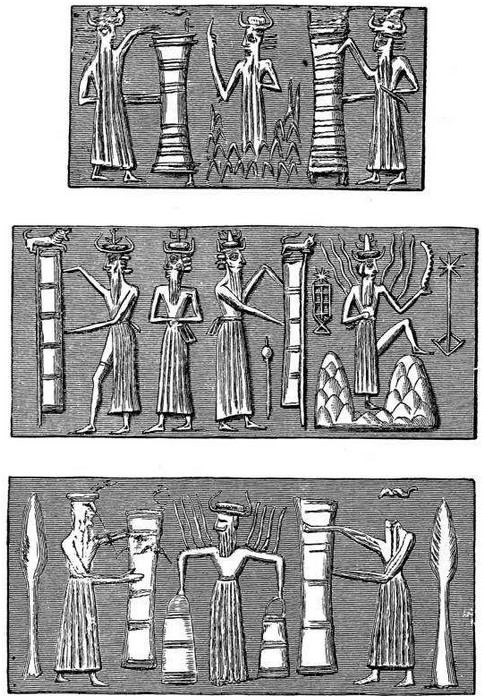
- The fragment also included pictographs of what the Babylonians believed were part of the building of the tower:
Shem’s Descendants
Genesis 11:10 This is the genealogy of Shem: Shem was one hundred years old, and begot Arphaxad two years after the flood.
Genesis 11:11 After he begot Arphaxad, Shem lived five hundred years, and begot sons and daughters.
Genesis 11:12 Arphaxad lived thirty-five years, and begot Salah.
Genesis 11:13 After he begot Salah, Arphaxad lived four hundred and three years, and begot sons and daughters.
Genesis 11:14 Salah lived thirty years, and begot Eber.
Genesis 11:15 After he begot Eber, Salah lived four hundred and three years, and begot sons and daughters.
Genesis 11:16 Eber lived thirty-four years, and begot Peleg.
Genesis 11:17 After he begot Peleg, Eber lived four hundred and thirty years, and begot sons and daughters.
Genesis 11:18 Peleg lived thirty years, and begot Reu.
Genesis 11:19 After he begot Reu, Peleg lived two hundred and nine years, and begot sons and daughters.
Genesis 11:20 Reu lived thirty-two years, and begot Serug.
Genesis 11:21 After he begot Serug, Reu lived two hundred and seven years, and begot sons and daughters.
Genesis 11:22 Serug lived thirty years, and begot Nahor.
Genesis 11:23 After he begot Nahor, Serug lived two hundred years, and begot sons and daughters.
Genesis 11:24 Nahor lived twenty-nine years, and begot Terah.
Genesis 11:25 After he begot Terah, Nahor lived one hundred and nineteen years, and begot sons and daughters.
Genesis 11:26 Now Terah lived seventy years, and begot Abram, Nahor, and Haran.
Terah’s Descendants
 Quantum Study Bible