
Words in italic type have been added for clarity. They are not found in the original Hebrew or Aramaic.
II Kings 14
The Story of Amaziah #8. A righteous king, who pushes for a battle with Jehoash #31, who is snubbed by Jehoash #31, with a parable indicating Amaziah #8 is not his equal in battle.
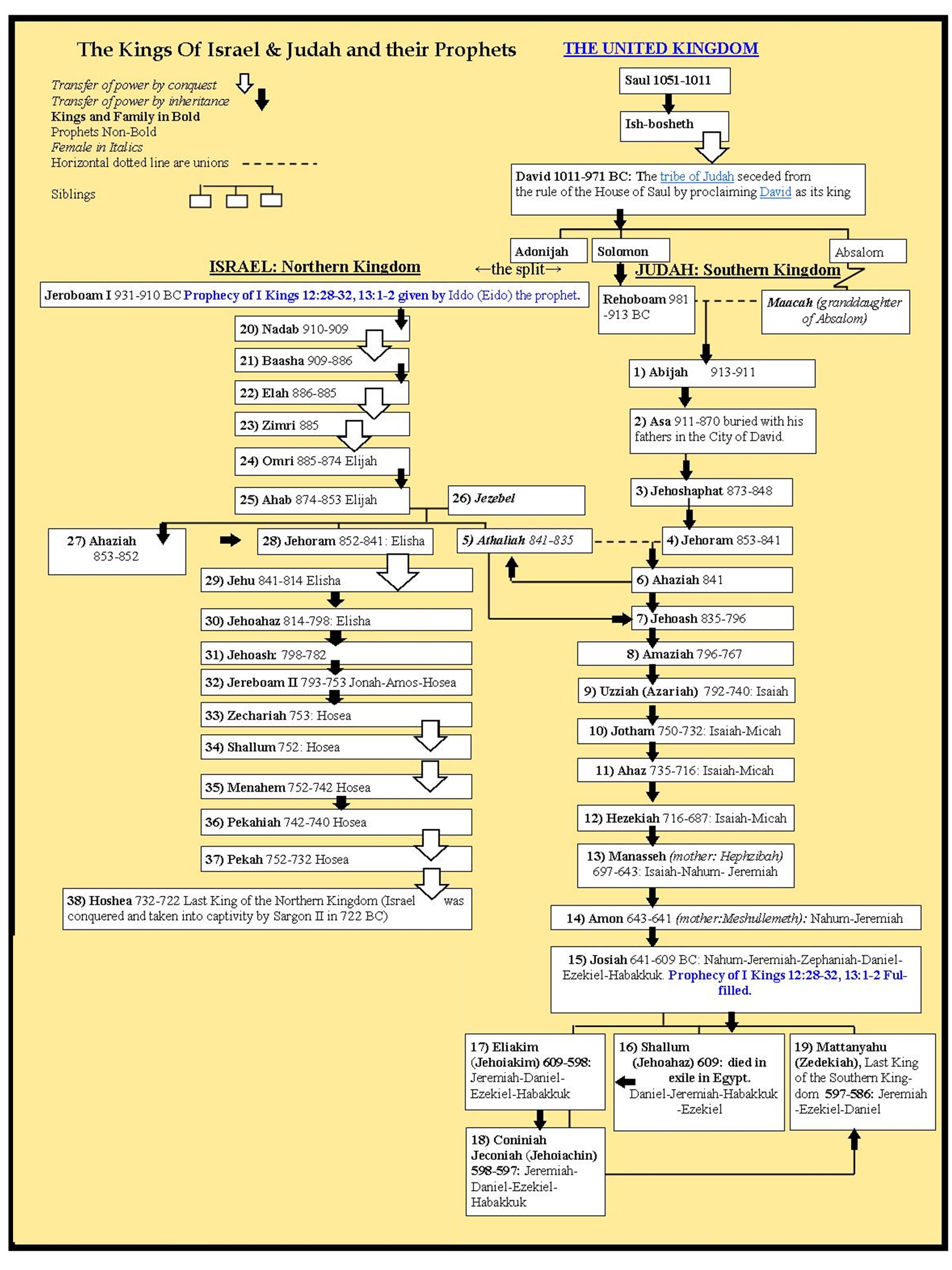
- Kings of Israel
- About #29 Jehu: Jehu is known for dismantling the evil King Ahab and his dynasty.
- About #30 Jehoahaz: The people of people of Israel were oppressed by Hazael, King of Aram. God allowed this captivity to take place because Jehoahaz had endorsed the Golden Calf Cult in Israel.
- About #31 Joash orJehoash king of Israel captured Amaziah #8 the king of Judah. He
broke down the wall of Jerusalem and robbed the temple. - About #32 Jereboam II victorious over the Arameans, conquered Damascus, and extended Israel to its former limits, from “the entering of Hamath to the sea of the plain”.
- About #33 Zechariah reigned six months before being assassinated by Shallum.
- Kings of Judah
- About #7 Joash: Murdered by a conspiracy among his servants.
- About #8 Amaziah (good king – kinda): People made him king in place of his father. He executed those who had murdered his father Joash.
- About #9 Uzziah: Burned incense in the temple and became a leper.
- About #10 Jotham: Built the High or Upper Gate of the Temple of Jerusalem, as the New Gate mentioned in Jeremiah 36:10
Amaziah Reigns in Judah
II Kings 14:1 In the second year of Joash #31 (who was) the son of Jehoahaz #30, king of Israel, (that) Amaziah (#8) the son of Joash (#7) king of Judah, became king.
- Note: There are two kings named Joash, one was the king of Israel (#31) and one was the king of Judah (#7). But this story is about Joash King of Israel (#31) and Amaziah King of Judah (#8), who just happens to be the son of the other Joash (#7) King of Judah who was assassinated by his own royal servants who were then executed in vengeance by his son, Amaziah #8.
II Kings 14:2 He was twenty-five years old when he (Amaziah) became king, and he reigned twenty-nine years in Jerusalem. His mother’s name was Jehoaddan of Jerusalem.
II Kings 14:3 And he (Amaziah #8) did what was right in the sight of the Lord (Yᵊhōvâ), yet not like his father David; he did everything as his father Joash #7 had done.
II Kings 14:4 However the high places (Places for pagan worship) were not taken away, and the people still sacrificed and burned incense on the high places.
II Kings 14:5 Now it happened, as soon as the kingdom was established in his hand, that he (Amaziah) executed his servants who had murdered his father (Joash) the king.
II Kings 14:6 But the children of the murderers he (Amaziah) did not execute, according to what is written in the Book of the Law of Moses, in which the Lord (Yᵊhōvâ) commanded, saying,
“Fathers shall not be put to death for their children, nor shall children be put to death for their fathers; but a person shall be put to death for his own sin.”
II Kings 14:7 He killed ten thousand Edomites in the Valley of Salt, and took Sela (Lit. The Rock; the city of Petra) by war, and called its name Joktheel to this day.
- Petra = Joktheel (“the blessedness of God”)
II Kings 14:8 Then Amaziah sent messengers to Jehoash (Joash, 2 Kin. 13:9, 12–14, 25; 2 Chr. 25:17ff.) the son of Jehoahaz, the son of Jehu, king of Israel, saying, “Come, let us face one another in battle.”
- Jehu’s #29 son was Jehoahaz #30, and Jehoahaz’s son was Jehoash/Joash #31 who snubbed Amaziah #8.
II Kings 14:9 And Jehoash #31 king of Israel sent to Amaziah #8 king of Judah, saying, “The thistle (Amaziah #8) that was in Lebanon sent to the cedar (Jehoash #31) that was in Lebanon, saying, ‘Give your daughter to my son as wife’; and a wild beast that was in Lebanon passed by and trampled the thistle.
- A thistle/thorn grows in a barren land. it is symbolic for curse.
- The cedar is prized for its ability to resist rot or decay and for its heavenly fragrance.
- To ask a man’s daughter in marriage for one’s self or for one’s son was to claim to be his equal. Amaziah #8 is no equal to Jehoash #31 in the same way the thistle is no equal to the cedar. Jehoash (#31) is thumbing his nose at Amaziah who is puffed up from his victory among the Edomites. A wild beast cannot trample a cedar tree, but a thistle is nothing under the beast’s feet. According to Jehoash (#31), Amaziah #8 “the troublesome thistle”, has no business being there.
II Kings 14:10 You have indeed defeated Edom, and your heart has lifted you up (Made you proud). Glory in that, and stay at home; for why should you meddle with trouble so that you fall—you and Judah with you?”
- It’s typical for opposing kings to hurl insults at one another, however; Jehoash #31 snubs Amaziah and tries to discourage him from making a decision he will regret. Amaziah is told to mind his own business.
II Kings 14:11 But Amaziah #8 would not heed (listen). Therefore Jehoash #31 king of Israel, went out; so he and Amaziah #8, king of Judah faced one another at (the area of) Beth Shemesh, which belongs to Judah (of which Amaziah #8 is king).
- Beth-shemesh means “house of the sun” or “sun-temple”
II Kings 14:12 And Judah (king Amaziah #8) was defeated by Israel (king Jehoash #31), and every man (of Judah) fled to his tent.
II Kings 14:13 Then Jehoash #31 king of Israel CAPTURED Amaziah #8 king of Judah,
[(Amaziah #8) the son of Jehoash #7 (king of Judah), the son of Ahaziah #6], AT Beth Shemesh; and he (Jehoash) went (continued) to Jerusalem, and broke down the wall of Jerusalem from the Gate of Ephraim to the Corner Gate—four hundred cubits (About 600 feet).
- Ahaziah’s #6 son was Jehoash #7 and his son was Amaziah #8 who faced Jehoash #31 at Beth Shemesh in Judah.
- Jehoash #31 captured Amaziah #8, then continued the battle into Jerusalem by breaking down the wall and leaving a breach of about 600 feet.
- Jehoash #31 was then able to plunder the temple of its gold, silver, articles of the temple, and treasury, as well as take hostages before returning to Samaria, the capital of Israel.
II Kings 14:14 And he (Jehoash #31) king of Israel) took all the gold and silver, all the articles that were found in the house of the Lord (Yᵊhōvâ) and in the treasuries of the king’s house, and hostages, and returned to Samaria.
II Kings 14:15 Now the rest of the acts of Jehoash #31 which he did—his might, and how he fought with Amaziah king of Judah—are they not written in the book of the chronicles of the kings of Israel?
II Kings 14:16 So Jehoash #31 rested with his fathers (Died and joined his ancestors,) and was buried in Samaria with the kings of Israel. Then Jeroboam II his son reigned in his (Jehoash’s) place.
II Kings 14:17 Amaziah #8 the son of Joash #7 king of Judah, lived fifteen years after the death of Jehoash #31 the son of Jehoahaz #30, king of Israel.
II Kings 14:18 Now the rest of the acts of Amaziah #8, are they not written in the book of the chronicles of the kings of Judah?
II Kings 14:19 And they (his servants) formed a conspiracy against him (Amaziah) in Jerusalem, and he fled to Lachish; but they sent after him to Lachish and killed him there.
II Kings 14:20 Then they (Amaziah’s servants) brought him on horses, and he was buried at Jerusalem with his fathers in the City of David.
II Kings 14:21 And all the people of Judah took Azariah #9 (Uzziah, 2 Chr. 26:1ff.; Is. 6:1; etc.), who was sixteen years old, and made him king instead of his father Amaziah #8.
II Kings 14:22 He built Elath (Heb. Eloth) and restored it to Judah, after the king (Amaziah #8) rested with his fathers (Amaziah #8 died and joined his ancestors).
Jeroboam II Reigns in Israel
II Kings 14:23 In the fifteenth year of Amaziah #8 the son of Joash #7, king of Judah, Jeroboam II #32 the son of Joash #31, king of Israel, became king in Samaria, and reigned forty-one years.
II Kings 14:24 And he did evil in the sight of the Lord (Yᵊhōvâ); he did not depart from all the sins of Jeroboam I #32 (King of Israel at the split of the kingdom) who had made Israel sin; the son of Nebat.
- Jeroboam I, son of Nebat, pulled ten tribes away from the United Kingdom under Solomon’s son, Rehoboam, and caused the kingdom to be split between Judah and Israel. He erected a golden calf on each border (North and South) of the newly created Israel so that the people would worship the calves instead of going to the temple in Jerusalem which was part of Judah to worship the God of Abraham, Isaac, and Jacob.
II Kings 14:25 He (Jeroboam II #32) restored the territory (border) of Israel from the entrance of Hamath to the Sea of the Arabah (The Dead Sea), according to the word of the Lord God (Yᵊhōvâ ‘ĕlōhîm) of Israel, which He had spoken through His servant Jonah the son of Amittai, the prophet who was from Gath Hepher.
- “The ‘entering in of Hamath’ was always reckoned the northern boundary of the Holy Land (see Numbers 34:8; Joshua 13:5; Judges 3:3; 1 Kings 8:65)”.
~The Pulpit Commentary
- Jonah, the son of Amittai, the prophet who was from Gath Hepher – the Jonah from the Biblical book Jonah.
- When the chief priests and Pharisees (the learned among the Jews) during the days of Jesus, said “Search and look, for no prophet has arisen out of Galilee” (John 7:52b) they must have forgotten about Jonah who was from Gath Hepher of Galilee.
- Thus, due to this verse (II Kings 14:25), Jonah lived before the time of King Jeroboam II King of Israel 793 BC – 753 BC.
 Quantum Study Bible