
Words in italic type have been added for clarity. They are not found in the original Hebrew or Aramaic.
Nehemiah 2
- About the title: Imagine, finally arriving at the first day of a prophetic prophecy.
Nehemiah Sent to Judah
Nehemiah 2:1 And it came to pass in the month of Nisan, in the twentieth year of King Artaxerxes 03/31/0446 BC, when wine was before him, that I took the wine and gave it to the king.

- This king is Artaxerxes I Longimanus Makrocheir. The Queen is Esther from the book of Esther.
Now I had never been sad in his presence before. 2 Therefore the king said to me, “Why is your face sad, since you are not sick? This is nothing but sorrow of heart.”
So I became dreadfully (Lit. very much) afraid, 3 and said to the king, “May the king live forever! Why should my face not be sad, when the city, the place of my fathers’ tombs, lies waste, and its gates are burned with fire?”
Nehemiah 2:4 Then the king said to me, “What do you request?”
So I prayed to the God (‘ĕlōhîm) of heaven. 5 And I said to the king, “If it pleases the king, and if your servant has found favor in your sight, I ask that you send me to Judah, to the city of my fathers’ tombs, that I may rebuild it.”
THE TRIGGER WHICH STARTS THE PROPHECY OF DANIEL’S SEVENTY WEEKS
- Nehemiah is the one designated to begin the prophecy of Daniel’s 70 “weeks”.
There is a reason why the prophecy uses the word “weeks” instead of literal “years”. It is seven seventies (of not days) but years to total 490 years.
Reason One: There is one week in the High Holy Days which is a pattern of 7 days of affliction to represent the last week of Daniel.
Reason Two: Jesus suffered for 7 days after His Triumphal Entry until His resurrection. According to Numbers 14:34 for each day of disobedience the Jews are punished one year – and finishes with “you shall know My rejection.”
- Daniel’s 70 weeks broken down:
- That from the going forth of the command
To restore and build Jerusalem- (Nehemiah received the command from Artaxerxes on 03/31/0446 BC)
- Until Messiah the Prince,
- (Jesus was the “Prince” on His triumphal entry on 04/21/0031)
- There shall be seven weeks and sixty-two weeks (a total of 69 weeks);
The street shall be built again, and the wall,
Even in troublesome times. - “And after (at the end of) the sixty-two weeks
Messiah shall be cut off, but not for Himself- (Jesus crucified on 04/25/31 AD);
- That from the going forth of the command
- The last “week” of this prophecy is a time of 7 years of tribulation. It is yet to come after the dispensation of the Gentile Age of Grace.
- The problem with the usage of years is that the Jewish Calendar equals 360 days while an astronomical year is actually 365 days a year creating confusion when someone tries to calculate dates. Therefore; these dates must be calculated by days because one day is equitable across all calendar systems.
- Biblical calculations are 360 days per year on the Hebrew calendar multiplied by 490 years which equal 176,400 days to cover the totality of Daniel’s 70 “weeks”.
The first 69 weeks are fulfilled in history over 173,880 days proving the veracity of scripture and prophecy. 
The last week is 2,520 days. These days equal the days in Revelation and Daniel: 2,520 days for one week and 1,260 days for half a week.
- The problem with the usage of years is that the Jewish Calendar equals 360 days while an astronomical year is actually 365 days a year creating confusion when someone tries to calculate dates. Therefore; these dates must be calculated by days because one day is equitable across all calendar systems.
Nehemiah 2:6 Then the king said to me (the queen also sitting beside him), “How long will your journey be? And when will you return?” So it pleased the king to send me; and I set him a time.
Nehemiah 2:7 Furthermore I said to the king, “If it pleases the king, let letters be given to me for the governors of the region beyond the River (The Euphrates), that they must permit me to pass through till I come to Judah, 8 and a letter to Asaph the keeper of the king’s forest, that he must give me timber to make beams for the gates of the citadel (palace) which pertains to the temple (Lit. house) , for the city wall, and for the house that I will occupy.” And the king granted them to me according to the good hand of my God (‘ĕlōhîm) upon me.
Nehemiah 2:9 Then I went to the governors in the region beyond the River, and gave them the king’s letters. Now the king had sent captains of the army and horsemen with me. 10 When Sanballat the Horonite and Tobiah the Ammonite official (Lit. servant) heard of it, they were deeply disturbed that a man had come to seek the well-being of the children of Israel.
Nehemiah Views the Wall of Jerusalem
Nehemiah 2:11 So I came to Jerusalem and was there three days. 12 Then I arose in the night, I and a few men with me; I told no one what my God had put in my heart to do at Jerusalem; nor was there any animal with me, except the one on which I rode. 13 And I went out by night through the Valley Gate to the Serpent Well and the Refuse (Dung) Gate, and viewed (examined) the walls of Jerusalem which were broken down and its gates which were burned with fire. 14 Then I went on to the Fountain Gate and to the King’s Pool, but there was no room for the animal under me to pass. 15 So I went up in the night by the valley (torrent valley, wadi), and viewed (examined) the wall; then I turned back and entered by the Valley Gate, and so returned. 16 And the officials did not know where I had gone or what I had done; I had not yet told the Jews, the priests, the nobles, the officials, or the others who did the work.
The “FOOTPRINT” of Jerusalem.
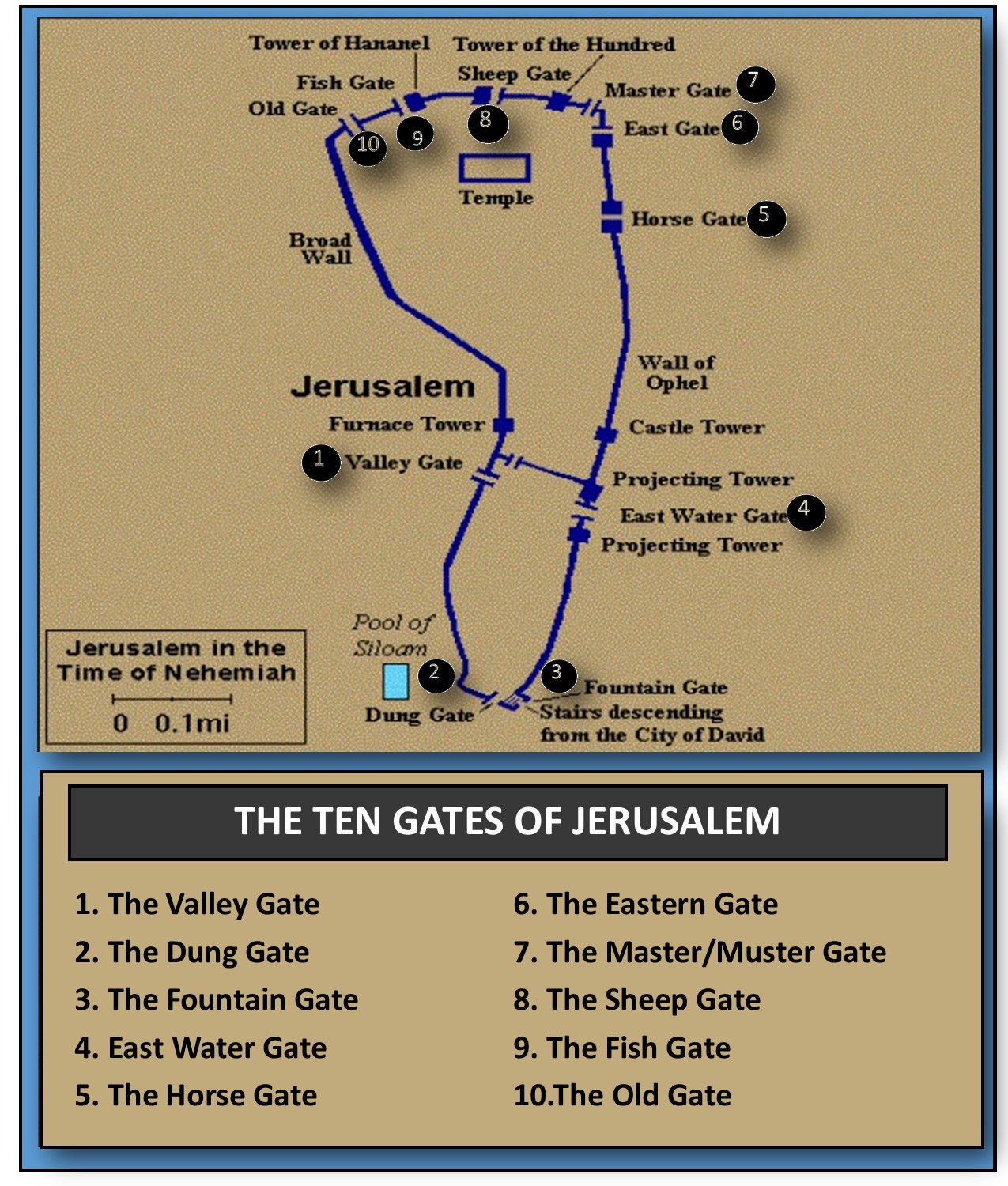
Nehemiah 2:17 Then I said to them, “You see the distress that we are in, how Jerusalem lies waste (desolate), and its gates are burned with fire. Come and let us build the wall of Jerusalem, that we may no longer be a reproach.” 18 And I told them of the hand of my God (‘ĕlōhîm) which had been good upon me, and also of the king’s words that he had spoken to me.
So they said, “Let us rise up and build.” Then they set (Lit. strengthened) their hands to this good work.
A city is not gauged by its length and width, but by the broadness of its vision and the height of its dreams. ~Herb Caen
Nehemiah 2:19 But when Sanballat the Horonite, Tobiah the Ammonite official, and Geshem the Arab heard of it, they laughed at us and despised us, and said, “What is this thing that you are doing? Will you rebel against the king?”
- Sanballat: from the Babylonian name Sinuballit, which means “Sin has begotten.” (Sin was the “moon god” Babylonians worshiped.)
- Tobias: טוב (tob), good, and יה (yah), the name of the Lord.
- Geshem: (גשם) is a Hebrew word for “rain,” and is the name of a prayer for rain recited on the Jewish holiday of Shemini Atzeret.
 Quantum Study Bible