
Words in italic type have been added for clarity. They are not found in the original Hebrew or Aramaic.
I Samuel 1
What should we learn from this chapter?
- Samuel is considered one of the prophets.
- Nazareth is the home town of Jesus and not to be confused with a Nazarite.
- The difference between a Levite and a Nazarite:
- The Levite is a priest, part of a bloodline such as Eli and his sons.
- The Nazarite voluntarily gives vows to the Lord he performs before the priest who is the Levite.
- A Levite cannot also be a Nazarite. (John the Baptist was a Levite, born of the priestly line.)
The Family of Elkanah
I Samuel 1:1 Now there was a certain man of Ramathaim Zophim, of the mountains of Ephraim, and his name was Elkanah the son of Jeroham, the son of Elihu (Eliel, I Chronicles 6:34), the son of Tohu (Toah, I Chronicles 6:34), the son of Zuph, an Ephraimite.
- The Hebrew meaning of Elkanah (qānâ H511)., Hannah’s husband = God (el) has possessed, made, redeemed or obtained
- The tribe of Ephraim is from Joseph, the son of Jacob.
- Genealogy of Samuel
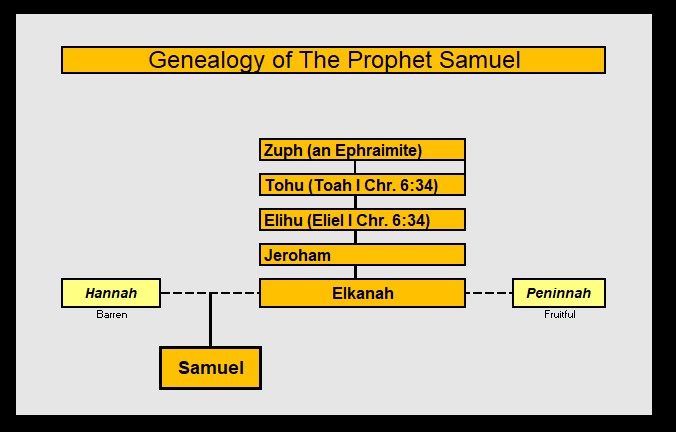
I Samuel 1:2 And he had two wives: the name of one was Hannah, and the name of the other Peninnah. Peninnah had children, but Hannah had no children.
I Samuel 1:3 This man went up from his city yearly to worship and sacrifice to the Lord of hosts (Yᵊhōvâ ṣāḇā’) in Shiloh (A place of rest). Also, the two sons of Eli, Hophni and Phinehas, the priests of the Lord (Yᵊhōvâ), were there.
- SHILOH Hebrew Meaning:
Genesis 49:10 The scepter (kingship) shall not depart from Judah,
Nor a lawgiver from between his feet,
Until Shiloh (Rest, Peace, Tranquility, the Messiah) comes;
And to Him shall be the obedience of the people. - Eli, Hophni and Phinehas were Levites and therefore; priests of the Lord because of their bloodline.
I Samuel 1:4 And whenever the time came for Elkanah to make an offering, he would give portions to Peninnah his wife and to all her sons and daughters.
I Samuel 1:5 But to Hannah he would give a double portion, for he loved Hannah, although the Lord (Yᵊhōvâ) had closed her womb.
I Samuel 1:6 And her rival also provoked her severely, to make her miserable, because the Lord (Yᵊhōvâ) had closed her womb.
- Peninnah would be Hannah’s rival.
I Samuel 1:7 So it was, year by year, when she went up to the house of the Lord (Yᵊhōvâ), that she (Peninnah) provoked her; Therefore, she wept and did not eat.
Hannah’s Vow
I Samuel 1:8 Then Elkanah her husband said to her, “Hannah, why do you weep? Why do you not eat? And why is your heart grieved? Am I not better to you than ten sons?”
I Samuel 1:9 So Hannah arose after they had finished eating and drinking in Shiloh. Now Eli the priest was sitting on the seat by the doorpost of the tabernacle (palace or temple, Heb. Heykal) of the Lord (Yᵊhōvâ).
I Samuel 1:10 And she was in bitterness of soul, and prayed to the Lord (Yᵊhōvâ) and wept in anguish (Lit. wept greatly).
I Samuel 1:11 Then she made a vow and said, “O Lord of hosts (Yᵊhōvâ ṣāḇā’), if You will indeed look on the affliction of Your maidservant and remember me, and not forget Your maidservant, but will give Your maidservant a male child, then I will give him to the Lord (Yᵊhōvâ) all the days of his life, and no razor shall come upon his head.”
- According to the law of the Nazirite no razor is allowed to be used on the head, no grapes or raisins imbibed in or eaten, nor are they allowed to touch a corpse else the vow of consecration and separation becomes broken.
- THE NAZIRITES MENTIONED IN THE BIBLE:
- John the Baptist could NOT have been a Nazirite because by bloodline he was a Levite. According to Torah, a Levite was not allowed to become a Nazarite.
- The Torah is the first five books of the Bible; namely Genesis, Exodus, Leviticus, Numbers and Deuteronomy.
- Samson was a Nazirite and a Judge. (Judges 13:5)
- Samuel was a Nazirite and a prophet (1 Samuel 1:11)
- John the Baptist could NOT have been a Nazirite because by bloodline he was a Levite. According to Torah, a Levite was not allowed to become a Nazarite.
I Samuel 1:12 And it happened, as she continued praying before the Lord (Yᵊhōvâ), that Eli watched her mouth.
I Samuel 1:13 Now Hannah spoke in her heart; only her lips moved, but her voice was not heard. Therefore, Eli thought she was drunk.
I Samuel 1:14 So Eli said to her, “How long will you be drunk? Put your wine away from you!”
I Samuel 1:15 But Hannah answered and said, “No, my lord, I am a woman of sorrowful spirit. I have drunk neither wine nor intoxicating drink but have poured out my soul before the Lord (Yᵊhōvâ).
I Samuel 1:16 Do not consider your maidservant a wicked woman (Lit. daughter of Belial), for out of the abundance of my complaint and grief I have spoken until now.”
I Samuel 1:17 Then Eli answered and said, “Go in peace, and the God (‘ĕlōhîm) of Israel grant your petition which you have asked of Him.”
I Samuel 1:18 And she said, “Let your maidservant find favor in your sight.” So the woman went her way and ate, and her face was no longer sad.
Samuel Is Born and Dedicated
 Quantum Study Bible