
Words in italic type have been added for clarity. They are not found in the original Hebrew or Aramaic.
Judges 4
- Historical Event: 1233 BC
For a Timeline of Events See Timeline 1171 BC-1270 BC. (Then) Scroll down to 1233 BC. - The Times of the Judges:
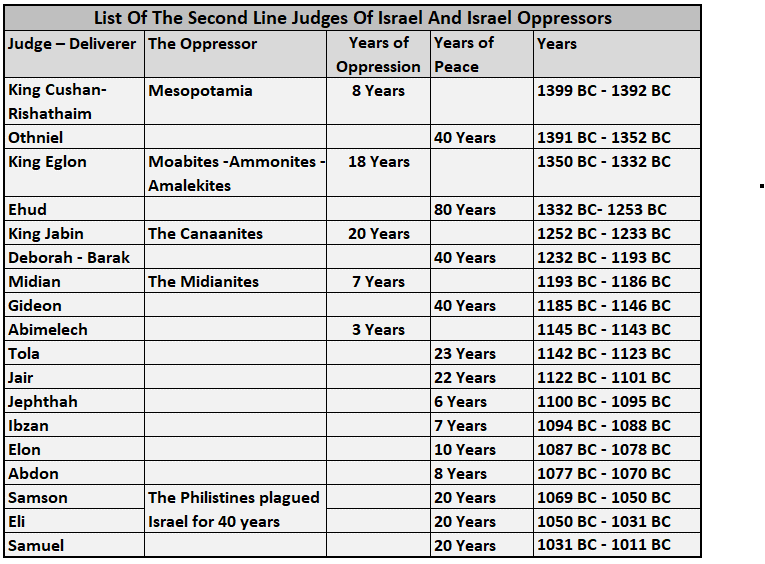
Deborah
Judges 4:1 When Ehud was dead, the children of Israel again did evil in the sight of the Lord (Yᵊhōvâ). 2 So the Lord (Yᵊhōvâ) sold them into the hand of Jabin king of Canaan, who reigned in Hazor. The commander of his army was Sisera, who dwelt in Harosheth Hagoyim.
- “A letter from the Archives of Mari, from approximately the first half of the reign of Zimri’Lim … mentions the name of a king of Hazor, almost certainly the same as the city of Palestine that Joshua conquered. The period the letter refers to is almost certainly the same time-period with which we are here dealing, that of the conquest of the MB I people of Palestine. The name of the king of Hazor was Ibni-Hadad – an extremely interesting name considering the period with which we are dealing. If we exclude the second part of the name, which obviously is the name of the king’s god, and concentrate upon the proper part of the name, that is, Ibni, it is almost certain that this word is exactly the same as the name translated in the Bible as Jabin, king of Hazor. They are one and the same.”
- “Mari’s Ibni-Hadad of Hazor cannot be Joshua’s Jabin of Hazor, but is a ruler of Hazor of a significantly later period.”
- ~Acadamia: King Jabin of Hazor and the oppression of Israel
Judges 4:3 And the children of Israel cried out to the Lord (Yᵊhōvâ); for Jabin had nine hundred chariots of iron, and for twenty years he had harshly oppressed the children of Israel.
Judges 4:4 Now Deborah, a prophetess, the wife of Lapidoth, was judging Israel at that time.
* Deborah is both a prophetess and a judge.
- Prophetess’ noted in Scripture
- Miriam Exodus 15:20
- Deborah, judge of Israel, wife of Lapidoth Judges 4:4
- Huldah, wife of Shallum II Kings 22:14, II Chronicles 34:22
- Noadiah, Nehemiah 6:14
- The unnamed wife of Isaiah, Isaiah 8:3 who bore a son and named him Maher-Shalal-Hash-Baz (Lit. Speed the Spoil, Hasten the Booty)
- Anna, the daughter of Phanuel, of the tribe of Asher. Luke 2:36. She identified the Messiah.
Judges 4:5 And she (Deborah) would sit under the palm tree of Deborah between Ramah (meaning: high, exalted, thunder) and Bethel (house of God) in the mountains of Ephraim. And the children of Israel came up to her for judgment.
Judges 4:6 Then she sent and called for Barak the son of Abinoam from Kedesh in Naphtali, and said to him, “Has not the Lord God (Yᵊhōvâ ‘ĕlōhîm) of Israel commanded, ‘Go and deploy (Lit. draw) troops at Mount Tabor; take with you ten thousand men of the sons of Naphtali and of the sons of Zebulun; 7 and against you I will deploy Sisera, the commander of Jabin’s army, with his chariots and his multitude at the River Kishon; and I will deliver (march) him into your hand’?”
Map for Judges 4: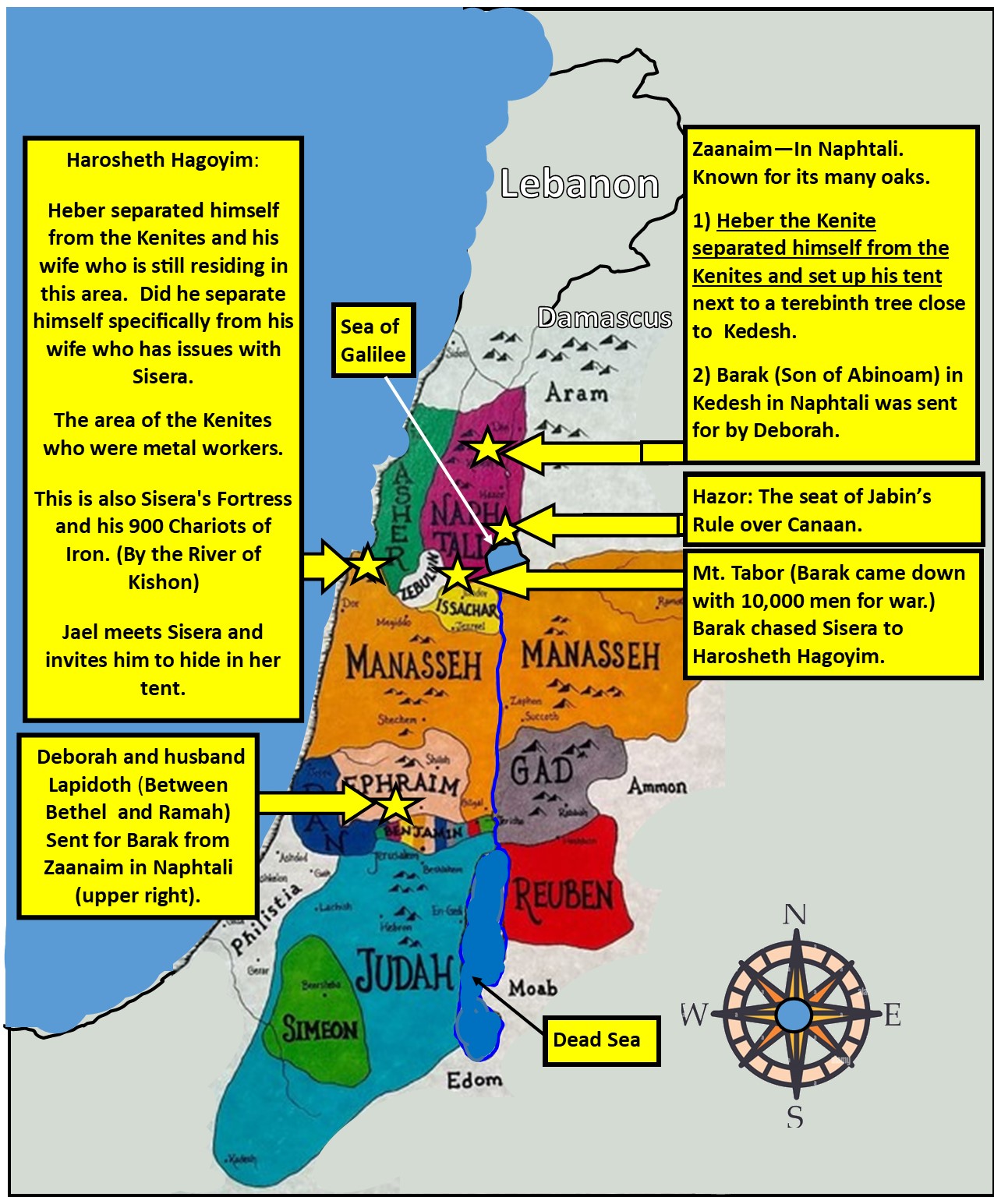
Judges 4:8 And Barak said to her, “If you will go with me, then I will go; but if you will not go with me, I will not go!”
Judges 4:9 So she said, “I will surely go with you; nevertheless there will be no glory for you in the journey you are taking, for the Lord (Yᵊhōvâ) will sell Sisera into the hand of a woman.” Then Deborah arose and went with Barak to Kedesh. 10 And Barak called Zebulun and Naphtali to Kedesh; he went up with ten thousand men under his command (Lit. at his feet), and Deborah went up with him.
- The sons of Zebulun and the sons of Naphtali were both in the northern area of Galilee close to Kedesh in Zaanaim.
Judges 4:11 Now Heber the Kenite, of the children of Hobab (the father-in-law of Moses), had separated himself from the Kenites and pitched his tent near the terebinth tree at Zaanaim, which is beside Kedesh.
- Note: In Exodus, Moses’ father-in-law is initially referred to as “Reuel” (Exodus 2:18) but afterwards as “Jethro” (Exodus 3:1). He was also identified as Hobab in the Book of Numbers 10:29.
Judges 4:12 And they reported to Sisera that Barak the son of Abinoam had gone up to Mount Tabor.
Judges 4:13 So Sisera gathered together all his chariots, nine hundred chariots of iron, and all the people who were with him, from Harosheth (Carved Out) Hagoyim (the Gentiles) to the River Kishon.
Judges 4:14 Then Deborah said to Barak, “Up! (Arise!) For this is the day in which the Lord (Yᵊhōvâ) has delivered Sisera into your hand. Has not the Lord (Yᵊhōvâ) gone out before you?” So Barak went down from Mount Tabor with ten thousand men following him.
- Barak had 10,000 men.
- Sisera had 900 chariots of iron and his army.
Judges 4:15 And the Lord (Yᵊhōvâ) routed Sisera and all his chariots and all his army with the edge of the sword before Barak; and Sisera alighted from his chariot and fled away on foot. 16 But Barak pursued the chariots and the army as far as Harosheth Hagoyim, and all the army of Sisera fell by the edge of the sword; not a man was left.
- The Israelite army marched to Mount Tabor. Their movements were reported to Sisera, who hastened to the Wadi Kishon (Kishon River), near Mount Tabor. God caused a strong rainstorm that saturated the ground, causing the heavy iron chariots of the Canaanites to become stuck in the mud. Rain filled the streams on the mountain causing a flash flood at the Wadi Kishon, sweeping many away(Judges 5:21) The Canaanites panicked and fled, and the Israelites pursued them and slew them to the last man.(Judges 4:15–16) ~Wikipedia
Judges 4:17 However, Sisera had fled away on foot to the tent of Jael, the wife of Heber the Kenite; for there was peace between Jabin king of Hazor and the house of Heber the Kenite.
Judges 4:18 And Jael went out to meet Sisera, and said to him, “Turn aside, my lord, turn aside to me; do not fear.” And when he had turned aside with her into the tent, she covered him with a blanket (rug).
Judges 4:19 Then he said to her, “Please give me a little water to drink, for I am thirsty.” So she opened a jug of milk, gave him a drink, and covered him. 20 And he said to her, “Stand at the door of the tent, and if any man comes and inquires of you, and says, ‘Is there any man here?’ you shall say, ‘No.’ ”
Judges 4:21 Then Jael, Heber’s wife, took a tent peg and took a hammer in her hand, and went softly to him and drove the peg into his temple, and it went down into the ground; for he was fast asleep and weary. So he died.
- About the Title: Sisera was killed by a tent peg through his temple. The meaning of Barak’s name is “Lightning”. Therefore; Sisera’s death was in the temple after being chased by Lightning.
Judges 4:22 And then, as Barak pursued Sisera, Jael came out to meet him, and said to him, “Come, I will show you the man whom you seek.” And when he went into her tent, there lay Sisera, dead with the peg in his temple.
Judges 4:23 So on that day God (‘ĕlōhîm) subdued Jabin king of Canaan in the presence of the children of Israel. 24 And the hand of the children of Israel grew stronger and stronger against Jabin king of Canaan, until they had destroyed Jabin king of Canaan.
- Jabin, “the king of Canaan,” overpowered the Israelites of the north one hundred and sixty years after Joshua’s death, and for twenty years held them in painful subjection. The whole population were paralyzed with fear, and gave way to hopeless despondency (Judges 5:6 – 11), until Deborah and Barak aroused the national spirit, and gathering together ten thousand men, gained a great and decisive victory over Jabin in the plain of Esdraelon (Jezreel Valley aka the Valley of Megiddo) (Judges 4:10 – 16; compare Psalms 83:9) This was the first great victory Israel had gained since the days of Joshua. For the next forty years, they never needed to fight another battle with the Canaanites (Judges 5:31).
~ Wikipedia Jabin, King of Canaan
Questions:
- Who was Jael’s husband?
- Why did Sistera trust Heber the Kenite?
 Quantum Study Bible