
Words in italic type have been added for clarity. They are not found in the original Hebrew or Aramaic.
Ruth 4
See: Comparison of Boaz and Jesus: Qualifications of a Kinsman Redeemer
See: Comparison of Boaz and Jesus: Duties of a Kinsman Redeemer
Every Redeemer in scripture married a Gentile before they could redeem the Jews. Boaz married Ruth and redeemed Naomi’s family line. (Moses married Zipporah, Joseph married Asenath)
Boaz Redeems Ruth
Ruth 4:1 Now Boaz went up to the gate and sat down there; and behold, the close relative of whom Boaz had spoken came by. So Boaz said, “Come aside, friend (Heb. peloni almoni, lit. so and so), sit down here.” So he came aside and sat down.
Ruth 4:2 And he took ten men of the elders of the city, and said, “Sit down here.” So they sat down.
Ruth 4:3 Then he said to the close relative, “Naomi, who has come back from the country of Moab, sold the piece of land which belonged to our brother Elimelech.
Ruth 4:4 And I thought to inform you (Lit. uncover your ear), saying, ‘Buy it back in the presence of the inhabitants and the elders of my people. If you will redeem it, redeem it; but if you (he) will not redeem it, then tell me, that I may know; for there is no one but you to redeem it, and I am next after you.’ ”
And he said, “I will redeem it.”
Ruth 4:5 Then Boaz said, “On the day you buy the field from the hand of Naomi, you must also buy it from Ruth the Moabitess, the wife of the dead, to perpetuate (Lit. raise up) the name of the dead through his inheritance.”
Ruth 4:6 And the close relative said, “I cannot redeem it for myself, lest I ruin my own inheritance. You redeem my right of redemption for yourself, for I cannot redeem it.”
Ruth 4:7 Now this was the custom in former times in Israel concerning redeeming and exchanging, to confirm anything: one man took off his sandal and gave it to the other, and this was a confirmation in Israel.
Ruth 4:8 Therefore the close relative said to Boaz, “Buy it for yourself.” So he took off his sandal.
Ruth 4:9 And Boaz said to the elders and all the people, “You are witnesses this day that I have bought all that was Elimelech’s, and all that was Chilion’s and Mahlon’s, from the hand of Naomi.
Ruth 4:10 Moreover, Ruth the Moabitess, the widow of Mahlon, I have acquired as my wife, to perpetuate the name of the dead through his inheritance, that the name of the dead may not be cut off from among his brethren and from his position at the gate (Probably his civic office). You are witnesses this day.”
- In extrabiblical writings it is noted that Boaz was in his eighties and yet he was obligated to produce a child since he was a kinsman redeemer. It is further noted that he died the day after his honeymoon. If true, then Boaz gave his life to produce this lineage.
- Boaz was from the city of Bethlehem (where Jesus was born) in Judah and was believed to be much older than Ruth. According to the rabbis, Boaz was about 80 years of age when he married Ruth. He is believed to have been a widower with no children at the time of their marriage. See: Ruth and Boaz, the story of the Kinsman Redeemer.
- Boaz was eighty and Ruth forty years old (idem to iii. 10), but their marriage did not remain childless, though Boaz died the day after his wedding (Midrash Zuṭṭa, ed. Buber, 55, below).
- Bibliography: D. Hartmann, Das Buch Ruth in der Midrasch-Litteratur, 1901.
- If brethren dwell together, and one of them die, and have no child, the wife of the dead shall not marry outside the family unto a stranger; her husband’s brother shall go in unto her, and take her to him as his wife, and perform the duty of an husband’s brother to her. And it shall be, that the first-born whom she beareth shall succeed in the name of his brother who is dead, that his name be not put out of Israel (Deuteronomy 25:5–6).
- And if the man desire not to take his brother’s wife, then let his brother’s wife go up to the gate unto the elders, and say, My husband’s brother refuseth to raise up unto his brother a name in Israel; he will not perform the duty of my husband’s brother. Then the elders of his city shall call him, and speak unto him; and if he stand to it, and say, I desire not to take her, Then shall his brother’s wife come unto him in the presence of the elders, and loose his shoe from off his foot, and spit in his face, and shall answer and say, So shall it be done unto that man who will not build up his brother’s house. And his name shall be called in Israel, The house of him who hath his shoe loosed. (Deuteronomy 25:7–10)
- If brethren dwell together, and one of them die, and have no child, the wife of the dead shall not marry outside the family unto a stranger; her husband’s brother shall go in unto her, and take her to him as his wife, and perform the duty of an husband’s brother to her. And it shall be, that the first-born whom she beareth shall succeed in the name of his brother who is dead, that his name be not put out of Israel (Deuteronomy 25:5–6).
Ruth 4:11 And all the people who were at the gate, and the elders, said, “We are witnesses. The Lord (Yᵊhōvâ) make the woman who is coming to your house like Rachel and Leah, the two who built the house of Israel; and may you prosper in Ephrathah and be famous in Bethlehem.
- Micah 5:2 The Coming Messiah – “But you, Bethlehem Ephrathah, Though you are little among the thousands of Judah, Yet out of you shall come forth to Me The One to be Ruler in Israel, Whose goings forth are from of old, From everlasting.”
- “Hur” The Father of Bethlehem: The Family of Judah I Chronicles 4:1 The sons of Judah were Perez, Hezron, Carmi (Chelubai or Caleb), Hur, and Shobal. 2 And Reaiah the son of Shobal begot Jahath, and Jahath begot Ahumai and Lahad. These were the families of the Zorathites. 3 These were the sons of the father of Etam: Jezreel, Ishma, and Idbash; and the name of their sister was Hazelelponi; 4 and Penuel was the father of Gedor, and Ezer was the father of Hushah.
- These were the sons of Hur, the firstborn of Ephrathah the father of Bethlehem.
Ruth 4:12 May your house be like the house of Perez, whom Tamar bore to Judah, because of the offspring which the Lord (Yᵊhōvâ) will give you from this young woman.”
Descendants of Boaz and Ruth
Ruth 4:13 So Boaz took Ruth and she became his wife; and when he went in to her, the Lord (Yᵊhōvâ) gave her conception, and she bore a son.
Ruth 4:14 Then the women said to Naomi, “Blessed be the Lord (Yᵊhōvâ), who has not left you this day without a close relative (redeemer, Heb. Goel); and may his name be famous in Israel!
- The Messiah comes from the line of Boaz (a Jew) and Ruth (a Gentile). Another prophetic event indicating the Gentiles will be part of God’s kingdom and in an elevated position.
Ruth 4:15 And may he (their son) be to you (Naomi) a restorer of life and a nourisher (sustainer) of your old age; for your daughter-in-law (Ruth), who loves you, who is better to you than seven sons, has borne him.”
King David was one of Jesse’s SEVEN surviving SONS. The father of Jesse was Obed and the father of Obed was Boaz, the husband of Ruth.
Without Ruth, there would be no King David.
Ruth 4:16 Then Naomi took the child and laid him on her bosom, and became a nurse to him.
Ruth 4:17 Also the neighbor women gave him a name, saying, “There is a son born to Naomi.” And they called his name Obed (meaning “worshiper” and/or “servant”). He is the father of Jesse, the father of David.
- Through Ruth’s obedience, she bore the line of the future King of the Jews, and Jesus came from the legal line of David as the King of kings and the Jewish Messiah.
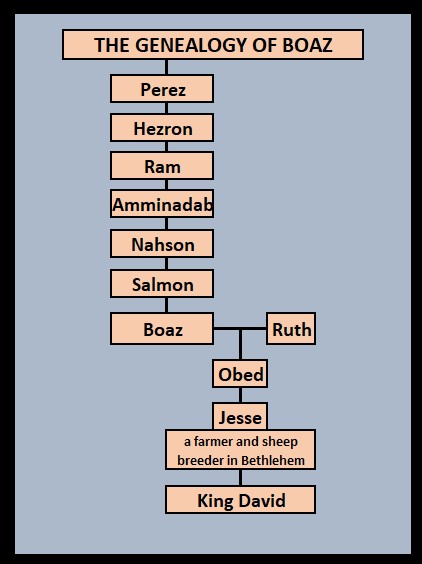
Ruth 4:18 Now this is the genealogy of Perez: Perez begot Hezron;
- About Perez:
- Perez’ father was Jacob and his mother was Tamar; she was the daughter in law of Jacob having married his first son Er who was wicked and killed by God. Then Tamar married Jacob’s second son Onan, who pulled his seed and God killed him also. Judah was concerned about giving Tamar his youngest son Shelah, so he withheld him over time until Tamar took a bold step to have a child; she disguised herself as a prostitute and seduced her father in law, resulting in a pregnancy of twins; Perez and Zerah. Who will be the eldest who inherits the birthright of the family and is in charge of the families best interest.
- The birthright belongs to the eldest. So which twin will be born first?
- Gen 38:28-30 “One (Zerah) put out his hand; and the midwife took a scarlet thread and bound it on his hand, saying, “This one came out first.” Then it happened, as he drew back his hand, that his brother came out unexpectedly; and she said, “How did you break through? This breach be upon you!” Therefore his name was called Perez (Breach/Breakthrough). Afterward his brother came out who had the scarlet thread on his hand. And his name was called Zerah (to appear).
- Perez inherited the birthright and Zerah inherited the scarlet thread.
- In scripture, this is known as the second swallowing up the first, like Jacob and Esau. Esau sold his birthright to Jacob which meant he sold the right to be in the birth-line of the Messiah. In essence it was abhorrent. Zerah didn’t sell it, it was just his lot.
- Perez had two sons: Hezron, who was the eldest and Hamul. (Gen. 46:12) Through Hezron is the Messianic line.
Ruth 4:19 Hezron begot Ram (aka Aram), and Ram begot Amminadab;
- About Hezron:
His name means “Enclosure”. His life seems to be non-notable.
- About Hezron’s son, Ram:
Ram meaning: exalted; strength. (A ram is an uncastrated male sheep).
Ruth 4:20 Amminadab begot Nahshon, and Nahshon begot Salmon (Heb. Salmah);
- About Nahshon: One of the Israelite leaders present with Moses during the Exodus. A notable leader of the tribe of Judah.
Ruth 4:21 Salmon begot Boaz, and Boaz begot Obed;
- Salmon, on of the Jewish spies, married Rahab, a prostitute and a Canaanite gentile who hid the spies when they fought for the promised land.
Her famous claim to the Faithful’s Hall of Fame was to tell a lie and her desire to be included into the hearts of the Jews. -
- “Salmon the father of Boaz, whose mother was Rahab“ (Matthew 1:5).
- Boaz was the son of a Jewish father, Boaz, and a gentile mother, Ruth, just like Obed.
Ruth 4:22 Obed begot Jesse, and Jesse begot David.
- Jesse, a farmer and sheep breeder had seven (surviving) sons. The youngest was David.
- Bethlehem was the place the family settled.
- Bethlehem was the place two kings were born; King David and Jesus.
- Jesse was a sheep breeder with his family line breeding God’s Passover Lamb.
 Quantum Study Bible