
Words in italic type have been added for clarity. They are not found in the original Hebrew or Aramaic.
| Also See: | ||
| Timeline 501 BC – 770 BC | II Chronicles, 32:21 | Isaiah 37: 36-38 |
- About the title “King Sennacherib, in this chapter leaves the Scene-(as a fallen) Cherub.
II Kings 19
Isaiah Assures Deliverance
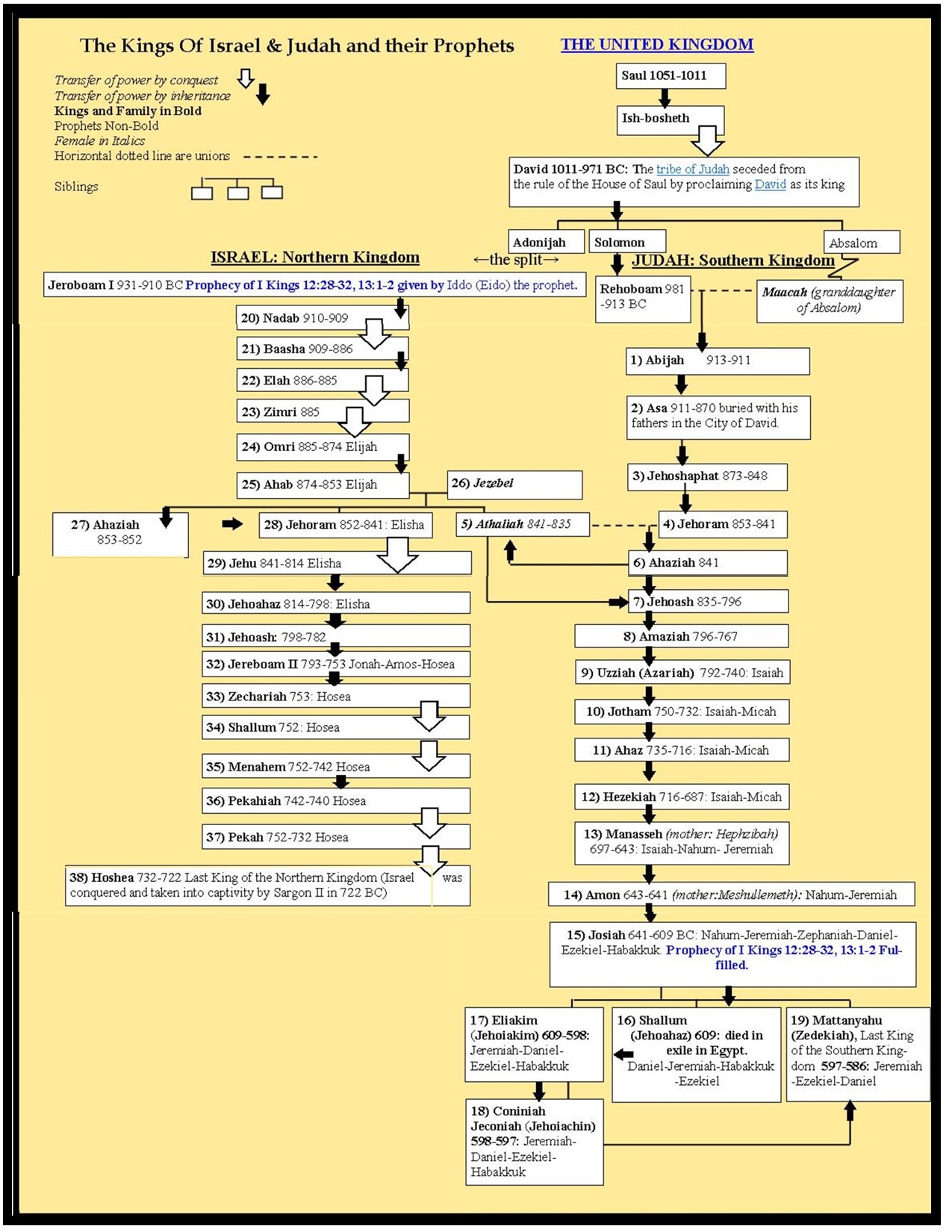
II Kings 19:1 And so it was, when King Hezekiah (#12 on chart above) heard it, that he tore his clothes, covered himself with sackcloth, and went into the house of the Lord (Yᵊhōvâ).
II Kings 19:2 Then he sent Eliakim, who was over the household, Shebna the scribe, and the elders of the priests, covered with sackcloth, to Isaiah the prophet, the son of Amoz.
II Kings 19:3 And they said to him, “Thus says Hezekiah: ‘This day is a day of trouble, and rebuke, and blasphemy; for the children have come to birth, but there is no strength to bring them forth (give birth/deliver).
II Kings 19:4 It may be that the Lord your God (Yᵊhōvâ ‘ĕlōhîm) will hear all the words of the Rabshakeh (commander), whom his master the king of Assyria has sent to reproach the living God (‘ĕlōhîm), and will rebuke the words which the Lord your God (Yᵊhōvâ ‘ĕlōhîm) has heard. Therefore lift up your prayer for the remnant that is left.’ ”
II Kings 19:5 So the servants of King Hezekiah came to Isaiah.
II Kings 19:6 And Isaiah said to them, “Thus you shall say to your master, ‘Thus says the Lord (Yᵊhōvâ): “Do not be afraid of the words which you have heard, with which the servants of the king of Assyria have blasphemed Me.
II Kings 19:7 Surely I will send a spirit upon him, and he shall hear a rumor and return to his own land; and I will cause him to fall by the sword in his own land.” ’ ”
Sennacherib’s Threat and Hezekiah’s Prayer
II Kings 19:8 Then the Rabshakeh returned and found the king of Assyria (Sennecherib) warring against Libnah, for he heard that he had departed from Lachish.
- Sennacherib ascended to the Assyrian throne after the death of his father, King Sargon II in 705 BC.
II Kings 19:9 And the king heard concerning Tirhakah king of Ethiopia, “Look, he has come out to make war with you.” So he again sent messengers to Hezekiah, saying,
II Kings 19:10 “Thus you shall speak to Hezekiah king of Judah, saying: ‘Do not let your God (‘ĕlōhîm) in whom you trust deceive you, saying, “Jerusalem shall not be given into the hand of the king of Assyria.”
II Kings 19:11 Look! You have heard what the kings of Assyria have done to all lands by utterly destroying them; and shall you be delivered?
II Kings 19:12 Have the gods of the nations delivered those whom my fathers have destroyed, Gozan and Haran and Rezeph, and the people of Eden who were in Telassar?
II Kings 19:13 Where is the king of Hamath, the king of Arpad, and the king of the city of Sepharvaim, Hena, and Ivah?’ ”
II Kings 19:14 And Hezekiah received the letter from the hand of the messengers, and read it; and Hezekiah went up to the house of the Lord (Yᵊhōvâ), and spread it before the Lord (Yᵊhōvâ).
II Kings 19:15 Then Hezekiah prayed before the Lord (Yᵊhōvâ), and said: “O Lord God (Yᵊhōvâ ‘ĕlōhîm) of Israel, the One who dwells between the cherubim, You are God (‘ĕlōhîm), You alone, of all the kingdoms of the earth. You have made heaven and earth.
II Kings 19:16 Incline Your ear, O Lord (Yᵊhōvâ), and hear; open Your eyes, O Lord (Yᵊhōvâ), and see; and hear the words of Sennacherib, which he has sent to reproach the living God (‘ĕlōhîm).
II Kings 19:17 Truly, Lord (Yᵊhōvâ), the kings of Assyria have laid waste the nations and their lands,
II Kings 19:18 and have cast their gods into the fire; for they were not gods, but the work of men’s hands—wood and stone. Therefore they destroyed them.
II Kings 19:19 Now therefore, O Lord our God (Yᵊhōvâ ‘ĕlōhîm), I pray, save us from his hand, that all the kingdoms of the earth may know that You are the Lord God (Yᵊhōvâ ‘ĕlōhîm), You alone.”
The Word of the Lord Concerning Sennacherib
II Kings 19:20 Then Isaiah the son of Amoz sent to Hezekiah, saying, “Thus says the Lord God (Yᵊhōvâ ‘ĕlōhîm) of Israel: ‘Because you have prayed to Me against Sennacherib king of Assyria, I have heard.’
II Kings 19:21 This is the word which the Lord (Yᵊhōvâ) has spoken concerning him:
‘The virgin, the daughter of Zion,
Has despised you, laughed you to scorn;
The daughter of Jerusalem
Has shaken her head behind your back!
II Kings 19:22 ‘Whom have you reproached and blasphemed?
Against whom have you raised your voice,
And lifted up your eyes on high?
Against the Holy One of Israel.
II Kings 19:23 By your messengers you have reproached the Lord (‘ăḏōnāy),
And said: “By the multitude of my chariots
I have come up to the height of the mountains,
To the limits of Lebanon;
I will cut down its tall cedars
And its choice cypress trees;
I will enter the extremity of its borders,
To its fruitful forest.
II Kings 19:24 I have dug and drunk strange water,
And with the soles of my feet I have dried up
All the brooks of defense.”
II Kings 19:25 ‘Did you not hear long ago
How I made it,
From ancient times that I formed it?
- Hebrew word for “Ancient” H6924 – qeḏem
- Eastward, to or toward the East
- Antiquity
- Beginning
- Front
- Faceward
- If civilization began in the “East” (Garden of Eden), it makes sense that the East is the location of antiquity.
II Kings 19:25 Now I have brought it to pass,
That you should be
For crushing fortified cities into heaps of ruins.
II Kings 19:26 Therefore their inhabitants had little power;
They were dismayed and confounded;
They were as the grass of the field
And the green herb,
As the grass on the housetops
And grain blighted before it is grown.
II Kings 19:27 ‘But I know your dwelling place,
Your going out and your coming in,
And your rage against Me.
II Kings 19:28 Because your rage against Me and your tumult
Have come up to My ears,
Therefore I will put My hook in your nose
And My bridle in your lips,
And I will turn you back
By the way which you came.
II Kings 19:29 ‘This shall be a sign to you:
‘You shall eat this year such as grows of itself (Without cultivation),
And in the second year what springs from the same;
Also in the third year sow and reap,
Plant vineyards and eat the fruit of them.
II Kings 19:30 And the remnant who have escaped of the house of Judah
Shall again take root downward,
And bear fruit upward.
II Kings 19:31 For out of Jerusalem shall go a remnant,
And those who escape from Mount Zion.
The zeal of the Lord of hosts (Yᵊhōvâ) will do this.’
II Kings 19:32 “Therefore thus says the Lord (Yᵊhōvâ) concerning the king of Assyria:
‘He shall not come into this city,
Nor shoot an arrow there,
Nor come before it with shield,
Nor build a siege mound against it.
II Kings 19:33 By the way that he came,
- “he came” H935 – bô’
- To enter
- To enter, into a woman, intercourse
- To enter into a chamber
By the same shall he return; And he shall not come into this city,’
Says the Lord (Yᵊhōvâ).
- “he return” H7725 – šûḇ
- To turn away (face), turn toward, et al.
II Kings 19:34 ‘For I will defend this city, to save it
For My own sake and for My servant David’s sake.’ ”
Sennacherib’s Defeat and Death (701 BC)
II Kings 19:35 And it came to pass on a certain night that the angel (Or Angel) of the Lord (Yᵊhōvâ) went out, and killed in the camp of the Assyrians one hundred and eighty-five thousand; and when people arose early in the morning, there were the corpses—all dead.
- “A recent discovery in Israel may corroborate an epic biblical account of an angel of the Lord wiping out 185,000 Assyrian soldiers, an independent scholar claims. Stephen Compton, an independent scholar specializing in Near Eastern archaeology, utilized a modern mapping technique to find the discovery of, what he believes, are ancient Assyrian military camps, from circa 700 BC. The discovery, which is also detailed in Assyrian texts, Greek histories and the Hebrew Bible, could verify the biblical account of II Kings 19:35; Isaiah 37: 36-38, and II Chronicles, 32:21.”
- Newsweek
- Near East Archeology
- Personal Application: When your outlook is bleak and without hope, remember to pray to the God that can wipe out 185,000 warriors with just one angel.
II Kings 19:36 So Sennacherib king of Assyria departed and went away, returned home, and remained at Nineveh.
II Kings 19:37 Now it came to pass, as he was worshiping in the temple of Nisroch his god, that his sons Adrammelech and Sharezer struck him down with the sword; and they escaped into the land of Ararat.

Nisroch, Sennacherib’s god for Assyria
Then Esarhaddon his son reigned in his place.
Previous: II Kings 18
Next: II Kings 20
 Quantum Study Bible