
Words in italic type have been added for clarity. They are not found in the original Hebrew or Aramaic.
See Topic: Jesus as the Rain Bringing in the Harvest
A TRUE RESURRECTION
A true resurrection is one in which the person does not die again (ie: Lazarus whom Jesus raised from the dead.)
THE JEWISH FEASTS:
- The Jewish Feasts are prophetic.
- They are divided between the Spring Feasts, and the Autumn Feasts.
- Some of the Feasts meet the descriptions of resurrections tied to the harvests.
- The Feasts given by God total seven:
- (spring) Passover
- (spring) [Resurrection] First Fruits
- (spring) Feast of Unleavened Bread (which also includes the Wave Offering [Resurrections])
- (spring) Pentecost
- (autumn) Feast of Trumpets
- (autumn) Day of Atonement
- (autumn) Feast of Booths
PROPHETIC:
One can say with certainty that the Spring Feasts were prophetic because they were all fulfilled by Jesus during His first ministry on earth: 1) Jesus was killed the same day the Passover lamb was slaughtered. 2) He rose from the dead on First Fruits. 3) Certain tombs of the saints were opened as the Wave Offering. The last of the Spring Feasts, 4) Pentecost, was celebrated as the 50th day when Moses received the ten commandments on Mount Sinai after leaving Egypt during the Exodus. At the feast of Pentecost tongues were given, fulfilling the law.
With the understanding of how prophecies were fulfilled on the Jewish Spring Feasts by Jesus, what does this tell us about the Autumn Feasts?
Spring Feasts relate to Jesus’ first ministry indicating the Autumn Feasts are also prophetic and tied to Jesus’ second ministry at His return to earth.
JEWISH FEASTS and THE HARVESTS:
Scripture compares resurrections to God’s harvest of souls.
(Matthew 13:24-30) (Matthew 9:37-38) (John 4:35) (Revelation 14:14-15) (Mark 4) (Hosea 6:11) (Joel 3:13)
JESUS’ CRUCIFIXION WEEK:
The following calendar matches all references in scripture. The only year matching this scenario is 31 AD.
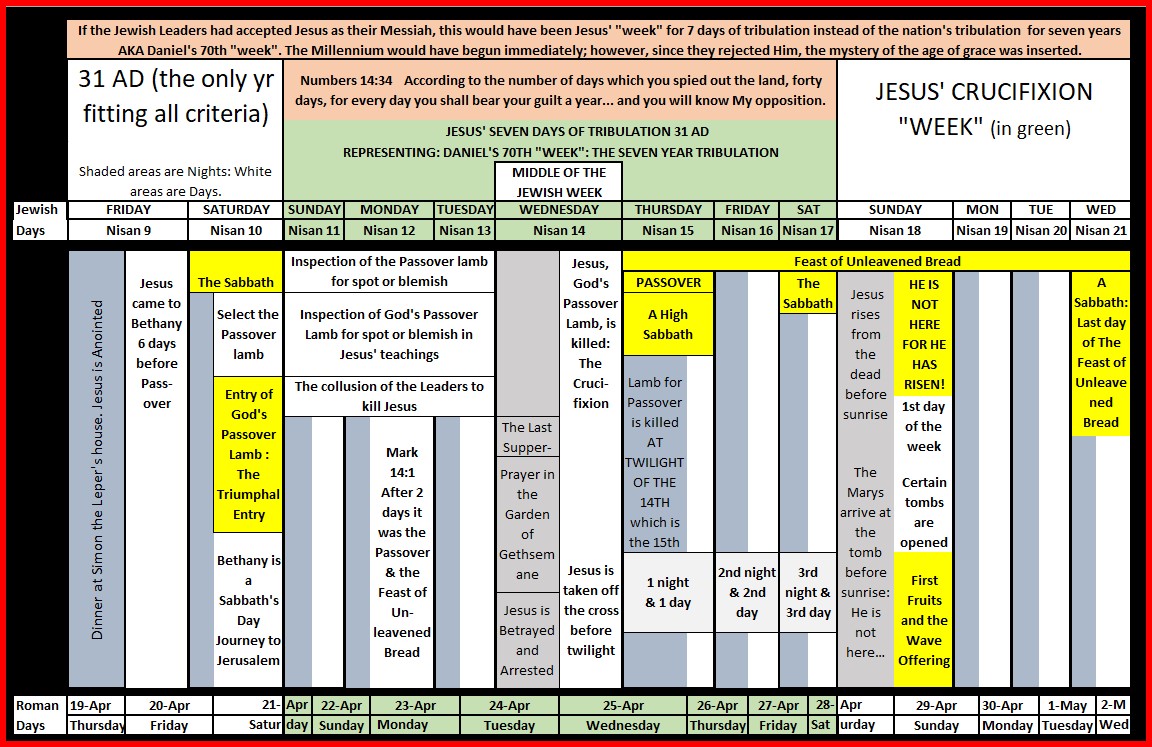
The Spring Feast Resurrections are First Fruits, when Jesus rose from the dead, and the Wave Offering when certain tombs of the saints were opened, both during the Feast of Unleavened Bread.
Jesus used the word “Leaven” to symbolize “Pride” which “puffs up”. The Feast of Unleavened Bread celebrates “Sin-Less-Ness”.
How might Autumn Feasts line up with Future Prophecies?
See Chart of the High Holy Days Below:
The High Holy Days match the timing of the Rapture/Resurrections, followed by seven days/years of the tribulation, then the return of Jesus represented by The Day of Atonement. A total of ten days.
The Jews call the last day and tenth day which is the Day of Atonement, “The Return”.
The seven days/years match Daniel’s 70th “week” which is called the Seven Year Tribulation.
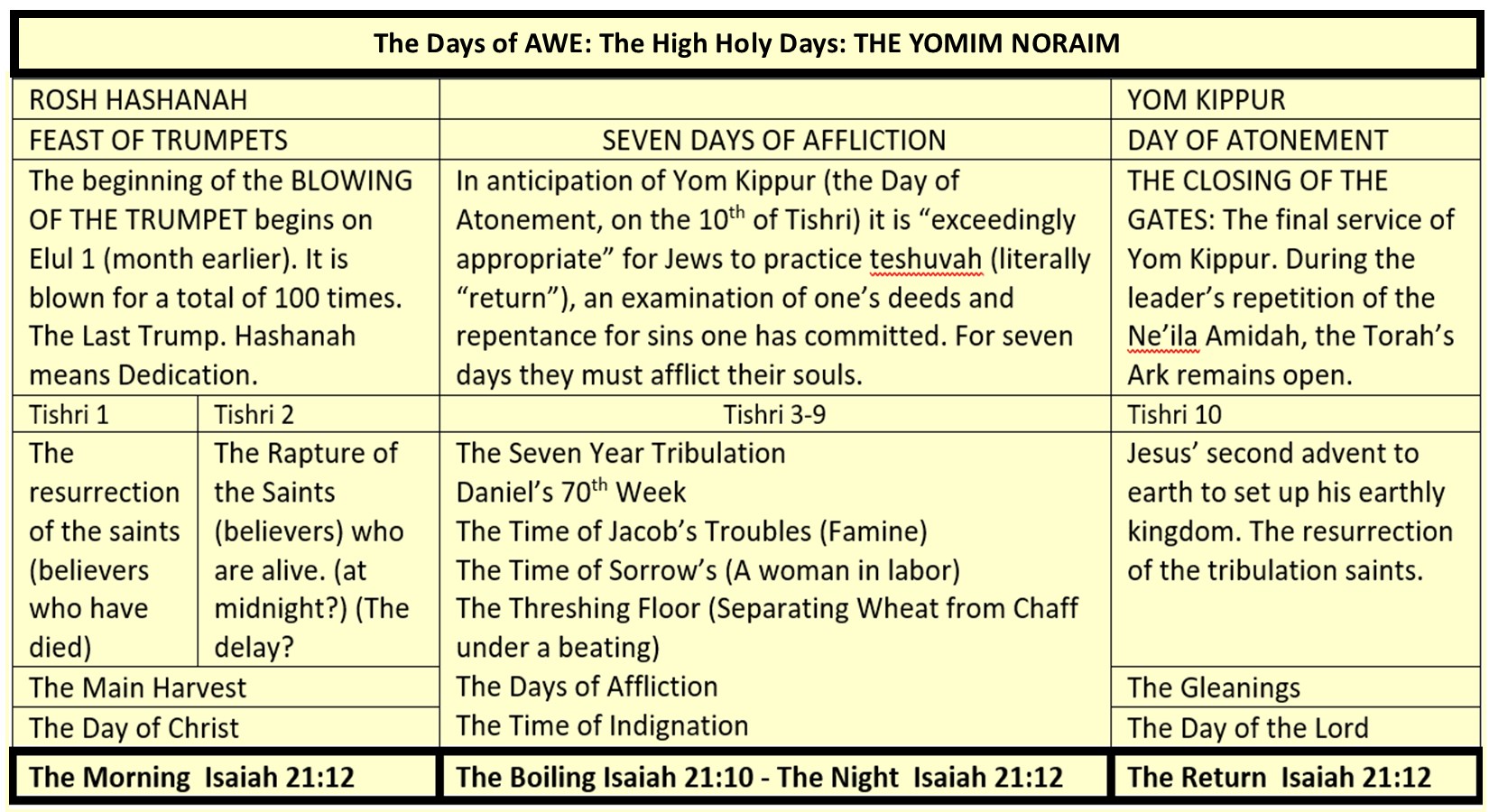
Trumpets are blown 3 times a day for 30 days for a total of 90 trumps in the Jewish month of Elul. Then, on the first day of a new month called Tishri, the trumpet is blown for the last ten times for a total of 100 trumpet blows for the Feast of Trumpets lasting two days.
“On Rosh Hashanah, G‑d looks at all human beings and decides what will happen to them in the coming year.” ~Chabad
This description seems to match Paul’s letters for the rapture and resurrections:
- I Corinthians 15:52 in a moment, in the twinkling of an eye, at the last trumpet. For the trumpet will sound, and the dead will be raised incorruptible, and we shall be changed.
- I Thessalonians 4:17 Then we who are alive and remain shall be caught up together with them in the clouds to meet the Lord in the air. And thus we shall always be with the Lord.
THE SEQUENCE OF HARVESTS
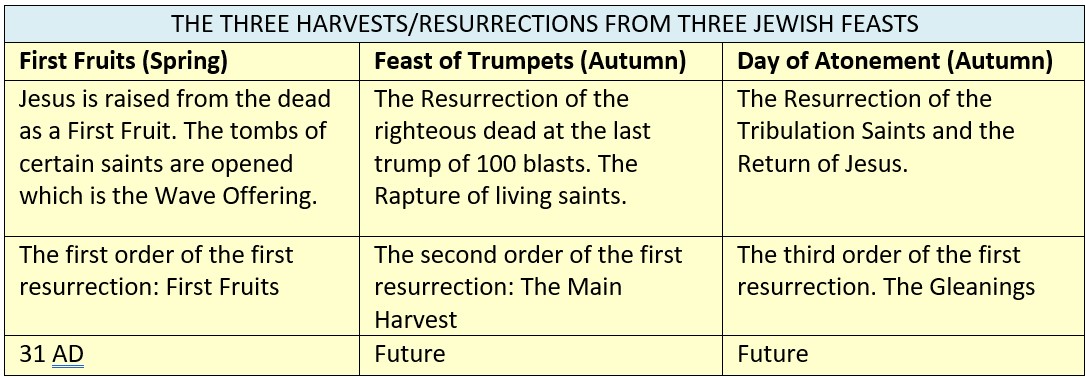
There are three orders of resurrections for the faithful believers. All three together is called the FIRST RESURRECTION.
- Jesus as the First Fruit and certain tombs of the saints opened as the Wave Offering.
- The Main Harvest for all righteous believers until the tribulation on the Feast of Trumpets.
- The Gleanings for the tribulation saints and martyrs on the Day of Atonement.
Daniel 12:13 But go thou thy way till the end be: for thou shalt rest, and stand in thy lot (order) at the end of the days.
I Corinthians 15:23 But each one in his own order: Christ the first fruits, afterward those who are Christ’s at His coming.
The High Holy Days are two days for the Feast of Trumpets, seven days of Affliction leading up to the one Day of Atonement.
(Note: all ten days are referred to as the days of affliction. However; there are only seven days between First Fruits and the Day of Atonement.)
All resurrections of believers together are called the “first resurrection”: The First Fruits, Wave Offering, Feast of Trumpets, and Day of Atonement.
THE HARVEST OF UNBELIEVERS
The harvest of unbelievers is called the second resurrection. It is a harvest of weeds (tares).
THE BOOK OF LIFE
Only those whose names are written in Jesus’ Book of Life are part of the first resurrection.
Those whose names are not written in Jesus’ Book of Life are designated for the second resurrection of weeds.
The wheat (righteous) is gathered and put in the barn but the weeds (unrighteous) are gathered and put into the oven.
THE SEVENTH JEWISH FEAST – THE FEAST OF BOOTHS (TABERNACLES/TENTS) THE FEAST OF INGATHERING:
On the fifth day after the Day of Atonement, on Tishri 15, begin the days of the Feast of Booths/Tents/Tabernacles.
The seventh feast, The Feast of Booths is the culmination of all Jewish Feasts, it represents the Millennium when Jesus reigns on earth. It is the time when the Jews are gathered from every corner of the heavens and the earth, called the “Ingathering”.
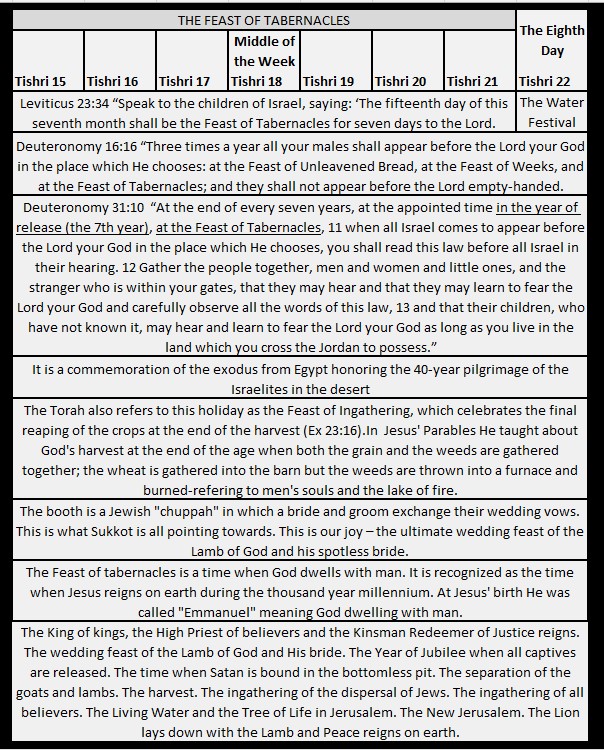
“Jews view the seventh day (aka Hoshana Rabba) of the Feast of Booths as the final chance to earn atonement during the high holiday season that begins with Rosh Hashana, and to ensure that God sends plentiful rainfall in the year ahead.” ~ Britannica
What does a “last chance” mean? The Feast of Booths is celebrated as the coming millennium when Jesus “dwells among men”. The last chance occurs during the millennium.
RAIN
The 8th day of the Feast of Booths is called “gešem“, The Water Festival, Tishri 22. See chart above.
Without Rain there can be no harvest.
There are “types” of rain in scripture:
- māṭar H4305
- gešem H1653 – a violent rain, a heavy shower: (Water Festival on Tishri 22 named gešem).
[Side Note: The same day Jesus called out to the crowds proclaiming HE was the living water.
John 7:37-38]
There is rain for a certain season:
- yôwreh H3138 – The first/former rain. A sprinkling. (Autumn by the Jewish Calendar)
- malqôš – H4456 – The rain which matures the crops. (Spring by the Jewish Calendar)
Rain is also translated as teacher and the faithful rain is the Messiah. Rain is withheld when nations are disobedient. (Jeremiah 3:3, Amos 4:7, Exodus 9:33). Since Rain is the Messiah and the Messiah is Jesus and since Jesus is the Word of God … to withhold Rain is to also have a famine of God’s Word in the land.
- Amos 8:11
“Behold, the days are coming,” says the Lord God, “That I will send a famine on the land, Not a famine of bread, Nor a thirst for water, But of hearing the words of the Lord.
THE RAINBOW
A “Bow” H7198 is symbolic of a “covenant”. Noah’s Rainbow is the Messiah’s Covenant.
 Quantum Study Bible