
Words in italic type have been added for clarity. They are not found in the original Hebrew or Aramaic.
II Kings 1
Ahaziah, the son of Ahab, is the worshiper of Baal-Zebub without regard to Yᵊhōvâ ‘ĕlōhîm, the God of Creation, the God of Abraham, Isaac, and Jacob, and the one and only true God.
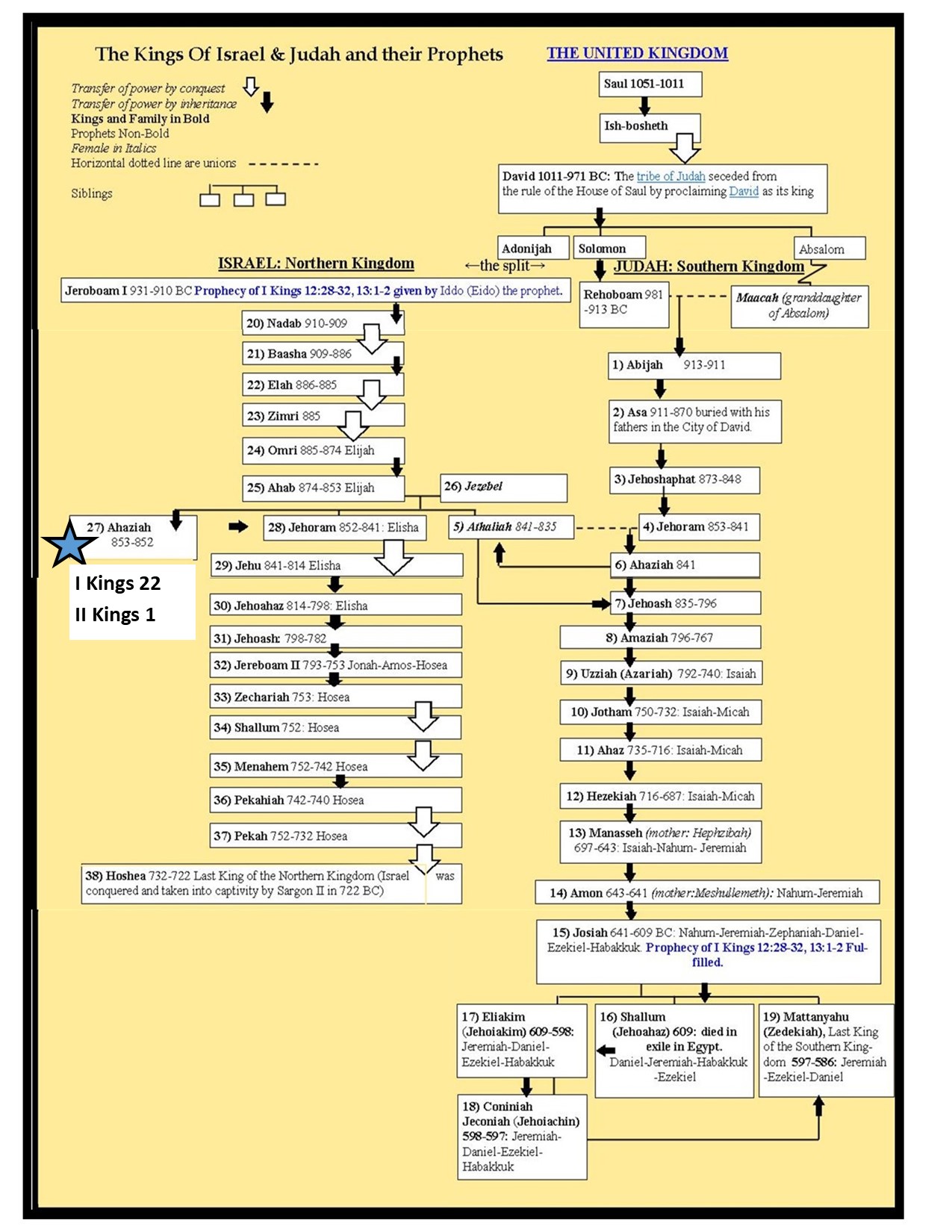
NOTE: There are two king Jehorams and two king Ahaziahs. In each case one rules over Judah and the other rules over Israel.
Judah’s kings are in bold blue. Jehoram (#4) and Ahaziah (#6).
Israel’s kings are in bold black. Jehoram (#28) and Ahaziah (#27).
The Jehorams ruled at the same time:
Jehoram #4 ruled in Judah (853-841 BC) is the son of Jehoshaphat #3.
Jehoram #28 ruled in Israel (852-841 BC) is the son of Ahab #25.
The Ahaziahs ruled in close proximately
Ahaziah #6 ruled in Judah for only a few months in (841 BC) as the son of the same Jehoram #4 already mentioned.
Ahaziah #27 ruled in Israel (853-852 BC) also for a short time, the brother of the same Jehoram #28 already mentioned and the son of Ahab #25.
NOTE: TO KEEP KINGS STRAIGHT BETWEEN ISRAEL AND JUDAH:
Bold Black=Kings of Israel (Samaria)
Bold Blue=Kings of Judea
God Judges Ahaziah
II Kings 1:1 Moab rebelled against Israel after the death of Ahab (#25) (king of Israel).
II Kings 1:2 Now Ahaziah (#27) (new king of Israel) fell through the lattice of his upper room in Samaria, and was injured; so he sent messengers and said to them, “Go, inquire of Baal-Zebub (Lit. Lord of Flies), the god of Ekron, whether I shall recover from this injury.”
II Kings 1:3 But the Angel (messenger) of the Lord (Yᵊhōvâ) said to Elijah the Tishbite, “Arise, go up to meet the messengers of the king of Samaria, and say to them, ‘Is it because there is no God (‘ĕlōhîm) in Israel that you are going to inquire of Baal-Zebub, the god of Ekron?’
II Kings 1:4 Now therefore, thus says the Lord (Yᵊhōvâ): ‘You shall not come down from the bed to which you have gone up, but you shall surely die.’ ” So Elijah departed.
II Kings 1:5 And when the messengers returned to him (Ahaziah #27), he said to them, “Why have you come back?”
II Kings 1:6 So they said to him, “A man came up to meet us, and said to us, ‘Go, return to the king who sent you, and say to him, “Thus says the Lord (Yᵊhōvâ): ‘Is it because there is no God (‘ĕlōhîm) in Israel that you are sending to inquire of Baal-Zebub, the god of Ekron? Therefore you shall not come down from the bed to which you have gone up, but you shall surely die.’ ” ’ ”
II Kings 1:7 Then he said to them, “What kind of man was it who came up to meet you and told you these words?”
II Kings 1:8 So they answered him, “A hairy man wearing a leather belt around his waist.”
And he said, “It is Elijah the Tishbite.”
II Kings 1:9 Then the king sent to him a captain of fifty with his fifty men. So he went up to him; and there he was, sitting on the top of a hill. And he spoke to him: “Man of God (‘ĕlōhîm), the king has said, ‘Come down!’ ”
II Kings 1:10 So Elijah answered and said to the captain of fifty, “If I am a man of God (‘ĕlōhîm), then let fire come down from heaven and consume you and your fifty men.” And fire came down from heaven and consumed him and his fifty.
II Kings 1:11 Then he (Ahaziah #27) sent to him another captain of fifty with his fifty men.
And he answered and said to him: “Man of God (‘ĕlōhîm), thus has the king (Ahaziah #27) said, ‘Come down quickly!’ ”
II Kings 1:12 So Elijah answered and said to them, “If I am a man of God (‘ĕlōhîm), let fire come down from heaven and consume you and your fifty men.” And the fire of God (‘ĕlōhîm) came down from heaven and consumed him and his fifty.
II Kings 1:13 Again, he (Ahaziah #27) sent a third captain of fifty with his fifty men. And the third captain of fifty went up, and came and fell on his knees (Lit. bowed down) before Elijah, and pleaded with him, and said to him: “Man of God (‘ĕlōhîm), please let my life and the life of these fifty servants of yours be precious in your sight.
II Kings 1:14 Look, fire has come down from heaven and burned up the first two captains of fifties with their fifties. But let my life now be precious in your sight.”
II Kings 1:15 And the angel (Messenger, ie Angel) of the Lord (Yᵊhōvâ) said to Elijah, “Go down with him; do not be afraid of him.” So he arose and went down with him to the king (Ahaziah #27).
II Kings 1:16 Then he (Elijah) said to him (Ahaziah #27), “Thus says the Lord (Yᵊhōvâ): ‘Because you have sent messengers to inquire of Baal-Zebub, the god of Ekron, is it because there is no God (‘ĕlōhîm) in Israel to inquire of His word? Therefore you shall not come down from the bed to which you have gone up, but you shall surely die.’ ”
II Kings 1:17 So Ahaziah #27 died according to the word of the Lord (Yᵊhōvâ) which Elijah had spoken. Because he had no son, Jehoram #28 (the new king of Israel) (brother of Ahaziah #27) the son of Ahab #25, king of Israel (II Kings 3:1) became king in his place, in the second year of Jehoram #4 (king of Judah) the son of Jehoshaphat #3, king of Judah.
II Kings 1:18 Now the rest of the acts of Ahaziah #27 which he did, are they not written in the book of the chronicles of the kings of Israel?
SUMMARY
Ahaziah falls from the heights of his balcony. Adam fell from his spiritual heights in the Garden of Eden. Both listened to unholy advice in which the judgment for both is death. Ahaziah’s story is significant; His kingship ended with both his personal downfall and the divine judgment upon his spiritual house (the house of Ahaz and Jezebel) resulting in the loss of kingship, like Adam who lost his dominance to the “god of this world/age” who is also “the lord of the flies.”
 Quantum Study Bible