
Words in italic type have been added for clarity. They are not found in the original Hebrew or Aramaic.
Isaiah 7
A mention of Ahaz, found outside of the Bible, was taken from a clay building inscription of Tiglath-Pileser III. In accounts from his battles against Israel, between 744 and 727 BC, he records the following:
- “From these I received tribute . . . Ahaz, the king of Judah . . . including gold, silver, iron, fine cloth and many garments made from wool that was dyed in purple . . . as well as all kinds of lavish gifts from many nations and from the kings that rule over them.”
This confirms II Kings 16:8 which states:
- “And Ahaz took the silver and gold that was found in the house of the LORD, and in the treasuries of the king’s house, and sent it as a present to the king of Assyria.”
Why God sent Tiglath-Pileser III and his horde of Assyrians against Ahaz is found in II Chronicles 28:19-21:
- “For the LORD brought Judah low because of Ahaz king of Israel, for he had encouraged moral decline in Judah and had been continually unfaithful to the LORD.
Also Tiglath-Pileser king of Assyria came to him and distressed him, and did not assist him. For Ahaz took part of the treasures from the house of the LORD, from the house of the king, and from the leaders, and he gave it to the king of Assyria; but he did not help him.”
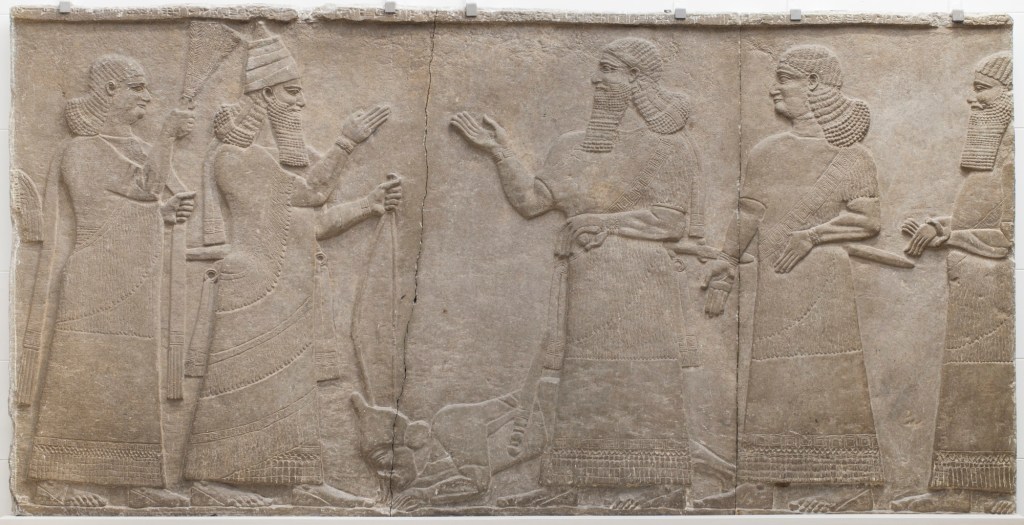
Tiglath-Pileser III receiving tribute. Photo: Detroit Institute of Arts / Public Domain
Notice the inscription of a man on the floor at (kissing?) Tiglath-Pileser’s feet.
In biblical descriptions the Assyrian king is called both Pul (II Kings 15:19) and Tiglath-Pileser (II Kings 15:29). The same is true in extra-biblical inscriptions, as Tiglath-Pileser is referred to as “Puwal, the great king of Assyria,” on the Incirli Trilingual Inscription (see below) and as Pulu in Babylonian inscriptions. (Tiglash-Pilesar III eventually merged the kingdoms of Assyria and Babylonia. Therefore; he is referred to as a Babylonian king as well as an Assyrian king. Tiglath-Pileser became the first king to rule as sovereign of both Assyria and Babylonia.)

The Incirli Stele is an ancient boundary stone with a Phoenician inscription that dates to the 8th century BC. On it, Tiglath-Pileser III is referred to as “Puwal, the great king of Assyria.” Photo: A.D. Riddle / BiblePlaces.com
King Ahaz’s seal is a bulla (impressed piece of clay) originating from the 8th century BC. The place of discovery of this seal is unknown, and it is currently part of Shlomo Moussaieff‘s private collection. The seal contains an ancient Hebrew inscription mentioning the name of Ahaz of Judah, as well as the name of his father, Jotham (Jotham/King Yehotam), identifying Ahaz as the “king of Judah”. The bulla contains a fingerprint which may belong to Ahaz himself.
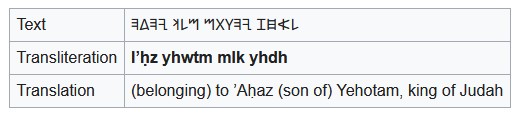
(l’hz = Ahaz, yhwtm = Yehotam, king = mlk, yhdh = Judah)
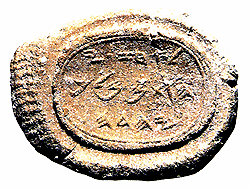
“This lump of clay, called a bulla, was used to seal a papyrus document. We know this because the back of the bulla still bears the imprint of the texture of the papyrus. Also on the back of the bulla, we can see the impression of the double string with which the document was tied.
On the left edge of the front of the bulla is a fingerprint that may well be that of King Ahaz himself! Around the edge of the seal impression is a groove about a millimeter thick. This indicates that the seal with which it was impressed was set in a metal bezel, either in a signet ring or in a pendant.”
http://www.archaeological-center.com/en/monographs/m1/
Isaiah Sent to King Ahaz
Isaiah 7:1-2 Now it came to pass in the days of Ahaz the son of Jotham, the son of Uzziah, king of Judah, that Rezin king of Syria and Pekah the son of Remaliah, king of Israel, went up to Jerusalem to make war against it, but could not conquer it. And it was told to the HOUSE OF DAVID, saying, “Syria has set up forces in the land of Ephraim.” So Ahaz’s heart and the hearts of his people were moved like the trees of the forest in a strong wind (in fear of sensing the danger).
- The annals of the king of Assyria, Tiglath-Pileser, whose writings state the following concerning Hoshea:
“They had overthrown their king, Pekah. Hoshea I placed as ruler over them. From him, I received a tribute of 10 talents of gold and 1,000 talents of silver.”
Isaiah 7:3-4 Then Yᵊhōvâ said to Isaiah, “Go out now to meet Ahaz, you and your son, Shear-Jashub (Lit. A Remnant Shall Return), at the end of the aqueduct from the upper pool, on the highway to the Fuller’s Field, tell him: “Be careful, and stay calm; do not fear or be fainthearted regarding these two stubs of smoking firebrands, which are the fierce anger of Rezin (ruling in Aram-Damascus) and Pekah (the son of Remaliah).
Isaiah 7:5-6 Because these two kings, Rezin and Pekah have plotted evil against you, saying, “Let us go up against Judah and trouble it (cause a sickening dread), and let us make a gap (hole) in its wall to allow us entrance, then we can set a king over them of our choosing, he who is the son of Tabel (Tabeel/Tabeal)” —
Isaiah 7:7 thus says ‘ăḏōnāy Yᵊhōvâ (concerning their plot against King Ahaz)
“It shall not stand,
Nor shall it come to pass.
Isaiah 7:8 For the head of Syria is (the city) Damascus,
And the head (ruler) of Damascus is Rezin.
Within sixty-five years Ephraim will be broken (Lit. shattered),
So that it will not be a people.
Isaiah 7:9 (and) The head of Ephraim is (the city) Samaria,
And the head of Samaria is Pekah (Remaliah’s son).
If you will not believe,
Surely you shall not be established.” ’ ”
The Immanuel Prophecy
Isaiah 7:10-11 Moreover Yᵊhōvâ spoke again to Ahaz, saying, “Ask a sign for yourself from Yᵊhōvâ ‘ĕlōhîm; ask it either in the depth or in the height above (Lit. make the request deep or make it high above).”
Isaiah 7:12 But Ahaz said, “I will not ask, nor will I test the Lord (Yᵊhōvâ)!”
Isaiah 7:13 Then he (Isaiah) said, “Hear now, O house of David (Judah)! Is it a small thing for you to weary men, but will you weary my ‘ĕlōhîm also?
God Gives Ahaz His Sign: The Future Virgin Birth
Isaiah 7:14-16 Therefore ‘ăḏōnāy Himself will give you a sign: Behold, the virgin shall conceive and bear a Son, and shall call His name Immanuel (Lit. God-With-Us). Curds (milk) and honey He shall eat, that He may know to refuse the evil and choose the good. For before the Child (Hezekiah/Jesus) shall know to refuse the evil and choose the good, the land that you dread will be forsaken by both her kings (Rezin and Pekah during Ahaz’s time).
Isaiah 7:17 Yᵊhōvâ will bring the king of Assyria upon you and your people and your father’s house—days that have not come since the day that Ephraim departed from Judah.”
Isaiah 7:18 And it shall come to pass IN THAT DAY
That Yᵊhōvâ will whistle (hiss) for the fly
That is in the farthest part of the rivers of Egypt,
And for the bee that is in the land of Assyria.
(IN THAT DAY Jerusalem will be desolate)
Isaiah 7:19 They will come, and all of them will rest
In the desolate valleys and in the clefts of the rocks,
And on all thorns and in all pastures.
Isaiah 7:20 In the same day ‘ăḏōnāy will shave with a hired razor,
With those from beyond the River (The Euphrates), with the king of Assyria (Tiglath-Pileser III),
The head and the hair of the legs,
And will also remove the beard.
Isaiah 7:21 It shall be in that day
That a man will keep alive a young cow and two sheep;
Isaiah 7:22 So it shall be, from the abundance of milk they give,
That he will eat curds;
For curds and honey, everyone will eat who is left (a remnant) in the land.
Isaiah 7:23 It shall happen in that day,
That wherever there could be a thousand vines
Worth a thousand shekels of silver,
It will be for briers and thorns.
Isaiah 7:24 With arrows and bows, men will come there,
Because all the land will become briers and thorns.
Isaiah 7:25 And to any hill which could be dug with the hoe,
You will not go there for fear of briers and thorns;
But it will become a range for oxen
And a place for sheep to roam.
{1 of 5} Isaiah 7 – “Oh No You Don’t! ” [The Root of All Prophecies]
{2 of 5} Isaiah 7 – “Ahaz, Pekah, and Resin” [History vs. Prophecies]
{3 of 5} Isaiah 7 – “Little Miss Muffet” [Curds and Honey]
{4 of 5} Isaiah 7 – “Wipe Out”
{5 of 5} Isaiah 7 – “King, after King” [Archeology]
 Quantum Study Bible