
Words in italic type have been added for clarity. They are not found in the original Hebrew or Aramaic.
What should we learn from this chapter?
- A righteous man’s attitude toward sinners?
- That love covers a multitude of sins.
- The relationship between law and love.
Jonah
Mixed Metaphors: In the first 3 chapters of the book of Jonah, Jonah is compared to Jesus undergoing similar experiences of misery.
Jonah voluntarily sacrifices himself to save the people in the ship (boat/ship sym. of the world throughout scripture), He is thrown into the sea (sym. of a sea of people throughout scripture). He has seaweed wrapped around his head similar to Jesus’ crown of thorns. Jonah says, “the waves and the billows passed over me (like the angel of death who passed over the Hebrews in Exodus 12:13). Jonah’s life was spared like the Passover in Egypt. Then he is swallowed by a reptilian sea monster (the Leviathan symbolizing Satan the serpent), and he remains in the stomach of the Leviathan for 3 days and 3 nights, even as Jesus was in the heart of the earth, which was His grave. Jonah is then vomited up out of the Leviathan’s mouth even as Jesus is resurrected from His grave, the mouth of death. When Jesus rose, it was the Gentiles (like the Ninevites) who repented, (not the Jews, Jonah was a Jew). Finally, Jesus, having left His roots in the earth, is lifted up to heaven to give the people of the earth rest and relief.
- Isaiah 53:2
For He shall grow up before Him as a tender plant, And as a root out of dry ground. He has no form or comeliness; And when we see Him, There is no beauty that we should desire Him.
The mixed metaphor: Unlike his comparison to Jesus, Jonah represents self-righteousness, like the scribes and Pharisees who were also self-righteous in Jesus’ day. Jonah hated the Ninevites like the scribes and Pharisees who hated Jesus. Jonah was disgusted by the sinfulness of the Ninevites. Likewise, the scribes and Pharisees judged Jesus as a lawbreaker, sinning by not keeping the law when he healed people and harvested grains of wheat on the Sabbath. In their hatred, they conspired to put Him to death. Jonah’s hatred toward the people of Nineveh is like the hatred of the Scribes and Pharisees.
In chapter 4, Jonah sits on a hill in the hot sun for 40 days anxious to watch God utterly destroy Nineveh.
As he waits, a fast-growing plant springs up, putting forth large leaves, giving Jonah relief from the misery of the heat due to the hot sun beating on his head. The plant is comfort, shade, and respite for Jonah.
This Plant represents all the goodness and mercies characterizing a loving God: Christ, Love and Grace, Comfort, Shade, the New Covenant to come, Repentance, Forgiveness, Rest (Sabbath), and a Plant of healing (which could even cure Jonah’s hatred).
Then a worm appears on the Plant; it is an infestation of hatred, which attacks and kills the Plant. When the plant withers because of the worm, Jonah is angry that his comfort of shade is gone.
Note: Hatred produces self-righteous anger.
Jonah hates the people of Nineveh because they are disgusting sinners.
Isn’t hating someone a sin?
Jonah himself was a sinner, just like the scribes and Pharisees who killed THEIR Plant, which had the healing properties of relief, shade, and comfort for themselves and for all of mankind.
How should we then, as sinners, live? Should we Hate hating? Rather, we should love sinners within our own boundary lines of trying to curb our own sinfulness, honest with our opinions, being polite and wise as the serpent but innocent as the dove. We should love our neighbor as ourselves, with a motivation of having their best interest at heart as well as our own, even if it is “tough” love, while remembering that the essence of love covers a multitude of sins. In scripture, being “chosen” means one thing, chosen to serve God and others. The Jews are a chosen people…so is the Bride of Christ.
One further irony; The scribes and Pharisees hated Jesus for His so called “blasphemy”; they denied that He was the Son of God who wrote the law with His Own finger on Mt. Sinai. He was the Lord of the Law, and the Lord of the Sabbath rest.
Finally, Jonah is angry because he stated that he hated the fact that God was a merciful God, abundant in loving kindness and feared that God would forgive the Ninevites. He only wanted that Mercy and Grace for himself, but not for others.
Jonah’s Anger and God’s Kindness
Jonah 4:1 But it displeased Jonah exceedingly, and he became angry.
Jonah 4:2 So he prayed to the Lord (Yᵊhōvâ), and said, “Ah, Lord (Yᵊhōvâ), was not this what I said when I was still in my country? Therefore I fled previously to Tarshish; for I know that You are a gracious and merciful God (‘ēl), slow to anger and abundant in loving kindness, One who relents from doing harm.
- Jonah does not agree with God’s agenda of accepting these “gentiles”!
- He wants God to destroy these unbelieving “dogs” (a Jewish term of his day for gentiles).
- Jonah loves God’s laws, but not people who need God.
- In his pride, Jonah wants God’s mercy for himself, but not for the gentiles.
Jonah 4:3 Therefore now, O Lord (Yᵊhōvâ), please take my life from me, for it is better for me to die than to live!”
Jonah 4:4 Then the Lord (Yᵊhōvâ) said, “Is it right for you to be angry?”
Jonah 4:5 So Jonah went out of the city (of Nineveh) and sat on the east side of the city. There he made himself a shelter and sat under it in the shade, till he might see what would become of the city.
Jonah 4:6 And the Lord (Yᵊhōvâ) God (‘ĕlōhîm) prepared a plant (Heb. kikayon, fast growing) and made it come up over Jonah, that it might be shade for his head to deliver him from his misery. So Jonah was very grateful (Lit. rejoiced with great joy) for the plant.
- Isaiah 53:2 For He shall grow up before Him as a tender plant, And as a root out of dry ground…
- Jeremiah 33:15 ‘In those days and at that time I will cause to grow up to David A Branch of righteousness; He shall execute judgment and righteousness in the earth.
- Revelation 22:16 “I, Jesus, have sent My angel to testify to you these things in the churches. I am the Root and the Offspring of David, the Bright and Morning Star.”
Jonah 4:7 But as morning dawned the next day God (‘ĕlōhîm) prepared a worm, and it so damaged the plant that it withered.
- “Worm” is symbolic of the infestation of hatred toward Jesus.
Jonah 4:8 And it happened, when the sun arose, that God (‘ĕlōhîm) prepared a vehement east wind (Breath of Wrath, used with the concept of holiness. The Day of Wrath is the Seven Year Tribulation); and the sun beat on Jonah’s head, so that he grew faint. Then he wished death for himself and said, “It is better for me to die than to live.”
- Jonah 4:6 And the Lord God prepared a plant (Jesus as a plant) and made it come up over Jonah (In chapter 4 of the book of Jonah, Jonah represents the attitude of the nation Israel who worships the law, but has no heart for people), that it (the plant Jesus) might be shade (provide comfort) for his head (The head of a body are the leaders) to deliver (redeem) him (them) from his (their) misery. So Jonah was very grateful for the plant. 7 But as morning dawned the next day, God prepared a worm (infestation of hatred), and it (the worm) so damaged the plant (because of the beating and crucifixion) that it (the plant) withered (died). 8 And it happened, when the sun (Son) arose (resurrection), that God prepared a vehement east wind (A breath of Wrath) (East is associated with Holiness); and the sun (Son) beat on Jonah’s (the nation’s) head, so that he (Jonah as the Jewish nation) grew faint (in affliction). Then he wished death for himself and said, “It is better for me to die than to live. (in affliction and tribulation)”.
- But a shoot shall grow out of the stump of Jesse, A twig shall sprout from his stock. The spirit of the LORD shall alight upon him: A spirit of wisdom and insight, A spirit of counsel and valor, A spirit of devotion and reverence for the LORD He shall sense the truth by his reverence for the LORD: He shall not judge by what his eyes behold, Nor decide by what his ears perceive. Thus he shall judge the poor with equity and decide with justice for the lowly of the land. He shall strike down a land with the rod of his mouth and slay the wicked with the breath of his lips (the eastern wind). Justice shall be the girdle of his loins, and faithfulness the girdle of his waist (Isaiah 11:1-5).
Jonah 4:9 Then God (‘ĕlōhîm) said to Jonah, “Is it right for you to be angry about the plant?”
- Jesus is the plant that provides mercy.
And he said, “It is right for me to be angry, even to death!”
Jonah 4:10 But the Lord (Yᵊhōvâ) said, “You have had pity on the plant for which you have not labored, nor made it grow, which came up in a night (Lit. was a son of a night) and perished in a night.
- Nineveh was a gentile city. When Jesus rose from the dead it was the gentiles who believed and repented. But the Jewish Israel, like Jonah, never repented. Ironically, they sacrificed the God of the law because of their legalistic views of His law.
Jonah 4:11 And should I not pity Nineveh, that great city, in which are more than one hundred and twenty thousand persons who cannot discern between their right hand and their left—and much livestock?”
- They cannot discern between right and wrong because they were never exposed to the law. Only God delivers a correct morality of what is right and what is wrong.
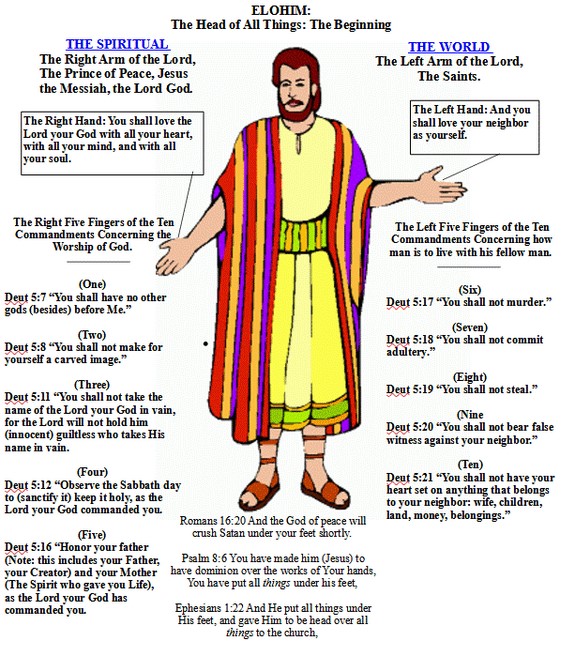
God “chose” the Jews for this very purpose – to take His Light to the nations.
Previous: Jonah 3
Next: Micah 1
 Quantum Study Bible