
Something extraordinary happened inside a sealed tomb so supernaturally charged, it leaves men recalculating reality, actually believing they also could be raised from the dead to live forever with God.
It is Sunday, April 29th, 31 AD, outside Jerusalem when two women walk together just before dawn to a carved-out rock in the side of a cliff with an enormous round, flat stone rolled across its entrance; sealed and guarded by two soldiers.
How were they to know that this tomb was the Holy of Holies where the “Ark of the Covenant” came to life? After all, “Ark” means “coffin”.
After His crucifixion, Jesus was laid on a bed, a mercy seat where His blood would bleed onto the seat. A place where He no longer dwelt in the flesh, with two angels on His bed, the seat, one at the foot and one at the head.
How does someone broach an event so inexplicable that it introduces dimensions hitherto unknown to man, pushing man’s imagination beyond its limits?
How can it fit so perfectly with every piece of infallible scripture hidden in Old Testament verses, within symbolisms, patterns, revelations, numerology, metaphors, shadows, and parables? No man can write a book like this except Someone who knows every event that will happen from the beginning to the end, someone supernatural who exists in the present, eternally.
But man, in his ignorance, that which he cannot understand, will disregard, mock, neglect, disdain and scoff, becoming like the walking dead. Dead in spirit.
Jesus was no ordinary man. He shocked everyone with miracles, teachings, and outrageous claims. To be exposed to Jesus forced people to take a stand – is He … Or Isn’t He … the only Son of God! He wasn’t just from the heavens, He was from the Highest of Heavens, the Creator of Everything!
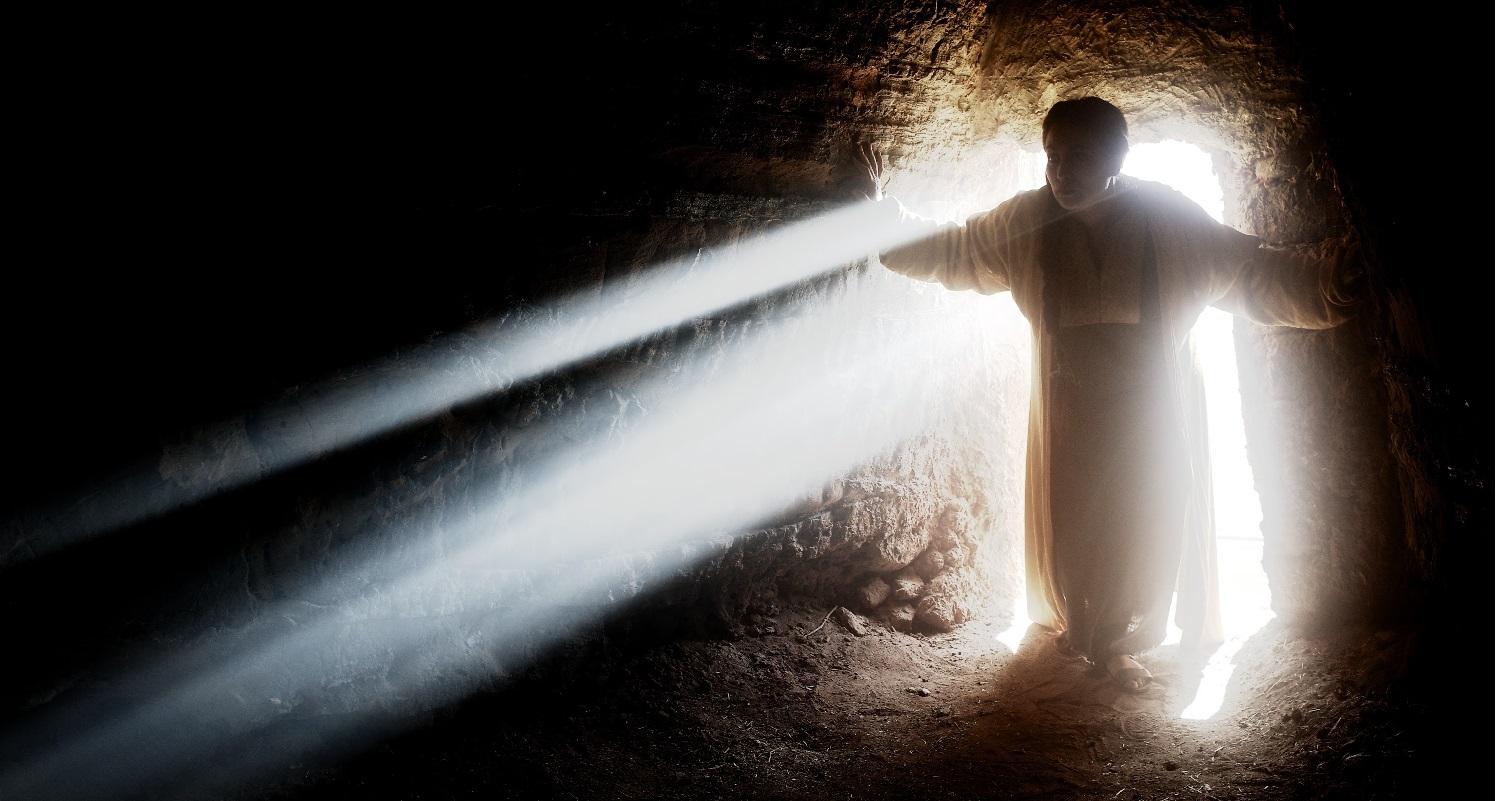
The tomb was located close to where an extraordinary man had been crucified. With more power than an atomic bomb; this man exploded back to life from the dead after a three-day burial – leaving behind His burial cloth and His face cloth along with strips of linen. Jesus picked up His face cloth and folded it before He walked through the stone that had been rolled over the door, in a strange new body defying Physics .
The burial cloth he left behind was the evidence of a resurrection from the dead. There is no other relic like it. According to Professor Paolo Di Lazzaro it would take 14,000 lazers all going off at the same time to replicate the Shroud of Turin, and even then, would it really capture everything because there is so much more? Professor Paolo Di Lazzaro, is head of a group of researchers from the National Agency for New Technologies, Energy and Development in Italy.
Professor Paolo Di Lazzaro, noted back in May 7, 2010 that the latest discoveries on the Shroud of Turin “are not in contradiction with the theory of the Resurrection” of Christ.
In an interview with Europa Press, Di Lazzaro explained the results of their study, which lasted four years and focused on how the image came to appear on the cloth. According to tradition, the shroud was used to wrap the body of Jesus after his crucifixion.
Di Lazzaro said that scientists have not been able to reproduce an image, similar to the one on the shroud, with any kind of contact technique. While from far away, differences in the replications may appear unnoticeable, under a microscope they appear drastically different, he added.
Physical Evidence of Life After Death?
“An intriguing scientific journey exploring one of the greatest mysteries of the world. It has captivated the curiosity of international scientists, as well as religious and non-religious inquirers.” ~ Mark Niyr
Luke 24:12: “Peter, however, got up and ran to the tomb. Bending over, he saw the strips of linen lying by themselves, and he went away, wondering to himself what had happened.”
WHAT HAPPENED?
John 20:4–7: “Both were running, but the other disciple (John) outran Peter and reached the tomb first. 5 He bent over and looked in at the strips of linen lying there but did not go in. 6 Then Simon Peter came along behind him and went straight into the tomb. He saw the strips of linen lying there, 7 as well as the cloth that had been wrapped around Jesus’ head. The cloth was still lying in its place, separate from the linen.”
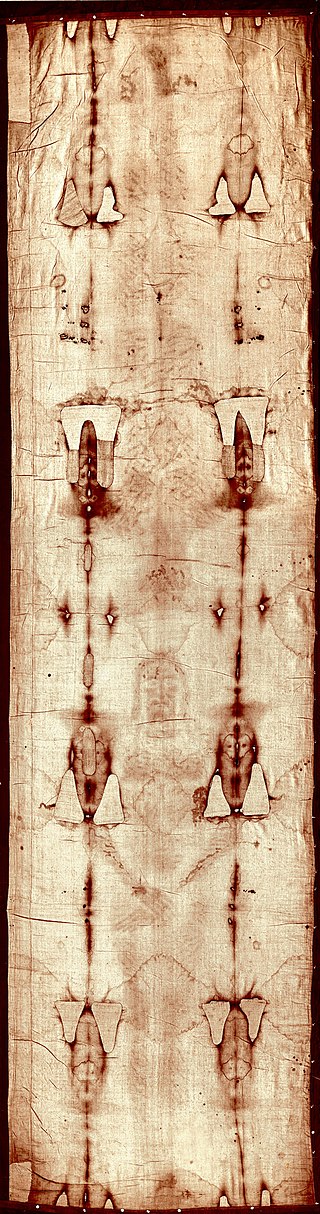
1) FACTS:
- THE BURIAL CLOTH (ABOVE)
- Jesus’ burial cloth is called “The Shroud (burial cloth) of Turin (a cathedral in Italy)”. It is of one piece, wrapping the body from top to bottom, revealing the front and back of the body, laid out head to head.
- When the burial cloth was folded, preserved in a frame in such a way that only the face on the cloth was revealed; it was called the “Mandylion of Edessa”, or the “Image of Edessa”. Edessa is an ancient city in Southeastern Turkey (now called Urfa or Sanliurfa).
The folded cloth showing only the face of Jesus was revered by the Templars. During their initiation, they would kiss the face cloth. Later the King used this information to accuse them of witchcraft, confiscate their enormous wealth, kill the Templars, and dismantle the entire organization.
- THE FACE CLOTH
- Jesus’ face cloth is called “The Sudarium (face cloth or sweat cloth) of Oviedo (a place in Spain)”.
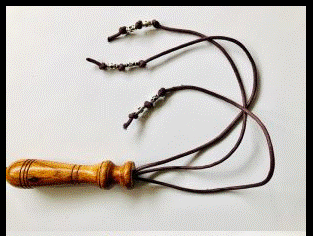
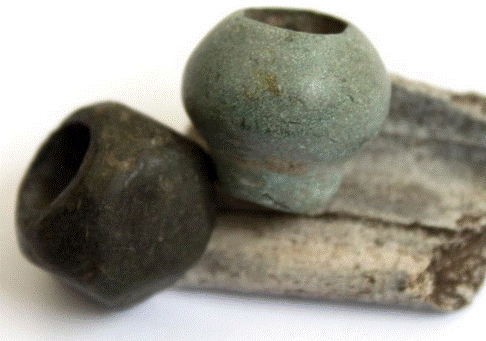
- A WHIPPING SCOURGE
- The whipping scourge is called a a flagellum.
2) MIRACULOUS COINCIDENCES
The question hanging over everyone’s head concerning the shroud and the face cloth is – how many coincidences can be involved before they are no longer “coincidences”, until they are called “miracles”?
Since it is now proven that the shroud was produced at the time of Jesus, one is forced to ask – how many men who were crucified claimed to be a king, thus having a crown of thorns? How many were beaten head to foot? How many had a spear thrust into their side? How many escaped with no bones broken? How many had their chin hairs pulled out in mockery? How many fell, leaving wounds on their knee and noses? How many were preceded by John the Baptizer, who told the crowds…”Behold the Lamb of God who takes away the sins of the world (the Passover lamb which was slaughtered on the same day as Jesus’ crucifixion as an atonement for their sins, fulfilling the Passover feast). How many claimed before they died that they would rise again from the dead? How many …..?
Click here to read verses where Jesus predicted His betrayal, His own death, The day and the type of death He would die: Jesus Predicts His Death. Click on the link for a summary of things Jesus predicted concerning His death.
How “coincidentally miraculous” is it that both the burial cloth AND the face cloth were preserved through the centuries? Despite having separate histories of locations and owners, they miraculously came together again for scientific research at the same time.
3) THE HISTORY OF THE MOVEMENT OF THE SHROUD (burial cloth)
The shroud and the face cloth apparently parted ways after the crucifixion. The shroud was taken from Constantinople in Turkey in 1204 by a crusader. In 1453 Margaret de Charny deeded the Shroud to the House of Savoy stored in a church in Chambery, France. In 1578 the House of Savoy took the shroud to Turin where it remained at Turin Cathedral. The shroud remained the property of the House of Savoy until 1983, when it was given to the Holy See (Catholic church).
It is miraculous indeed and full of wonder that both Jesus’ burial cloth and face cloth were both preserved in spite of having different backstories, travels, dangers and owners, to come together again in these last days for scrutiny under new technology.
4) HISTORY OF THE MOVEMENT OF THE FACE CLOTH OF JESUS:
An ancient tradition claims that St. Joseph of Arimathea gave Christ’s sudarium (face cloth) to St. Peter. It was later cared for by religious women in a cave close to the Monastery of St. Mark on the far side of the Jordan River. The Persians invaded Jerusalem and its environs in 612 AD. The face cloth was taken to Alexandria, Egypt, when 2 years later, the Persians conquered Alexandria as well, but the face cloth was already on its way to Spain into the custody of St. Isidore (560-636), bishop of Seville. After Isidore’s death, St. Ildephonsus, his disciple who became bishop of Toledo, brought the relic to Toledo, the new Christian capital of Spain. It remained there until the Muslim invasion. Arabic manuscripts state that the face cloth with other relics were hidden in a well on a mountaintop called Monsacro, an ancient sacred peak near the city of Oviedo. King Alfonso II the Chaste (c. 759-842) built the Holy Chamber for the relics at his palace in Oviedo. the Holy Chamber was destroyed in 1934, just before the Spanish Civil War, when Marxists placed dynamite in the lower crypt of St. Leocadia. The Sudarium, however, was found miraculously unharmed in the rubble.
The burial cloth (shroud) and face cloth were themselves “raised from the dead” after being hidden for many centuries, like Ezekiel’s dry bones coming together, the face cloth and the shroud miraculously “came together.”
New evidence has proven the reality of the shroud as being the burial cloth of Jesus. The image produced is proof of a “resurrection”; even as scripture documents, describing the facecloth folded and left behind in an empty tomb.
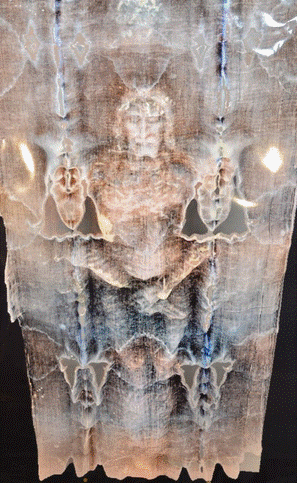
Actual 3 D image Above: Beaten from head to foot on the front and on the back. No painkillers. Every white spot is a place Jesus was beaten.
The shroud thunders forth from the historical past as a witness to the glorious Word of Salvation: The crown of thorns, the marks of the scourging whip, beaten on the front and back from the head to the foot and then crucified, the imprint of the nails in His hand and the place where the spear lacerated His side.
But there would be no gospel of good news without a resurrection …
“Sarah’s womb was an empty tomb, but the Messiah came out of it” ~ unknown
- I Corinthians 15:20 The Last Enemy Destroyed – But now Christ is risen from the dead, and has become the first fruits of those who have fallen asleep (died).
- The nation Israel was sick from her foot to her head. therefore; the Messiah had to be beaten from His foot to His head in order to cover the nation’s sins.
- Prophetically: Isaiah 1:6 From the sole of the foot even to the head, There is no soundness in it, But wounds and bruises and putrefying sores; They have not been closed or bound up, Or soothed with ointment.
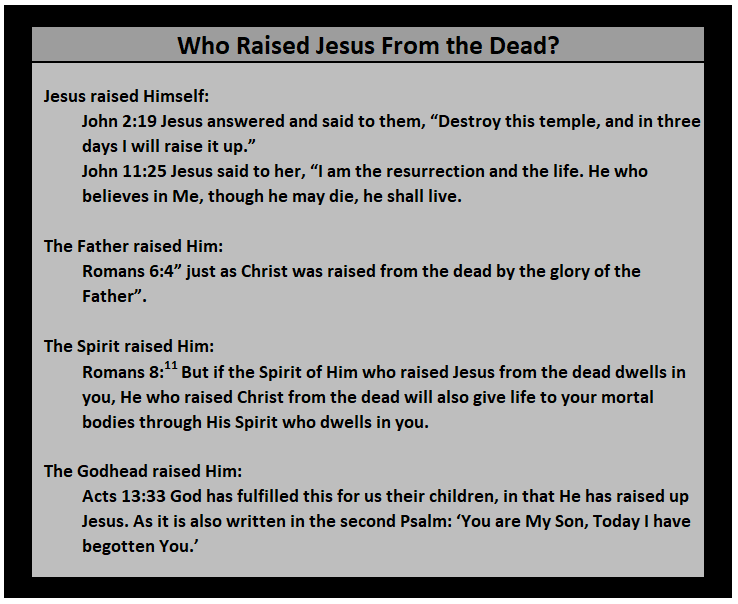
5) WHO RAISED JESUS FROM THE DEAD?
John 10:17-18 “Therefore My Father loves Me, because I lay down My life that I may take it again. No one takes it from Me, but I lay it down of Myself. I have the power to lay it down, and have power to take it again. This command I have received from My Father.” Jesus raised Himself…working in tandem with …the Godhead.
6) COIN IMPRINT: Coin imprint on the Shroud of Turin proves this shroud genuinely dates back to Jesus’ crucifixion and connects its veracity to the face cloth:
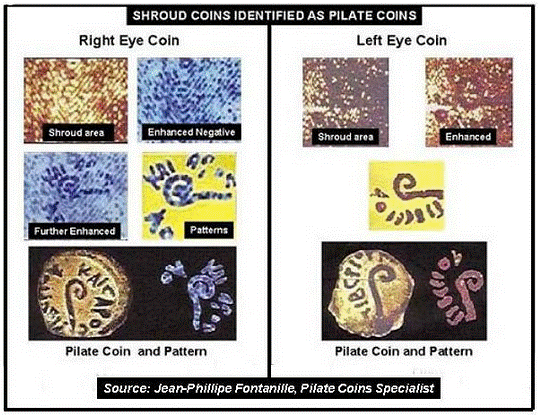
- Notice the “K” misspelling on the right eye.
- Note: ‘Pontius Pilate issued misspelled coins no earlier than 29 AD. and perhaps through 32 AD at the latest.
- Jesus began His ministry in 29 AD and was crucified in 31 AD.
- To verify 31 AD crucifixion date Click here to see notes on Jesus’ crucifixion week. A pop up will appear. Click on link at top of the pop up.
- To verify 29 AD as Jesus’ ministry date: Click here to see notes in Luke chapter 3. A pop up will appear. Click on link at top of the pop up.
- The misspelled coin over Jesus’ right eye is dated 29 AD.
UPI Archives
Sept. 2, 1981
Coin imprint proves Shroud of Turin genuine
By JACK LESAR
https://www.upi.com/Archives/1981/09/02/Coin-imprint-proves-Shroud-of-Turin-genuine/2030368251200/
CHICAGO — A misspelling on a rare Pontius Pilate coin helped convince researchers that human imprints on the Shroud of Turin, believed to be the burial cloth of Jesus Christ, are genuine and date back to the first century (time of Jesus).
Magnifications of a rare coin — believed widely used around Palestine until 70 AD to cover the eyes of the dead — showed the same misspelling found in the shroud imprint, a Loyola University theologian said Tuesday. The Rev. Francis L. Filas said the matching misspellings prove the shroud originated around the same time and place (that) Christ was crucified during Pilate’s reign.
‘The coin provides concrete proof that the misspelling did exist in the past (even) as it exists today,’ Filas said.
What makes the discovery so definitive is the fact that an … extremely rare misspelling from the Greek words for ‘Tiberius Caesar’ occurs on both the shroud – AND on the COIN. Up to now, the ‘u cai’ could only be theorized as a misspelling of a ‘c’ for a ‘k’ in ‘Tiberiou Kaisaros.’
‘Imprints of a misspelled Pontius Pilate coin now in existence are the same as imprints of an apparent coin on the right eye of the crucified man’s figure on the SHROUD of Turin,’ said Filas, a professor of theology at Loyola. Filas said his discovery is the strongest evidence yet the shroud is authentic.
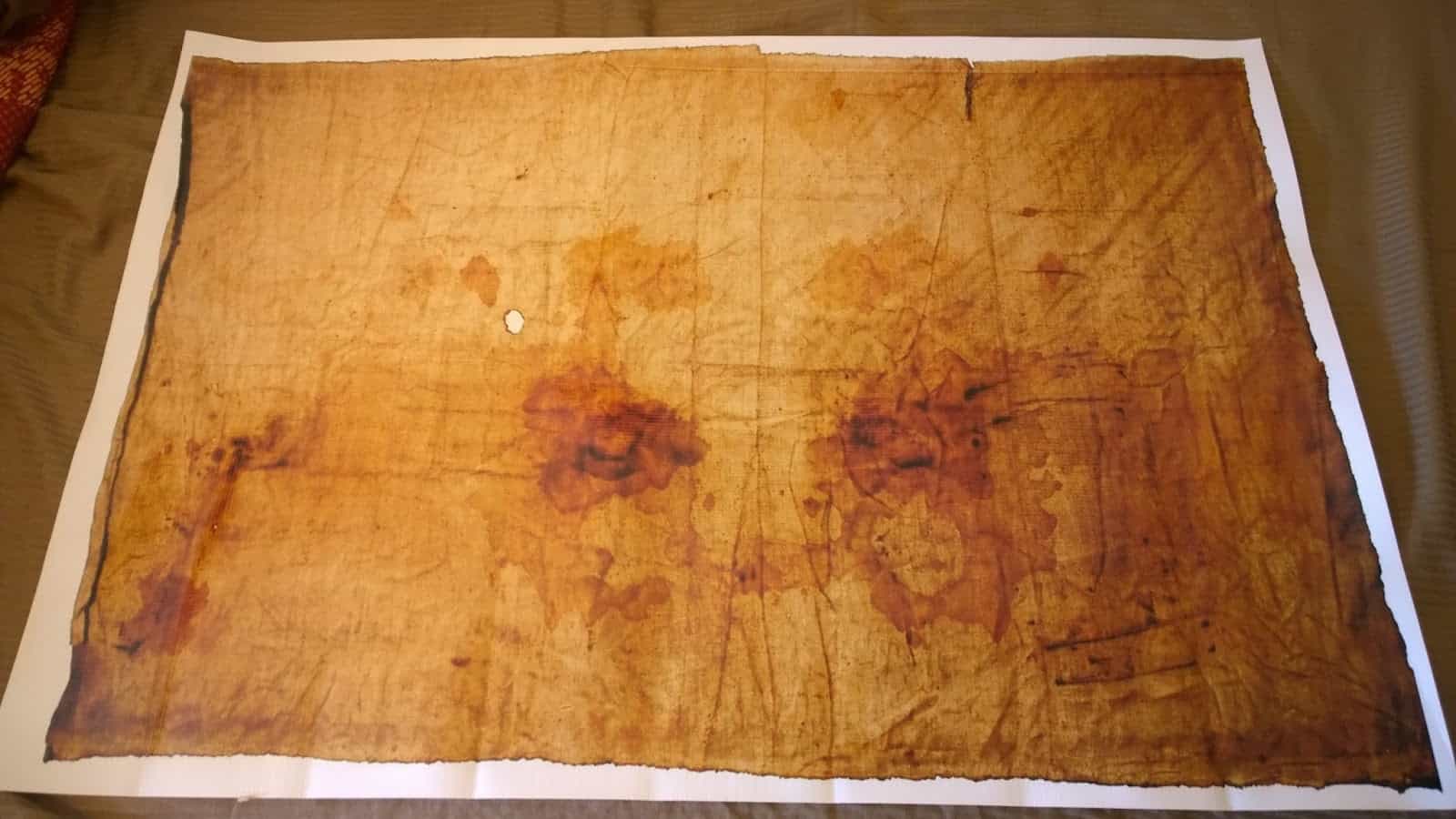
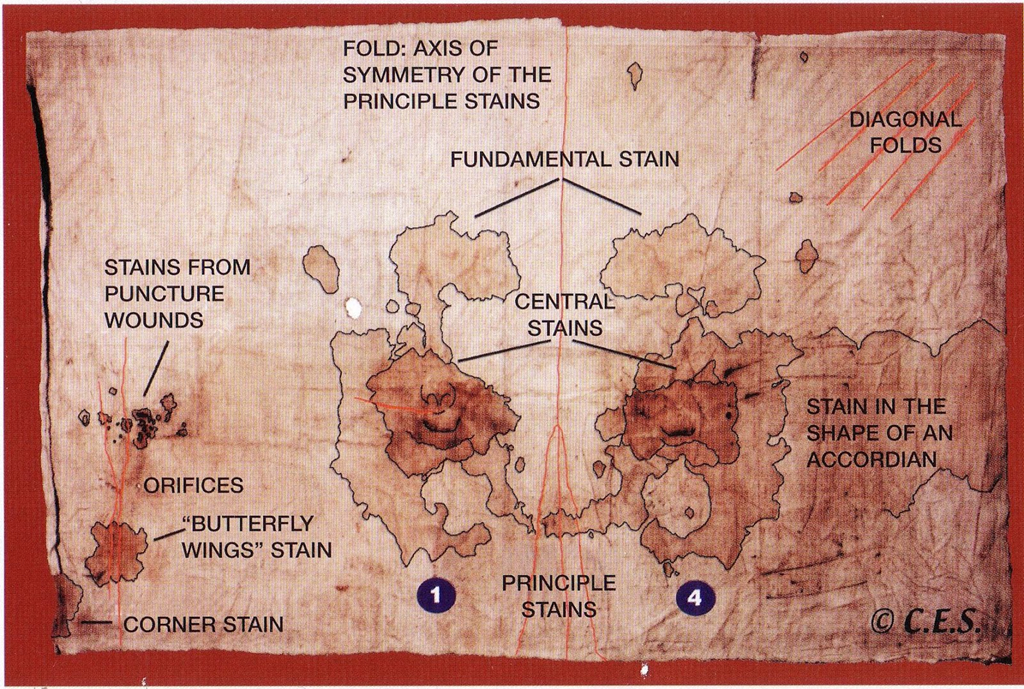
- John 20:7 and the face cloth (above) that had been around His head, not lying with the linen cloths, but folded together in a place by itself.
- Unlike the Shroud, the face cloth does not display an image, but it contains male blood of type AB, which matches the blood on the Shroud. Moreover, the pattern of blood-flow on the face cloth is consistent with those of a crucified man.
- Some have questioned whether blood type AB existed at the time of Christ. Such questions have been settled by the discovery of this blood type in skeletal remains that are approximately 1,600-2,000 years old (Am. J. Phys. Anthrop. 47: 89-91, 1977), and in tissues of mummies from 3 BC up to the 4th century (Forensic Science International, 43: 113-124, 1989). These studies were done using serological methods (antibodies), which recognize the ABO molecules on the surfaces of blood cells.
https://texasknight-news.net/articles/2021-3-the-shroud-of-turin
- Some have questioned whether blood type AB existed at the time of Christ. Such questions have been settled by the discovery of this blood type in skeletal remains that are approximately 1,600-2,000 years old (Am. J. Phys. Anthrop. 47: 89-91, 1977), and in tissues of mummies from 3 BC up to the 4th century (Forensic Science International, 43: 113-124, 1989). These studies were done using serological methods (antibodies), which recognize the ABO molecules on the surfaces of blood cells.
7. POLLEN
Around the head on the shroud is pollen from the plant Gundelia tournefortii: called “thumb thistle”.
Plant‘s place of origin Israel; calphotos.berkeley.edu › cgi › img_queryGundelia tournefortii
Photo Below: Gundelia tournefortii

Note: The timing of the crucifixion and the timing of the pollen below:
 August 3, 1999
- Botanist Avinoam Danin of The Hebrew University of Jerusalem determined the origin of the Shroud based on a comprehensive analysis of pollen taken from the Shroud and plant images associated with the Shroud. The review of plant and pollen evidence is being published by the Missouri Botanical Garden Press as Flora of the Shroud of Turin by Danin, Alan Whanger, Mary Whanger , and Uri Baruch. ..
Danin presented his research findings at a lecture series held in conjunction with the XVI International Botanical Congress.
Analysis of the floral images by Danin and an analysis of the pollen grains by Uri Baruch identify a combination of certain species that could be found only in the months of March and April in the region of Jerusalem during that time. The analysis positively identifies a high density of pollen of the thistle Gundelia tournefortii which has bloomed in Israel between March and May for millennia. An image of the plant can be seen near the image of the man’s shoulder. It has been hypothesized by the Whangers, who have researched the Shroud for decades, that this is the plant used for the “crown of thorns” on Jesus’ head.
- Botanist Avinoam Danin of The Hebrew University of Jerusalem determined the origin of the Shroud based on a comprehensive analysis of pollen taken from the Shroud and plant images associated with the Shroud. The review of plant and pollen evidence is being published by the Missouri Botanical Garden Press as Flora of the Shroud of Turin by Danin, Alan Whanger, Mary Whanger , and Uri Baruch. ..
- Two pollen grains of Gundelia tournefortii were also found on the widely accepted burial face cloth of Jesus.
https://www.sciencedaily.com/releases/1999/08/990803073154.htm
- The place matches the crucifixion. Pollen on the Shroud is unique (only) to the Jerusalem area.
Another type of flower is like a clock, telling the time when Jesus was removed from the cross, images of these flowers are shown on the shroud.
Capparis aegyptia flowers, which display a distinctive pattern during daylight hours, have also been seen on the Shroud. The process of buds opening ceases when the flowers are picked and no water is supplied. The images of these flowers on the Shroud suggest they were picked in the Judean Desert or the Dead Sea Valley between 3 and 4 p.m. on the day they were placed on the Shroud.
https://www.sciencedaily.com/releases/1999/08/990803073154.htm

The Judean desert lies next to Jerusalem.
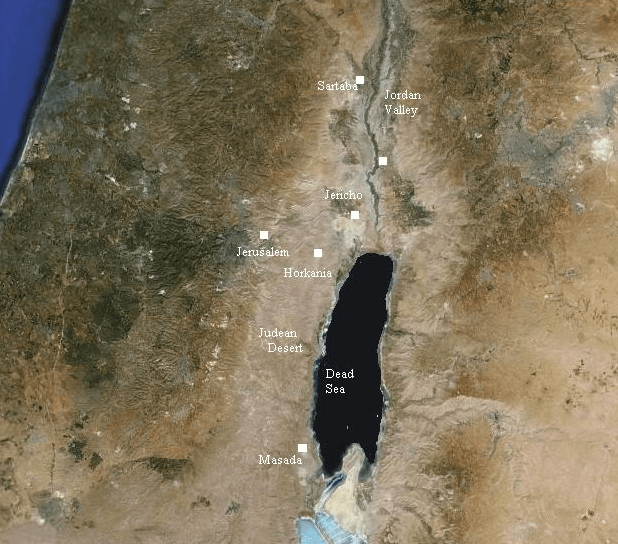
Researchers used pollen and plant images to conclude that the shroud dates from Jerusalem before the 8th century. Additionally, the same pollen grains on the face cloth is known to date back to the 1st century. We have identified by images and by pollen grains species, the shroud is restricted to the vicinity of Jerusalem,” botany professor Avinoam Danin of The Hebrew University of Jerusalem said during an International Botanical Congress at the university. He continues: “The sayings that the shroud is from European origin can’t hold.” See article: “Study dates Shroud of Turin to before 8th century,” CNN/AP report, August 3, 1999.
8. THE FACE CLOTH
THE FACE CLOTH MATCHES THE SHROUD in stains, pollen, blood type, and patterns.
The blood on the Turin Shroud matches the blood on the face cloth. Both belong to the rare AB group, in spite of the fact the two cloths were in different places over the centuries. Not only is the bloodstain a match, but so is the pattern of pre-mortem and post-mortem blood.
The length of the nose through which oedema fluid flowed onto the face cloth is exactly the same length as the nose on the Turin Shroud.
If the face of the image of the Shroud is superimposed over the stains on the face cloth, there is an exact correspondence of facial and neck stains (seventy points with the front image on the Shroud and fifty points with the rear side image—a total of 120 points).
The face cloth is also covered with aloe, which was used in first-century Jewish burials as a preservative. St. John testifies that Nicodemus brought 100 pounds of aloes and myrrh to anoint Jesus.
In the case of severe trauma and when blood flowed at the time of death, Jewish law mandated use of a sudarium (face cloth) to retrieve the victim’s blood. Since blood was viewed as the “seat of life,” it was unthinkable to move a disfigured corpse without covering it, and it was imperative not to lose the blood because it was just as much a part of the body as the flesh. Burial of the blood was required, even to the extent of digging up blood-soaked earth and interring bloodstained clothes and linens.
https://www.simplycatholic.com/face-cloth-of-jesus-burial-the-sudarium-of-oviedo/
- The “seat of life”: The life is in the blood.
Leviticus 17:11 For the life of the flesh is in the blood, and I have given it to you upon the altar to make atonement for your souls; for it is the blood that makes atonement for the soul.’
Since Jesus is the only crucifixion victim reportedly crowned with thorns. The Shroud of Turin has in fact a distinctive trickle of blood on the forehead in the shape of the Greek letter epsilon, which appears above a drop of the same blood, from a puncture wound. This pattern appears on the Face Cloth in exactly the same place.
9. CONCLUSIONS concerning the comparisons between the shroud and the face cloth:
“the blood types match, the wound marks match, the facial features and measurements coincide…” (Mary Jo Anderson, “The Other Shroud of Christ,”). These coincidences indicate that, in all likelihood, the man whose head was wrapped by the facecloth and the man whose corpse was wrapped in the Shroud of Turin were one and the same person.
10. A MICROSCOPIC AMOUNT OF DIRT IS FOUND IN ABRASIONS ON THE NOSE AND ON ONE KNEE.
Mark 15:21 Then they compelled a certain man, Simon a Cyrenian, the father of Alexander and Rufus, as he was coming out of the country and passing by, to bear His cross. 22 And they brought Him to the place Golgotha, which is translated, Place of a Skull.
The abrasions explain the need for Simon of Cyrene to carry His cross: Jesus must have been too weak to carry the cross Himself and, upon falling down, hurt his knee and nose ,which made the Romans realize they had to find someone else carry the cross to Golgotha.
11. THE BLOOD
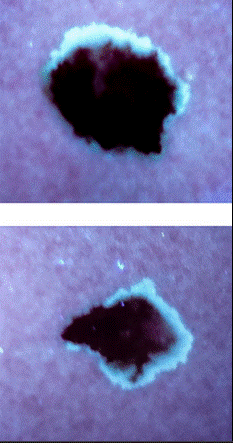
- Serum Rings:
- Invisible serum rings are seen only with ultraviolet light around the blood from the scourge marks.
- Blood Type:
- Blood Type AB matches both the Shroud and the Face Cloth.
- Bilirubin
- Bilirubin is a yellowish substance in your blood. It forms after red blood cells break down. The high concentration of bilirubin in the blood stains of the Shroud identify the many traumas suffered by Jesus, before his death.
- Consistent with bodily response to extreme trauma (so a previous corpse could not have been used to create the image).
- Red Pigment
- Repeated scientific tests by independent experts have shown the red pigment to be a product of the breakdown of red blood cells. Bloodstains are evident about the head area, the wrists and the feet, the side, and the back. Each individual blood wound shows a distinct serum clot retraction ring; and such blood halos are only visible under ultraviolet light, a detail that a forger is unlikely to have been familiar with. Over ten different chemical tests have established that these markings are indeed bloodstains and contain specific blood components, including hemoglobin, bilirubin, and albumin.
- Not only is the bloodstain a match, but so is the pattern of pre-mortem and post-mortem blood between the shroud and the face cloth.
- Blood stains were on the cloth before the image was made.
- In other words, Jesus’ blood touched the cloth before His resurrection when the image exploded in radiation on the cloth.
12. MICROSCOPIC LIMESTONE IN THE DIRT FROM THE FEET
- Microscopic chips of limestone were found near the feet on the shroud matching the type in Jerusalem dirt.
13. WRITINGS ON THE CLOTH
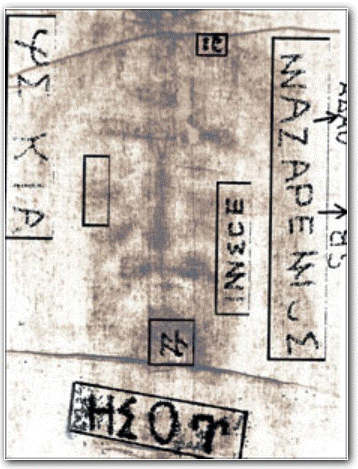
In 1979 Italian scientist Piero Ugolotti claimed to have found Greek and Latin letters on the shroud written near the face of the image. These were further studied in 1997 by Professor André Marion, whose digital analysis reportedly revealed other writings, including: INNECEM (a shortened form of Latin “in necem ibis”—”you will go to death”), NNAZAPE(N)NUS (Nazarene), IHSOY (Jesus) and IC (Iesus Chrestus). The uncertain letters IBE(R?) have been conjectured as “Tiberius”.
In 2009, Barbara Frale, a paleographer in the Vatican Secret Archives, stated that it is possible to read on the image the burial certificate of Jesus of Nazareth, imprinted in fragments of Greek, Hebrew and Latin writing. She stated the text on the shroud reads: “In the year 16 of the reign of the Emperor Tiberius Jesus the Nazarene, taken down in the early evening after having been condemned to death by a Roman judge because he was found guilty by a Hebrew authority, is hereby sent for burial with the obligation of being consigned to his family only after one full year.” Since Tiberius became emperor after the death of Octavian Augustus in AD 14, the 16th year of his reign would be within the span of the years AD 30 to 31.
https://www.abroadintheyard.com/shroud-of-turin-1st-century-relic-or-medieval-forgery/
- This confirms the following:
- The name Jesus is ON the shroud
- He died in 31 AD
- The confirmation of the years of Tiberius’ reign (Luke chapter 3)
- His ministry was from 29 AD to 31 AD
- The writing in 3 different languages of the sign over Jesus’ head match the languages of his death certificate.
- John 29:20 JESUS OF NAZARETH, THE KING OF THE JEWS. Then many of the Jews read this title, for the place where Jesus was crucified was near the city; and it was written in Hebrew, Greek, and Latin.
Click Here to See: Topic: Chart of Jesus’ Crucifixion Week collaborating His death in 31 AD. Sample below:
This Document includes both Roman and Jewish Dates, shaded to indicate Evenings. 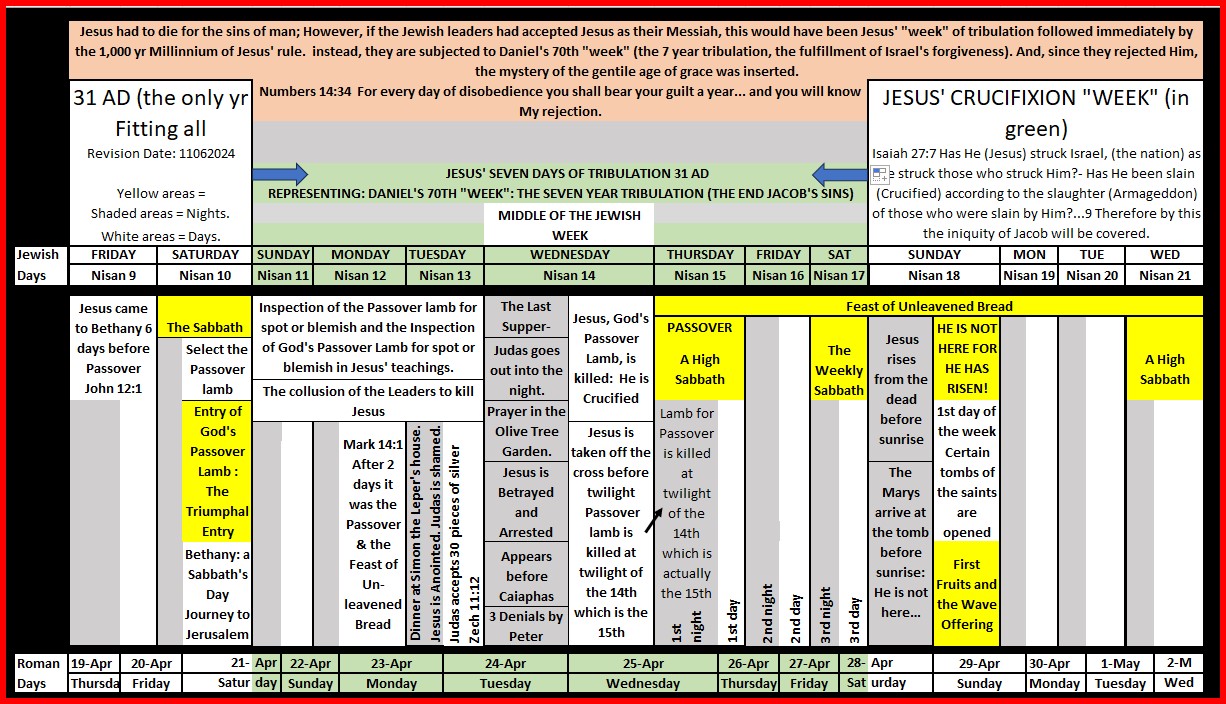
See Luke chapter 3 for the Baptism date of Jesus being 29 AD. (Side Note: the same year as the date on one of the coins over Jesus’ right eye)
Luke 3:1 Now in the fifteenth year of the reign of Tiberius Caesar (29 AD)
(Tiberius Caesar reigned 14 AD to 37 AD)
* The 16th year follows at 30 to 31 AD.
14. CRUCIFIXION IN THE WRISTS:
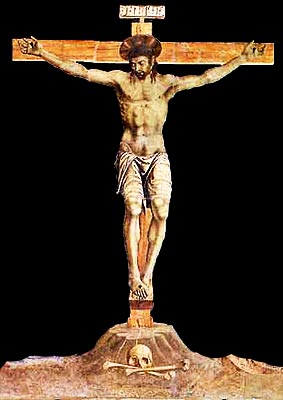
- The nails in the wrists fold the thumbs under, contrary to paintings from the Middle Ages where painters put the nails in the palm of the hand. The painters believed this is how He was crucified, but the palms would not hold a body on a cross.
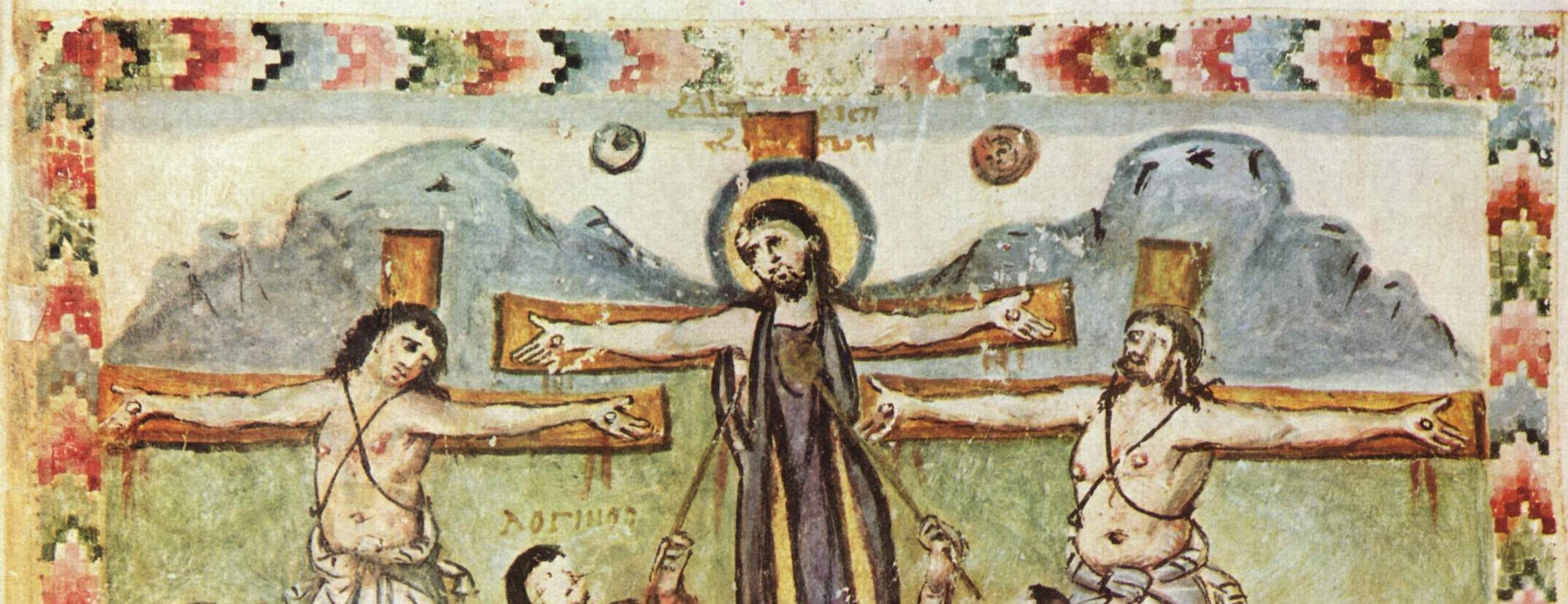
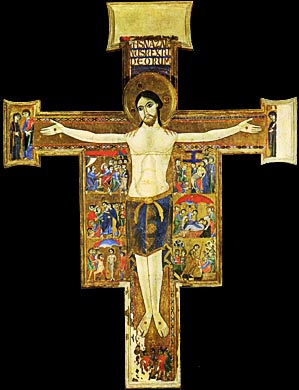
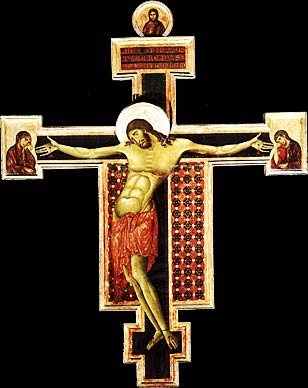
Crucifix Cimabu 1270
15) STITCHING OF THE SHROUD
A stitch unique to the first century was used to sew the three-inch wide side strip to the main shroud where the original sample was taken.
Note Below: One illustration within the Pray Codex shows the burial of Jesus. It is sometimes claimed that the display shows remarkable similarities with the Shroud of Turin: that Jesus is shown entirely naked with the arms on the pelvis, just like in the body image of the Shroud of Turin, that the supposed fabric shows a herringbone pattern, identical to the weaving pattern of the Shroud of Turin, that the four tiny circles on the lower image, which appear to form a letter L, “perfectly reproduce four apparent “poker holes” on the Turin Shroud”, which likewise appear to form a letter L.

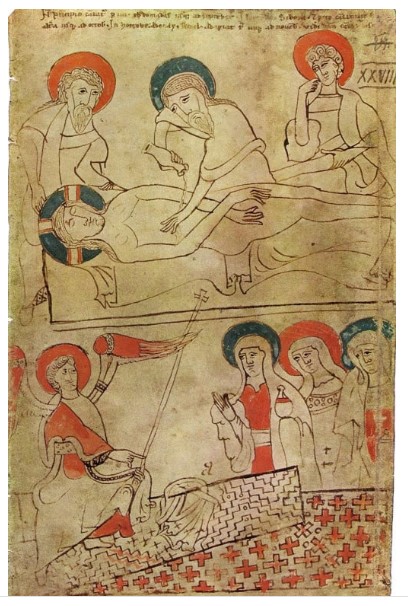
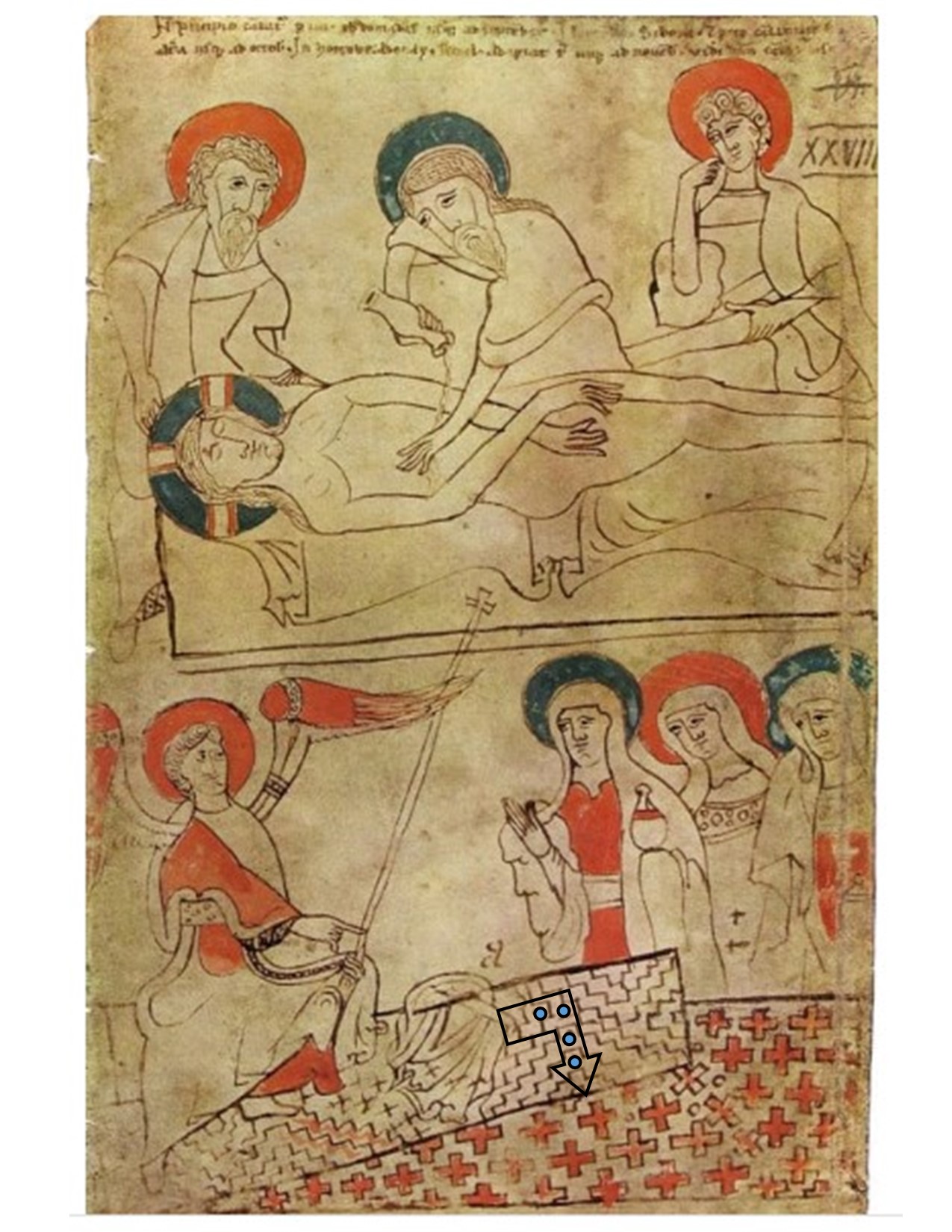
Above: The painting illustrates the three Marys arriving at the tomb to anoint Jesus with spices. An angel points out a wadded up cloth which is left discarded. He is not here, he is risen. Above them, Jesus appears to still be dead but three men are anointing him, Jesus’ thumbs are hidden like the image on the shroud. The Juxtaposition of the arms matches the shroud. The pattern of the Herringbone weave is illustrated. above. The burnt poker holes are outlined in order to help the reader see the poker hole pattern that matches the shroud.
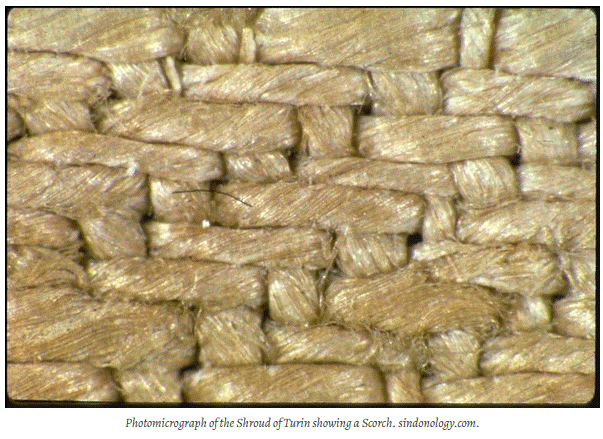
Note above: Herringbone pattern with scorch magnified.
16) COVALENT BONDING
The image on the shroud is based on a change in the covalent bonding of the carbon atoms in the cellulose molecules.
The bonds that hold atoms together to form molecules are called covalent bonds. They are pretty tough and not easily made or broken apart. It takes energy to make the bonds – energy is released when the bonds are broken.
Trees take light and use it to make bonds between carbon atoms and molecules of cellulose. If we burn wood, those bonds are broken and we get heat and some light.
(Note: If a man was risen from the dead, it is not mental gymnastics to understand energy would be released from the process of breaking apart the covalent bonding in the molecules.)
17) 3D INFORMATION CREATING A QUANTUM JESUS
The shroud is a negative image with 3D information content in the image which is not understood and cannot be replicated.
Formation of the image on the Shroud: The image was not formed by dyes, chemicals, vapors or scorching. The only known explanation for the formation of the image is an intense burst of vacuum ultraviolet radiation (equivalent to the output of 14,000 excimer lasers) emitted from every three-dimensional point of the body in the Shroud.
https://www.simplycatholic.com/shroud-of-turin-evidence-of-jesus-resurrection/
If you believe, as I do, that the shroud is evidence of a resurrection as scripture declares, then this is hallelujah news! To believe is not just a matter of thoughts, its also a matter of actions. It is incumbent upon men to discover this miraculous Jesus who has declared much more than just a future resurrection but eternal life. He has also given statements of truth about how to be part of this coming resurrection:
- There is no way you are going to be resurrected unless you go through Him ONLY. No other belief system will save you.
John 14:6 Jesus said to him, “I am the way, the truth, and the life. No one comes to the Father except through Me. - It also means you have to know His Truths. That he died, was buried, and rose again on the third day.
1 Corinthians 15:1 The Risen Christ, Faith’s Reality -Moreover, brethren, I declare to you the gospel which I preached to you, which also you received and in which you stand … 3 For I delivered to you first of all that which I also received: that Christ died for our sins according to the Scriptures, 4 and that He was buried, and that He rose again the third day according to the Scriptures, - This means you are baptized into a life of “death to self” in order to serve Him.
Matthew 20:22-23 But Jesus answered and said, “You do not know what you ask. Are you able to drink the cup that I am about to drink, and be baptized with the baptism that I am baptized with?” They said to Him, “We are able.” So He said to them, “You will indeed drink My cup, and be baptized with the baptism that I am baptized with; but to sit on My right hand and on My left is not Mine to give, but it is for those for whom it is prepared by My Father.”
18) HOW THE SHROUD WAS NOT MADE:
The image does not contain any silver compounds. This eliminates a photographic process by a forger.
Since the image is not luminescent under ultra violet light, it means the image could not have been caused by a forger using contact with a hot object.
If it were a painting the image would have to be made with without pigment, carrier, brush strokes, or clumping of material between the fibers or threads, and no cracking due to centuries of folding or rolling the Shroud. The image could not be due to paint or stain.
19) THE RESURRECTION:
20) PAINTINGS OF THE SHROUD OVER THE AGES:
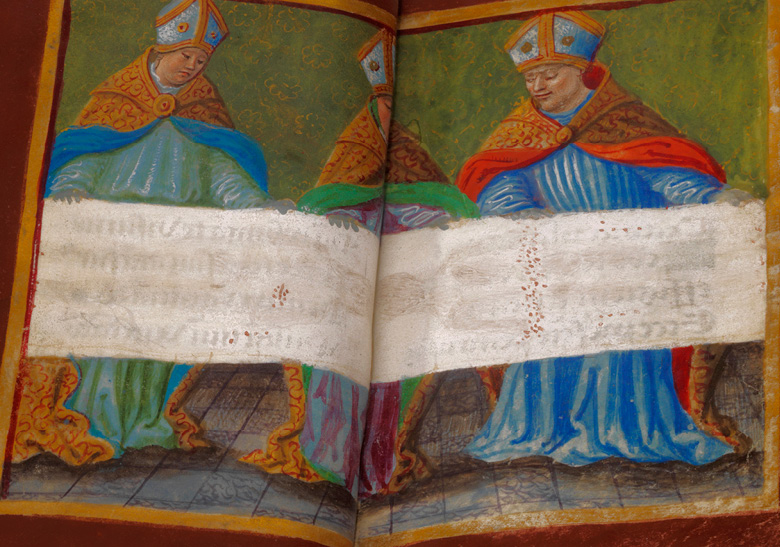
Above: The importance of Donandoni’s discovery is that the Shroud is shown undamaged by a fire that occurred in 1532 AD and left the cloth marred with large burnt areas. A group of Poor Clare nuns tried to repair some of the damage, but to this day the Shroud shows patches and numerous burnt marks. This may be the earliest painting of the shroud. It appears to have the feet shown separately instead of one over the other as they are shown on the shroud.
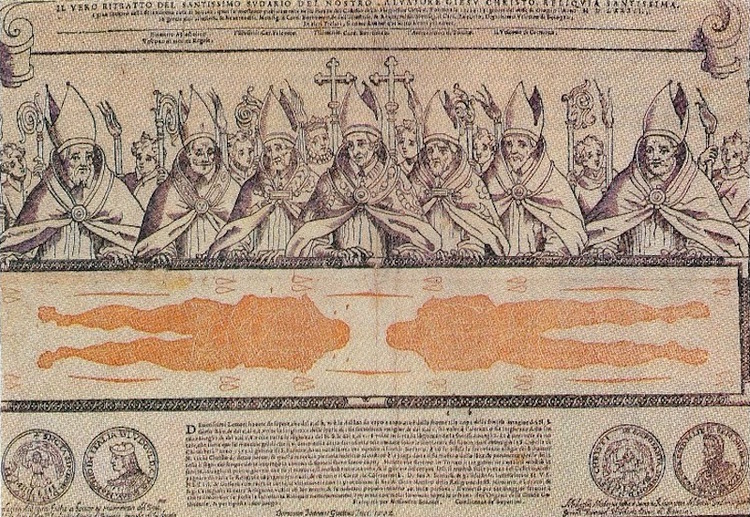
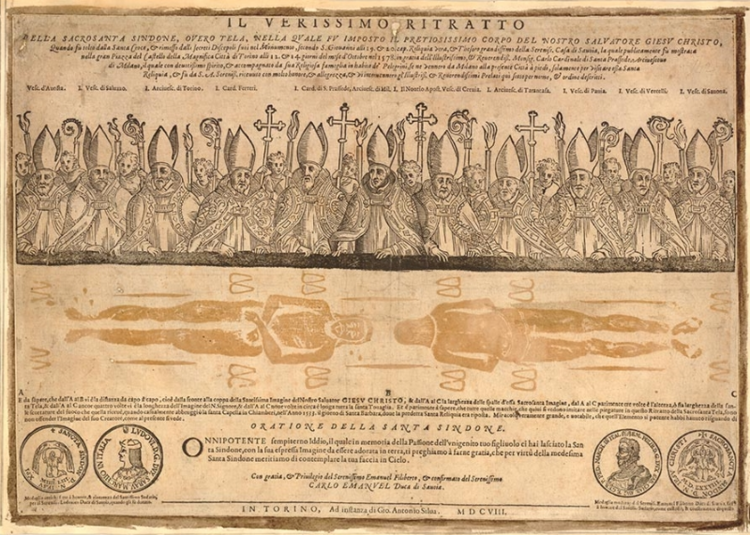
The printing press is often said to have been created by Gutenberg in Mainz, Germany, around 1440 AD, and it began taking root in Europe in the 1450s with the printing of the Gutenberg Bible.
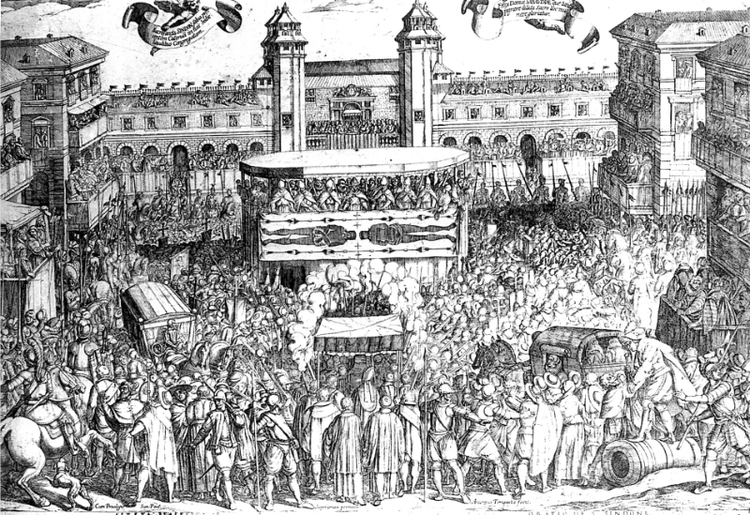
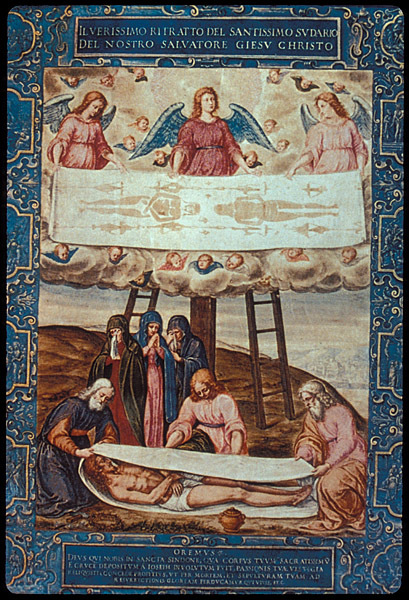
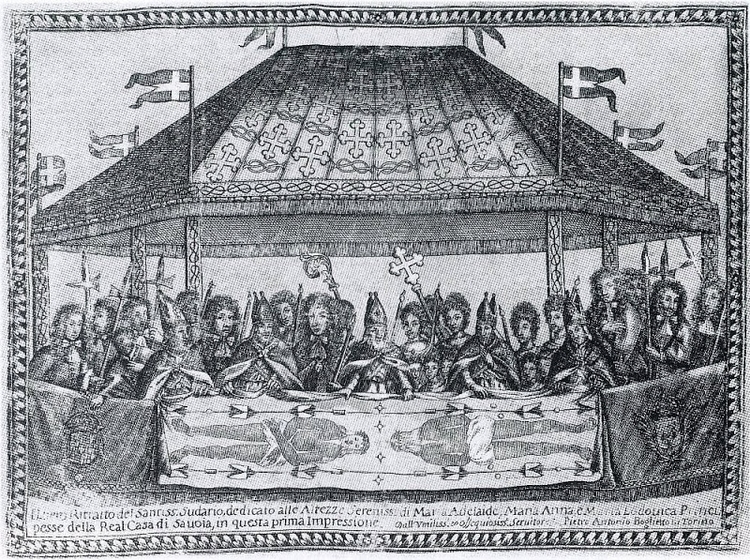
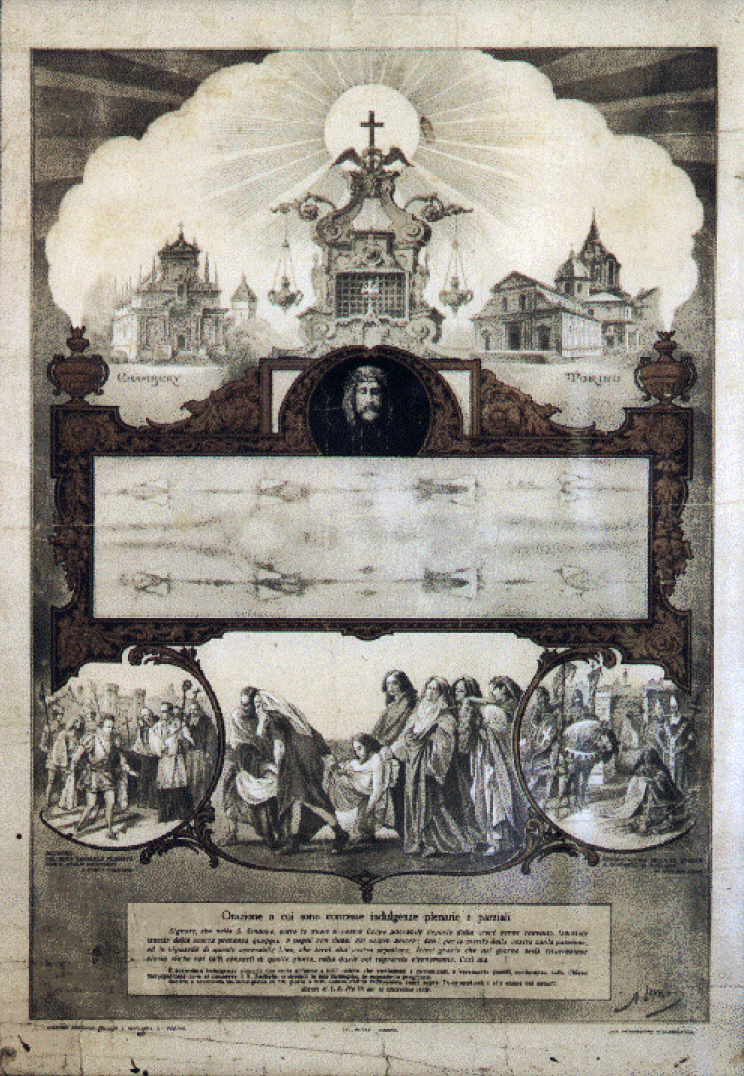
21) THE CROWN OF THORNS
The man on the shroud suffered head wounds caused by a “helmet” of thorns, something a medieval forger isn’t likely to have imagined, since the Gospels refer only to a “crown of thorns.”
22) ROBERT RUCKER
Robert Rucker, a nuclear physicist and Shroud Specialist is quoted in the Catholic News Agency for his research, participation, papers, videos, and seminars with specialists from around the globe.
23) THE ARCHEOLOGIST
New Findings Reinforce the Authenticity of the Shroud as Being Consistent with the Description of Jesus in the Garden of Gethsemane and subsequent beatings and crucifixion.
“in 2017, another team from the Institute of Crystallography found evidence of blood from a torture victim on the shroud, identifying substances like creatinine and ferritin, which are typically present in victims of severe trauma. These findings contradict the theory that the image was painted by medieval forgers.”
CONCLUSION
The evidence for the authenticity of the Shroud is now proven beyond speculation – deemed valid for any reasonable thinker; it continues to be a mystery only in the fact that it still cannot be duplicated.
 Quantum Study Bible