
Words in italic type have been added for clarity. They are not found in the original Hebrew or Aramaic.
II Kings 24
- See Timeline: 501 BC – 770 BC Scroll to 570 BC The transition of the conquered Pharaoh Apries to Amasis.
 Judah Overrun by Enemies
- Review: God instructed the kings of Judah to submit to King Nebuchadnezzar for seventy years – then they would be free to return. Each king refused to submit until the city and the temple were destroyed, and all the inhabitants taken to Babylon as captives.
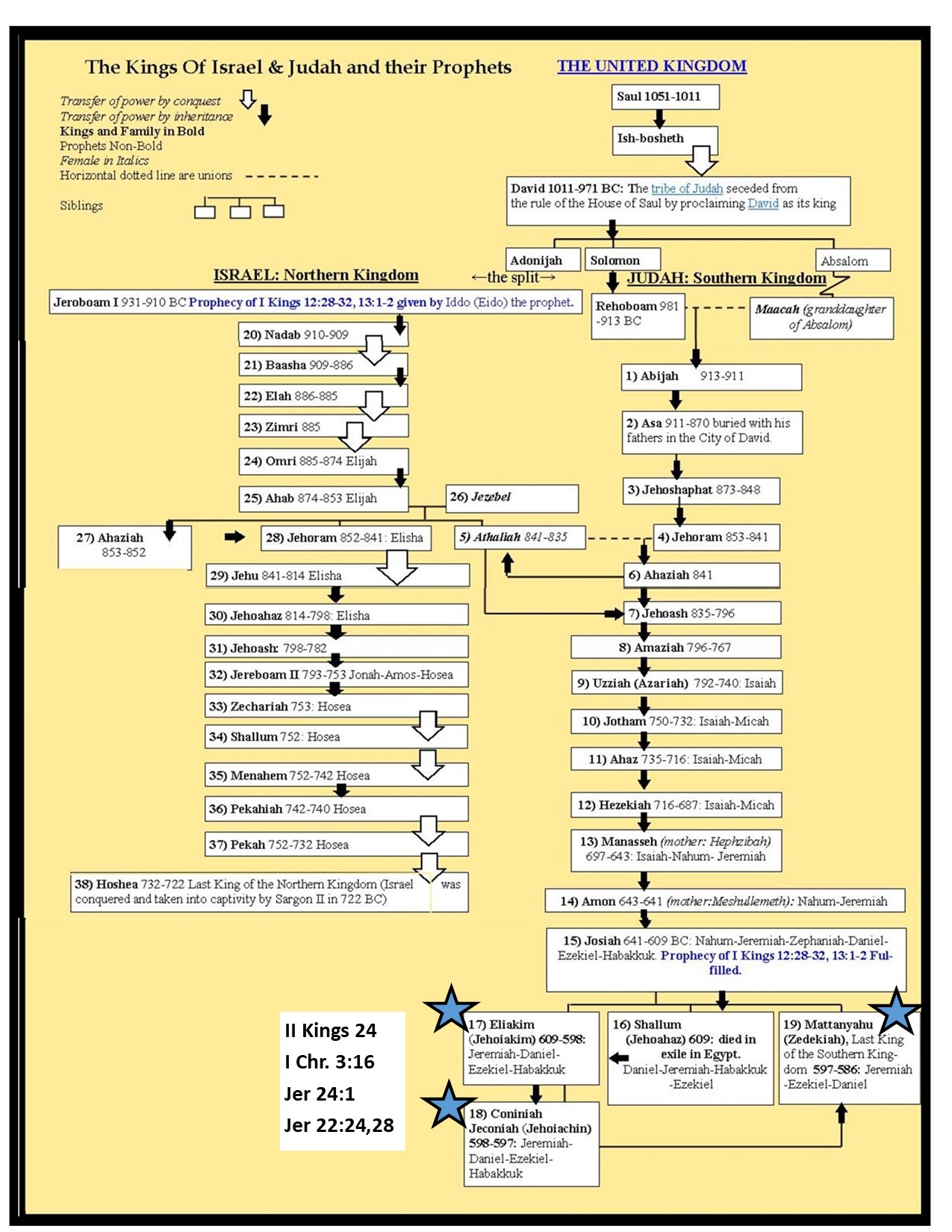
II Kings 24:1 In his days Nebuchadnezzar king of Babylon came up, and Jehoiakim became his vassal for three years. Then he turned and rebelled against him.
II Kings 24:2 And the Lord (Yᵊhōvâ) sent against him raiding bands (troops) of Chaldeans, bands of Syrians, bands of Moabites, and bands of the people of Ammon; He sent them against Judah to destroy it, according to the word of the Lord (Yᵊhōvâ) which He had spoken by His servants the prophets.
II Kings 24:3 Surely at the commandment of the Lord (Yᵊhōvâ) this came upon Judah, to remove them from His sight because of the sins of Manasseh, according to all that he had done,
II Kings 24:4 and also because of the innocent blood that he had shed; for he had filled Jerusalem with innocent blood, which the Lord (Yᵊhōvâ) would not pardon.
II Kings 24:5 Now the rest of the acts of Jehoiakim, and all that he did, are they not written in the book of the chronicles of the kings of Judah?
II Kings 24:6 So Jehoiakim rested with his fathers. Then Jehoiachin his son reigned in his place.
II Kings 24:7 And the king of Egypt did not come out of his land anymore, for the king of Babylon had taken all that belonged to the king of Egypt from the Brook of Egypt to the River Euphrates.
The Reign and Captivity of Jehoiachin
II Kings 24:8 Jehoiachin was eighteen years old when he became king, and he reigned in Jerusalem three months.
- Note: Jehoiachin (aka Jeconiah, 1 Chr. 3:16; Jer. 24:1; or Coniah, Jer. 22:24, 28)
His mother’s name was Nehushta the daughter of Elnathan of Jerusalem.
II Kings 24:9 And he did evil in the sight of the Lord (Yᵊhōvâ), according to all that his father had done.
II Kings 24:10 At that time the servants of Nebuchadnezzar king of Babylon came up against Jerusalem, and the city was besieged (Lit. came into siege).
II Kings 24:11 And Nebuchadnezzar king of Babylon came against the city, as his servants were besieging it.
II Kings 24:12 Then Jehoiachin king of Judah, his mother, his servants, his princes, and his officers went out to the king of Babylon; and the king of Babylon, in the eighth year of his reign, took him prisoner.
- “And indeed the prophet Jeremiah foretold every day, how vainly they relied on their hopes from Egypt, and how the city would be overthrown by the king of Babylon, and Jehoiakim the king would be subdued by him.” Antiquities of the Jews Book X Ch 6:2
- http://www.ccel.org/j/josephus/works/ant-10.htm
- Jehoiachin was taken prisoner with his family, servants, staff and officers.
- JEHOIACHIN RELEASED FROM PRISON AFTER 37 YEARS (562 BC)
Jeremiah 52;31 Now it came to pass in the 37th year of the captivity of Jehoiachin king of Judah, in the 12th month, on the 25th day of the month, that Evil-Merodach king of Babylon, in the first year of his reign, lifted up the head of Jehoiachin king of Judah and brought him out of prison.
The Captivity of Jerusalem
II Kings 24:13 And he carried out from there all the treasures of the house of the Lord (Yᵊhōvâ) and the treasures of the king’s house, and he cut in pieces all the articles of gold which Solomon king of Israel had made in the temple of the Lord (Yᵊhōvâ), as the Lord (Yᵊhōvâ) had said.
- These are more of the vessels from the temple which his grandson Belshazzar used for his great feast in Daniel chapter 5.
II Kings 24:14 Also he carried into captivity all Jerusalem: all the captains and all the mighty men of valor, ten thousand captives, and all the craftsmen and smiths. None remained except the poorest people of the land.
II Kings 24:15 And he carried Jehoiachin captive to Babylon. The king’s mother, the king’s wives, his officers, and the mighty of the land he carried into captivity from Jerusalem to Babylon.
II Kings 24:16 All the valiant men, seven thousand, and craftsmen and smiths, one thousand, all who were strong and fit for war, these the king of Babylon brought captive to Babylon.
Zedekiah Reigns in Judah
II Kings 24:17 Then the king of Babylon made Mattaniah, Jehoiachin’s (Lit. his) uncle, king in his place, and changed his name to Zedekiah.
II Kings 24:18 Zedekiah was twenty-one years old when he became king, and he reigned eleven years in Jerusalem. His mother’s name was Hamutal the daughter of Jeremiah of Libnah.
II Kings 24:19 He also did evil in the sight of the Lord (Yᵊhōvâ), according to all that Jehoiakim had done.
II Kings 24:20 For because of the anger of the Lord (Yᵊhōvâ) this happened in Jerusalem and Judah, that He finally cast them out from His presence. Then Zedekiah rebelled against the king of Babylon.
- Zedekiah hoped Egypt’s Pharaoh Hophra (Apries) would come to Judah’s defense and fight the Babylonians. Apries failed to help his ally King Zedekiah of Judah against the invading armies of Nebuchadrezzar II of Babylon, but after the fall of Jerusalem he received many Jewish refugees into Egypt (perhaps including Jeremiah). Later, according to Herodotus, he took the Phoenician port of Sidon, but, because of his subsequent failure in an attack on Cyrene in Libya, the Egyptian army mutinied and elected their general Amasis as king instead (570 BC). Apries was imprisoned but escaped; he later was murdered, perhaps by Egyptians.
- The prophet Jeremiah warned Zedekiah the Egyptians would be of no help.
- In 1935 an archaeologist unearthed several letters, written ~588 BC on 21 pottery pieces from among the burned ruins of the ancient city of Lachish of Judea. These letters were desperate pleas by the Judean defender for military assistance from Egypt. One of the letters mentions that no fire signals from Azekah (another defensive city) could be seen. [See Jeremiah 37]
The Lachish Letters
- The Lachish Letters or Lachish Ostraca, sometimes called Hoshaiah Letters, are a series of letters written in carbon ink containing ancient Israelite inscriptions in Ancient Hebrew on clay ostraca. The letters were discovered at the excavations at Lachish (Tell ed-Duweir).
- The ostraca were discovered by James Leslie Starkey in January–February 1935, during the third campaign of the Wellcome excavations. They were published in 1938 by Harry Torczyner (name later changed to Naftali Herz Tur-Sinai) and have been much studied since then. Seventeen of them are currently located in the British Museum in London, a smaller number (including Letter 6) are on permanent display at the Rockefeller Museum in East Jerusalem. The primary inscriptions are known as KAI 192–199.
- The individual ostraca probably come from the same broken clay pot and were most likely written in a short period of time. They were written to Yaush (or Ya’osh), possibly the commanding officer at Lachish, from Hoshaiah (Hoshayahu), a military officer stationed in a city close to Lachish (possibly Mareshah). In the letters, Hoshaiah defends himself to Yaush regarding a letter he either was or was not supposed to have read. The letters also contain informational reports and requests from Hoshaiah to his superior. The letters were probably written shortly before Lachish fell to the Babylonian army of King Nebuchadnezzar II in 588/6 BC during the reign of Zedekiah, king of Judah (ref. Jeremiah 34:7).
.jpg)
- Letter Number 1
Gemariah son of Hissilyahu, Jaazaniah son of Tobshillem, Hageb son of Jaazaniah, Mibtahyahu son of Jeremiah, Mattaniah son of Neriah.
- Letter Number 2
To my lord, Ya’ush, may YHWH cause my lord to hear tiding(s) of peace today, this very day! Who is your servant, a dog, that my lord remembered his [se]rvant? May YHWH make known(?) to my [lor]d a matter of which you do not know.
- Letter Number 3
Your servant, Hoshaiah, sent to inform my lord, Ya’ush: May YHWH cause my lord to hear tidings of peace and tidings of good. And now, open the ear of your servant concerning the letter which you sent to your servant last evening because the heart of your servant is ill since your sending it to your servant. And inasmuch as my lord said “Don’t you know how to read a letter?” As YHWH lives if anyone has ever tried to read me a letter! And as for every letter that comes to me, if I read it. And furthermore, I will grant it as nothing. And to your servant it has been reported saying: The commander of the army Coniah son of Elnatan, has gone down to go to Egypt and he sent to commandeer Hodaviah son of Ahijah and his men from here. And as for the letter of Tobiah, the servant of the king, which came to Shallum, the son of Jaddua, from the prophet, saying, “Be on guard!” your ser[va]nt is sending it to my lord.
- Notes: This ostracon is approximately fifteen centimeters tall by eleven centimeters wide and contains twenty-one lines of writing. The front side has lines one through sixteen; the back side has lines seventeen through twenty-one. This ostracon is particularly interesting because of its mentions of Konyahu, who has gone down to Egypt, and the prophet. For possible biblical connections according to Torczyner, reference Jeremiah 26:20–23.
- Letter Number 4
May YHWH cause my [lord] to hear, this very day, tidings of good. And now, according to everything which my lord has sent, this has your servant done. I wrote on the sheet according to everything which [you] sent [t]o me. And inasmuch as my lord sent to me concerning the matter of Bet Harapid, there is no one there. And as for Semachiah, Shemaiah took him and brought him up to the city. And your servant is not sending him there any[more —], but when morning comes round [—]. And may (my lord) be apprised that we are watching for the fire signals of Lachish according to all the signs which my lord has given, because we cannot see Azeqah.
- Letter Number 5
May YHWH cause my [lo]rd to hear tidings of pea[ce] and of good, [now today, now this very da]y! Who is your servant, a dog, that you [s]ent your servant the [letters? Like]wise has your servant returned the letters to my lord. May YHWH cause you to see the harvest successfully, this very day! Will Tobiah of the royal family c[o]me to your servant?
- Letter Number 6
To my lord, Ya’ush, may YHWH cause my lord to see peace at this time! Who is your servant, a dog, that my lord sent him the king’s [lette]r [and] the letters of the officer[s, sayin]g, “Please read!” And behold, the words of the [officers] are not good; to weaken your hands [and to in]hibit the hands of the m[en]. [I(?)] know [them(?)]. My lord, will you not write to [them] sa[ying, “Wh]y are you behaving this way? […] well-being […]. Does the king […] And […] As YHWH lives, since your servant read the letters, your servant has not had [peace(?)].
- Letter Number 7
This letter contains 10 lines on one side and 4 on the other, but the letters are unreadable due to degradation.
- Letter Number 9
May YHWH cause my lord to hear ti[dings] of peace and of [good. And n]ow, give 10 (loaves) of bread and 2 (jars) [of wi]ne. Send back word [to] your servant by means of Shelemiah as to what we must do tomorrow.
 Quantum Study Bible