
Words in italic type have been added for clarity. They are not found in the original Hebrew or Aramaic.
Judges 4
- A woman in Hebrew is defined as “The Womb of a Man”. Deborah carries the story instead of a man. Jael gets the glory instead of the commander. In Hebrew thought, women represent the spiritual world while men represent the physical world. In marriage, the woman and the man together in marriage represent the union of the physical and the spiritual. The story of Deborah and Jael make this a spiritual story.
- Deborah is a Jew. Jael is a Gentile. Together they prophetically fight the evil forces of Jabin, King of Canaan and Sisera.
- Canaan is the Mideast where all end-time events occur.
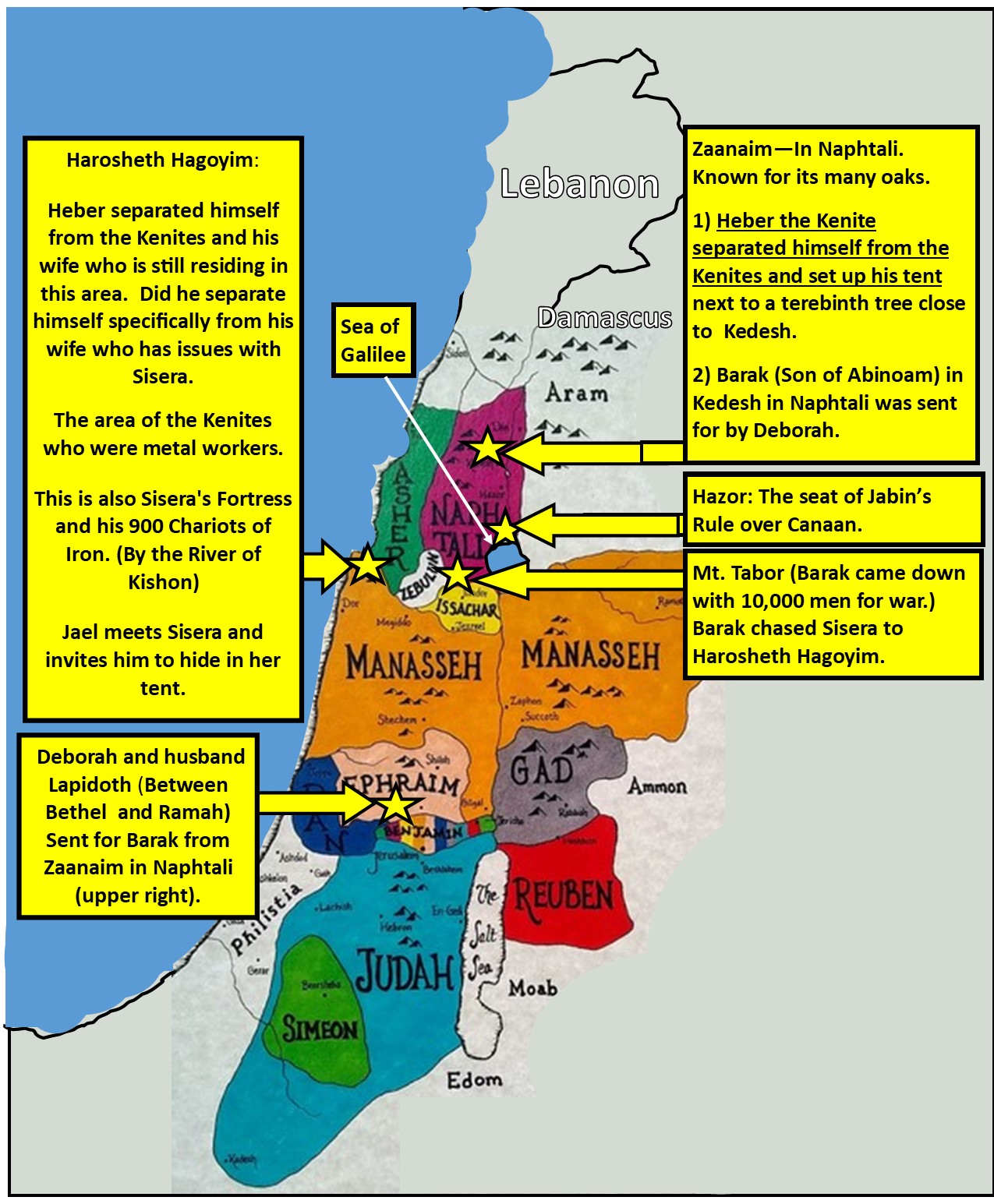
- Key:
Words with a light blue background are People - Words in dark blue background are Places
- Words in a red font are Things
Deborah
Judges 4:1 When Ehud was dead, the children of Israel again did evil in the sight of the Lord (Yᵊhōvâ). 2 So the Lord (Yᵊhōvâ) sold them into the hand of Jabin king of Canaan, who reigned in Hazor. The commander of his army was Sisera, who dwelt in Harosheth Hagoyim.
Judges 4:3 And the children of Israel cried out to the Lord (Yᵊhōvâ); for Jabin had nine hundred chariots of iron, and for twenty years he had harshly oppressed the children of Israel.
- 900 Chariots of Iron
- 20 Years he oppressed the Israelites.
The number “twenty” is symbolic for the Strength and Value of a Working Man/Men. - See Topic: Number Symbolism
Judges 4:4 Now Deborah, a prophetess, the wife of Lapidoth, was judging Israel at that time. 0400BA
Judges 4:5 And she (Deborah) would sit under the palm tree of Deborah between Ramah and in the mountains of Ephraim. And the children of Israel came up to her for judgment.
Judges 4:6 Then she sent and called for Barak the son of Abinoam from Kedesh in Naphtali, and said to him, “Has not the Lord God (Yᵊhōvâ ‘ĕlōhîm) of Israel commanded, ‘Go and deploy (Lit. draw) troops at Mount Tabor; take with you ten thousand men of the sons of Naphtali and of the sons of Zebulun; 7 and against you I will deploy Sisera, the commander of Jabin’s army, with his chariots and his multitude at the River Kishon; and I will deliver (march) him into your hand’?”
- Barak’s army was 10,000 men.
- Sisera’s army was defeated at the River Kishon.
Judges 4:8 And Barak said to her, “If you will go with me, then I will go; but if you will not go with me, I will not go!”
Judges 4:9 So she said, “I will surely go with you; nevertheless there will be no glory for you in the journey you are taking, for the Lord (Yᵊhōvâ) will sell Sisera into the hand of a woman.” Then Deborah arose and went with Barak to Kedesh. 10 And Barak called (the sons of) Zebulun and (the sons of) Naphtali to Kedesh; he went up with ten thousand men under his command (Lit. at his feet), and Deborah went up with him.
- Naphtali and Zebulun are both located around the Sea of Galilee.
- Barak’s army is 10,000 men.
Ten is the number for Accountability: Ordinal Perfection, Whole. - Ten is symbolic for the authority of God, stability, His government on earth and man’s responsibility to God.
- See Topic: Number Symbolism
Judges 4:11 Now Heber the Kenite, of the children of Hobab (the father-in-law of Moses), had separated himself from the Kenites and pitched his tent near the terebinth tree (a holy tree) at Zaanaim, which is beside Kedesh.
- Note: In Exodus, Moses’ father-in-law is initially referred to as “Reuel” (Exodus 2:18) but afterwards as “Jethro” (Exodus 3:1). He was also identified as Hobab in the Book of Numbers 10:29.
Judges 4:12 And they reported to Sisera that Barak the son of Abinoam had gone up to Mount Tabor.
- Heber may have been working on Sisera’s chariots of iron seeing that Kenites were metal workers.
Judges 4:13 So Sisera gathered together all his chariots, nine hundred chariots of iron, and all the people who were with him, from Harosheth Hagoyim (Carved Out -land of- the Gentiles) to the River Kishon.
- Harosheth Hagoyim: Sisera’s Fortress.
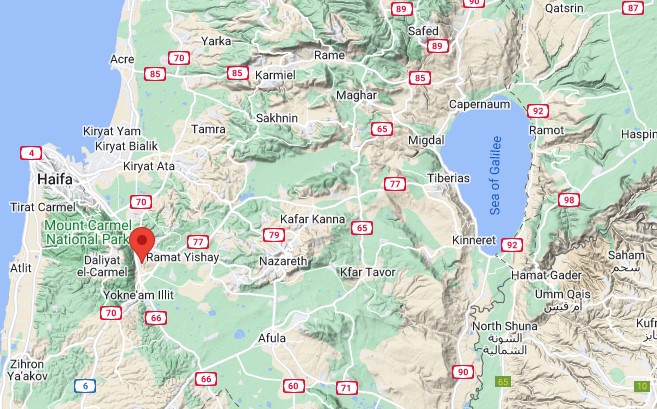
Judges 4:14 Then Deborah said to Barak, “Up! (Arise!) For this is the day in which the Lord (Yᵊhōvâ) has delivered Sisera into your hand. Has not the Lord (Yᵊhōvâ) gone out before you?” So Barak went down from Mount Tabor with ten thousand men following him.
Judges 4:15 And the Lord (Yᵊhōvâ) routed Sisera and all his chariots and all his army with the edge of the sword before Barak; and Sisera alighted from his chariot and fled away on foot. 16 But Barak pursued the chariots and the army as far as Harosheth Hagoyim, and all the army of Sisera fell by the edge of the sword; not a man was left.
- PROPHECY: A victory was led by Deborah and Barak against the Canaanites in the valley of Megiddo. Will there be parallels with man’s final battle at Armageddon (Megiddo) against the armies of the Lord?
What are the comparisons? - 1. Heber is an accuser.
- Satan has been cast down to earth during the tribulation. Satan’s name is “ha Satan” which means the Accuser.
Revelation 12:10 Then I heard a loud voice saying in heaven, “Now salvation, and strength, and the kingdom of our God, and the power of His Christ have come, for the accuser of our brethren (the Jews), who accused them before our God day and night, has been cast down.
- Satan has been cast down to earth during the tribulation. Satan’s name is “ha Satan” which means the Accuser.
- 2. Sisera comes from the place named for the abode of the Gentiles: Harosheth Hagoyim (Carved out for the Gentiles).
- The Antichrist, a gentile, rules over the Jews during the last half of the seven year tribulation. The Antichrist is the last Gentile who will rule over the Jews.
- Revelation 11:2 But leave out the court which is outside the temple, and do not measure it, for it has been given to the Gentiles. And they will tread the holy city underfoot for forty-two months.
- Revelation 13:5 And he was given a mouth speaking great things and blasphemies, and he was given authority to continue for forty-two months.
- Revelation 11:2 But leave out the court which is outside the temple, and do not measure it, for it has been given to the Gentiles. And they will tread the holy city underfoot for forty-two months.
- The Antichrist, a gentile, rules over the Jews during the last half of the seven year tribulation. The Antichrist is the last Gentile who will rule over the Jews.
- 3. Barak battles Sisera in the plain of Megiddo.
- Jesus battles the Antichrist (indwelt by Satan) in the plain of Megiddo.
- Jesus battles the Antichrist (indwelt by Satan) in the plain of Megiddo.
- 4. Sisera is chased through the Jezreel Valley
- Jesus will chase the Antichrist through the Jezreel Valley from Megiddo back to Jerusalem.
- Isaiah 27:1 Israel Will Be Restored
- In that day the Lord with His severe sword, great and strong, Will punish Leviathan (Satan indwelling the Antichrist) the fleeing serpent, Leviathan that twisted serpent; And He will slay the reptile that is in the sea (of people).
- Job 26:13 By His Spirit He adorned the heavens; His hand pierced the fleeing serpent.
- Zechariah 14:5 Then you shall flee through My mountain valley (from Megiddo), For the mountain valley shall reach to Azal (near Jerusalem). Yes, you shall flee As you fled from the earthquake In the days of Uzziah king of Judah. Thus the Lord my God will come, And all the saints with You.
- Jesus will chase the Antichrist through the Jezreel Valley from Megiddo back to Jerusalem.
- 5. Deborah is a judge.
- God will judge the nations who come against His people.
- Revelation 11:18 The nations were angry, and Your wrath has come, And the time of the dead, that they should be judged, And that You should reward Your servants the prophets and the saints, And those who fear Your name, small and great, And should destroy those who destroy the earth.”
- God will judge the nations who come against His people.
- 6. Israel is in great oppression because of her sins.
- During the tribulation, Israel is in great oppression because of her sins, then her Deliverer (Jesus) comes to fight in Meggido at Armageddon.
- Zechariah 12:10 – Mourning for the Pierced One – “And I will pour on the house of David and on the inhabitants of Jerusalem the Spirit of grace and supplication; then they will look on Me whom they pierced. Yes, they will mourn for Him as one mourns for his only son, and grieve for Him as one grieves for a firstborn.
- Hosea 5:15 I will return again to My place Till they acknowledge their offense. Then they will seek My face; In their affliction they will earnestly seek Me.”
- During the tribulation, Israel is in great oppression because of her sins, then her Deliverer (Jesus) comes to fight in Meggido at Armageddon.
- 7. Barak gathers 10,000 of his troops for battle.
- Jude 1:14 Now Enoch, the seventh from Adam, prophesied about these men also, saying, “Behold, the Lord comes with ten thousands of His saints,
- Song of Solomon 5:10 My beloved is white and ruddy, Chief among ten thousand.
- Jude 1:14 Now Enoch, the seventh from Adam, prophesied about these men also, saying, “Behold, the Lord comes with ten thousands of His saints,
- 8. Jael pierces Sisera’s head.
- Job 41:7 Can you fill his (Leviathan/Antichrist indwelt by Satan) skin with harpoons, Or his head with fishing spears?
- Job 41:7 Can you fill his (Leviathan/Antichrist indwelt by Satan) skin with harpoons, Or his head with fishing spears?
- 6. Symbolically, Metaphorically, Prophetically, the Antichrist will have his soul nailed to hell.
- 7. Conclusion: As Heber, also Satan the accuser. As Sisera, also the Antichrist who attacks the Jews and destroys. As Barak, also Jesus who comes with Lightning. As Deborah, also the Godhead who judges the sins of men. As Jabin, also an evil spirit who controls with oppression. As Jael, also the Spirit and Word of God.
- 8. Psalm 83 describes a prophetic war during the end times attacking Israel. The enemies include
Edom and the Ishmaelites; Moab and the Hagrites; Gebal, Ammon, and Amalek; Philistia with the inhabitants of Tyre; Assyria also has joined with them; They have helped the children of Lot. - All these are the Mideast, or Canaan.
- The author of Psalm 83 connects end times with Judges chapter 4.
“Deal with them as with Midian,
As with Sisera,
As with Jabin at the Brook Kishon,
Who perished at En Dor,
Who became as refuse on the earth.”
- The author of Psalm 83 connects end times with Judges chapter 4.
- The Events of Psalm 83 describe current day events:
- “They have taken crafty counsel against Your people,
And consulted together against Your sheltered ones.
They have said, “Come, and let us cut them off from being a nation,
That the name of Israel may be remembered no more.
For they have consulted together with one consent;
They form a confederacy against You.” - Events similar to the attack on Israel by Hamas in the Mideast on Oct 7, 2023.
Judges 4:17 However, Sisera had fled away on foot to the tent of Jael, the wife of Heber the Kenite; for there was peace between Jabin king of Hazor and the house of Heber the Kenite.
Judges 4:18 And Jael went out to meet Sisera, and said to him, “Turn aside, my lord, turn aside to me; do not fear.” And when he had turned aside with her into the tent, she covered him with a blanket (rug).
- Ja-el: The two names of God: Ja (Yaw) and El (El).
Judges 4:19 Then he said to her, “Please give me a little water to drink, for I am thirsty.” So she opened a jug of milk, gave him a drink, and covered him. 20 And he said to her, “Stand at the door of the tent, and if any man comes and inquires of you, and says, ‘Is there any man here?’ you shall say, ‘No.’ ”
Judges 4:21 Then Jael, Heber’s wife, took a tent peg and took a hammer (mallet) in her hand, and went softly to him and drove the peg into his temple, and it went down into the ground; for he was fast asleep and weary. So he died.
Judges 4:22 And then, as Barak pursued Sisera, Jael came out to meet him, and said to him, “Come, I will show you the man whom you seek.” And when he (Barak) went into her tent, there lay Sisera, dead with the peg in his temple.
Judges 4:23 So on that day God (‘ĕlōhîm) subdued Jabin king of Canaan in the presence of the children of Israel. 24 And the hand of the children of Israel grew stronger and stronger against Jabin king of Canaan, until they had destroyed Jabin king of Canaan.
Questions:
- What does the River Kishon mean? (See chart below)
- What does the number 20 represent?
Meanings of Names of people, places, and things
| BIBLICAL | HEBREW MEANINGS | PERSONS | NOTES | VERSES |
| Abinoam | Pleasant Father: From the noun אב (‘ab), father, and the verb נעם (naem), to be pleasant | Person | Father of Barak | v.6 |
| Barak | Lightning Hebrew: בָּרָק, bārāq, “lightning“ | Person | Son of Abinoam | v.6 |
| Deborah | Meaning: “Spoken”, “Thing”, “Bee”, “Formalizer”. To name a “thing” is to cause it to come into existence. From the word “debar”: All created “things” together form the truth of reality, which is called the Word of God. | Person | Prophetess, Judge, and War Hero. Wife of Lapidoth. | v.4 |
| Ehud | “I Shall Praise” From the verb ידה (yada), to praise. | Person | King Eglon who oppressed Israel for 18 years was Ehud then judged Israel for 80 years in peace. At Ehud’s death God sold Israel into the hand of King Jabin who oppressed them for 20 years. | v.1 |
| Heber | “Associate, Companion” From the verb חבר (habar), to join. | Person | Jael’s husband | v.11 |
| Hobab/Jethro/Reuel | “Reuel” (Exodus 2:18) but afterwards as “Jethro” (Exodus 3:1). He was also identified as Hobab (in the Book of Numbers 10:29.) a Kenite | Person | Moses’ father-in-law, a Midianite priest. Also a Kenite (Judges 1:16). Moses married Zipporah, Hobab’s daughter. | v.11 |
| Jabin | From the verb בין (bin) meaning to understand or have insight. | Person | King of Canaan, Sisera is his commander. | v.1 |
| Jael | Mountain Goat, He Who Gets Somewhere Because He’s Good At Something Useful. From the verb יעל (ya’al), to profit or be of practical use. | Person | Wife of Heber | |
| Lapidoth | Hebrew Meaning: “Torch” | Person | Deborah’s Husband | v.4 |
| Sisera | Speculations: The original meaning of the name Sisera may have been Meditation, but to a Hebrew audience the name Sisera may have sounded as something like Keen And Swift or See The Horse. Meaning of Sisera Abram Publications | Person | Commander of King Jabin’s army of Canaan. | v.1 |
| BIBLICAL | HEBREW MEANINGS | PLACES | NOTES | VERSES |
| Bethel | House of God | Place | In the mountains of Ephraim | v.5 |
| Canaan | Land Of Purple – International Trade, International Synchronicity. From the term kinahnu, purple dye. From the verb כנע (kana), to be brought into synchronicity (to give up individual leanings in order to unite more effectively as a group). | Place | Being located on the bridge between three continents, the historical people of Canaan maintained a flowering culture of trade. Thus the words כנען, meaning Canaan, and כנעני, meaning Canaanite, acquired the additional meaning of trade or merchant (Zephaniah 1:11, Ezekiel 16:29). | v.1 |
| Harosheth Hagoyim | Meaning: Carved out (of the) Gentile Nations. A fortress described in the Book of Judges as the fortress or cavalry base of Sisera. Carved out (as a smithy would) of/for the Gentile Nations can also be read as Smithy of the Gentiles. “Ha” means “the” and “goyim” means gentiles. | Place | Sisera’s Fortress | v.1 |
| Hazor | Meaning Village, Trumpet, Enclosure. From the verb חצר (hasar), to begin to cluster or gather. | Place | A stronghold of the Canaanites in the mountains north of Lake Merom (Joshua 11:1-5 ). Jabin reigned from Hazor. | v.17 |
| Kedesh | Not to be confused with Kedesh Barnea. | Place | Kedesh is located in “Naphtali”; The promised land. One of the 12 sons of Jacob in which each son was given a specific territory of their own and as assigned by God. Naphtali was the 6th son of Jacob. | v.6 |
| Naphtali | “Wrestling” from the root of “torturous and twisting, manipulative, crafty.” To act perverse and deceiving. “Nahash”: translated “serpent” in Genesis 3:1 described as manipulative, crafty. Also associated with twisting and coiling. | Place/Person | The sixth son of Jacob (with Bilhah). A region northwest of the Sea of Galilee. God provides an army of 10,000 from the descendants of Zebulun and Naphali together. | v.9 |
| Ramah | Meaning: High, Exalted, Thunder | Place | In the mountains of Ephraim | v.5 |
| Zaanaim | “Removal” where the root meaning is to “wander, travel” | Place | Zaanaim Location: North of the Sea of Galilee – Halfway to Damascus. | v.11 |
| Zebulun | Meaning: Comes from the Hebrew word zebel, which means “dwelling” or “habitation.” Therefore, Zebulun’s name signifies a sense of dwelling or living in a particular place. | Place/Person | Jacob’s 10th son (with Leah). Israel’s northern region, near the Sea of Galilee. God provides an army of 10,000 from the descendants of Zebulun and Naphali together. | v.9 |
| BIBLICAL | HEBREW MEANINGS | THINGS | NOTES | VERSES |
| Kenite | KENITE (Heb. קֵינִי), a large group of nomadic clans engaged chiefly in metal working. The root qyn has the same meaning in cognate Semitic languages, e.g., in Arabic qayna , “tinsmith.” | Thing, a Tribe | The Bible mentions the Kenites as living in or around Canaan as early as the time of Abraham. (Genesis 15:18–21) The Kenites are described as showing kindness to the Israelites during the Exodus. | v.17 |
| River Kishon | The Kishon River – the river of slaughter or dismemberment; a river in Israel that flows into the Mediterranean Sea near the city of Haifa. | Thing, a River | KISHON. A river, draining the Esdraelon (Megiddo) Valley, around which cluster numerous Biblical and historical incidents. | v.7 |
| Mount Tabor | Mount Tabor marks a boundary between the tribes of Issachar (Joshua 19:22), Naphtali (Joshua 19:34), and Zebulun (Joshua 19:12). The Via Maris, an ancient international trade highway, passed near Mount Tabor and made use of the point as a navigational tool on its route from Megiddo in Israel toward Damascus in Syria. | Thing, a Mountain | The place Barak had his troops until the battle begins with Sisera. | v.12 |
 Quantum Study Bible