
Words in italic type have been added for clarity. They are not found in the original Hebrew or Aramaic.
I Chronicles 20
- Side Note: Gath in Galilee, is biblically known for being a place of giants and the place of Jonah, not a giant, but a prophet.
Rabbah (An Ammonite Town) Is Conquered
- The Ammonites were descendants of Lot, Abraham’s nephew.
I Chronicles 20:1 It happened in the spring of the year (Lit. at the return of the year), at the time kings go out to battle, that Joab led out the armed forces and ravaged the country of the people of Ammon, and came and besieged Rabbah. But David stayed at Jerusalem. And Joab defeated Rabbah and overthrew it.
I Chronicles 20:2 Then David took their king’s crown from his head, and found it to weigh a talent of gold (75 lbs), and there were precious stones in it. And it was set on David’s head. Also he brought out the spoil (plunder) of the city in great abundance.
I Chronicles 20:3 And he brought out the people who were in it, and put them (cut them with) to work with saws, with iron picks, and with axes. So David did to all the cities of the people of Ammon. Then David and all the people returned to Jerusalem.
Philistine Giants Destroyed
I Chronicles 20:4 Now it happened afterward that war broke out at Gezer (Gob, II Sam. 21:18) with the Philistines, at which time Sibbechai the Hushathite killed Sippai (Saph, II Sam. 21:18), who was one of the sons of the giant (Or Raphah). And they were subdued.
I Chronicles 20:5 Again there was war with the Philistines, and Elhanan the son of Jair (Jaare-Oregim, II Sam. 21:19) killed Lahmi the brother of Goliath the Gittite, the shaft of whose spear was like a weaver’s beam.
I Chronicles 20:6 Yet again there was war at Gath, where there was a man of great stature, with twenty-four fingers and toes, six on each hand and six on each foot; and he also was born to the giant (Or: Raphah).
I Chronicles 20:7 So when he defied Israel, Jonathan the son of Shimea (Shammah, I Sam. 16:9 or Shimeah, II Sam. 21:21), David’s brother, killed him.
I Chronicles 20:8 These were born to the giant in Gath, and they fell by the hand of David and by the hand of his servants.
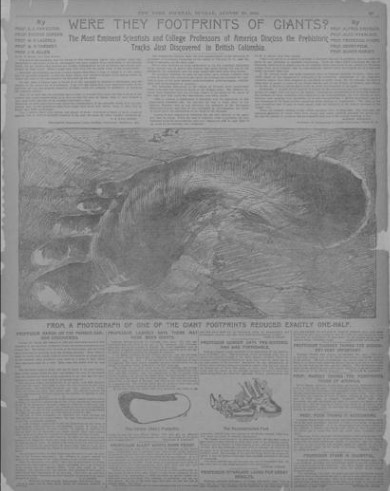
New York journal (New York [N.Y.]), August 23, 1896
Portions taken from this article:
“For these and many other reasons the report from British Columbia deserves all possible attention.
The footprints were found on the island of Victoria, near the town of Quatsino, on the west coast/ Their discoverer was John L. Leason, a storekeeper of the town, and a man of intelligence. He reported his find
to Captain Foot, of the steamer Mischief, who repeated his account to the members of the Provincial History Society. They were satisfied of its interest and importance, and a party was sent out to make an investigation.
It appears that Leason was walking at some distance from the town when his curiosity was aroused by a strange depression in a large flat rock that lay before him. He was at the time at the foot of a mountain.
The depression at once suggested a human foot, but it was of enormous size.
There was a well marked hollow where the heel would have been, and a very faint depression indicated the arch of the foot. The ball of the big toe and the rest of the forward part of the foot were plainly to be seen. It is to be remembered that no other animal has an arched foot like that of man.
Leason Immediately proceeded to measure the print, and found that it was twenty nine Inches in length. Its greatest depth was four Inches. Fascinated by his discovery, he carefully examined the vicinity. At first he saw nothing which he could connect with the print, but after a few minutes he ‘came upon another, almost
identical. It was nine feet away from the first. This apparently was the length of the stride, which the giant had been in the habit of taking.
Following the direction indicated by these two prints, Leason found a number of others. They came to an end abruptly, which was not surprising, for their surroundings must have undergone tremendous changes since they were made. The mountain itself may have come into existence in that time.
It is not surprising that footprints should have been preserved for so many ages. They may have been made in soft mud, which subsequently hardened and was then burled in the earth by volcanic action, and there turned Into stone and preserved from injury until another volcanic disturbance brought them to daylight again. A large part of the knowledge of animals of early geological periods has been obtained from imprints left by them in this way.
Leason, it Is said, has already set to work to chisel out the first footprint which he found. He intends to Insure public recognition as its discoverer.
Library of Congress
From Old World Roots of the Cherokee, chapter 5, “America’s Middle Ages,” pp. 78-79, we read:
What kind of Indians lived in the territory the Choctaw and Chickasaw carved out for their new home? According to their traditions, reports Cushman, as confirmed by excavations of bones in Tennessee, it was a “race of white giants”:
The tradition of the Choctaws . . . told of a race of giants that once inhabited the now State of Tennessee, and with whom their ancestors fought when they arrived in Mississippi in their migration from the west, doubtless Old Mexico. Their tradition states the Nahullo (race of giants [literally, wizards]) was of wonderful stature; but, as their tradition of the mastodon [which used to be found on the Great Plains], so this was also considered to be but a foolish fable, the creature of a wild imagination, when lo! Their exhumed bones again prove the truth of the Choctaws’ tradition (151).
Cushman recounts the discovery in 1880 at a burial mound site near Plano, Texas, of human bones “of enormous size . . . the femoral bones being five inches longer than the ordinary length, and the jaw bones . . . so large as to slip over the face of a man with ease.” Cushman goes on to identify them with the older occupants of North America called Allegewi or Taligewi (Talegans).
A story was told by the Comanches in 1857:
Innumerable moons ago, a race of white men, ten feet high, and far more rich and powerful than any white people now living, here inhabited a large range of country, extending from the rising to the setting sun. Their fortifications crowned the summits of the mountains, protecting their populous cities situated in the intervening valleys. They excelled every other nation which was flourished, either before or since, in all manner of cunning handicraft—were brave and warlike—ruling over the land they had wrested from its ancient possessors with a high and haughty hand. Compared with them the palefaces of the present day were pygmies, in both art and arms. They drove the Indians from their homes, putting them to the sword, and occupying the valleys in which their fathers had dwelt before them since the world began. At length, in the height of their power and glory, when they remembered justice and mercy no more and became proud and lifted up, the Great Spirit descended from above, sweeping them with fire and deluge from the face of the earth. The mounds we [i.e. the speaker Chief Rolling Thunder and his Spanish listener] had seen on the tablelands were the remnants of their fortresses, and the crumbling ruins that surrounded us all that remained of a mighty city.
Fritz Zimmerman‘s book, The Nephilim Chronicles, which reproduces over 300 historical accounts of Giant skeletons. Many are associated with the earliest mound sites in America, but Zimmerman’s survey of this worldwide phenomenon ranges from the Hunter-Fisher People of northeast Europe and Red Paint People whose movements were circumpolar to the giants of the Bible, noted by the Babylonian Talmud as having double rows of teeth, and “Giants’ Remains in the British Isles” (pp. 157-65).
https://www.loc.gov/resource/sn84024350/1896-08-23/ed-1/?dl=all&sp=23&st=text
 Quantum Study Bible