
Words in italic type have been added for clarity. They are not found in the original Hebrew or Aramaic.
Jeremiah 39
- PROOFS of God’s Word Number Six and Seven.
- People and Titles:
- Zedekiah, King of Judah
- Nebuchadnezzar, King of Babylon
- Evil Merodach, Son (in-law) of King Nebuchadnezzar. Became King of Babylon at Nebuchadnezzar’s death.
- Nergalo-Sharezer, A Babylonian Prince who sits with other princes in the Middle Gate in Jerusalem. Ultimately, the murderer of Evil Merodach, King of Babylon and Nergalo-Sharezer’s brother-in-law. He then takes the Babylon throne.
- Samgar (Sword)-(of) Nebo: (a Babylonian deity who presided over learning and letters; corresponds to Greek “Hermes”, Latin “Mercury”, and Egyptian “Thoth”) A Babylonian Prince who sits with other princes in the Middle Gate in Jerusalem.
- Sarsechim A Babylonian Prince who sits with other princes in the Middle Gate in Jerusalem. (“prince of the eunuchs”) (śar means “prince”, therefore sechim means “eunuch”). A “chief eunuch” named Nabu-sharrussu-ukin. (ie: Nabo-Sarsechim).
The Fall of Jerusalem
Jeremiah 39:1 In the ninth year of Zedekiah king of Judah, in the tenth month, Nebuchadnezzar king of Babylon and all his army came against Jerusalem, and besieged it.
Jeremiah 39:2 In the eleventh year of Zedekiah, in the fourth month, on the ninth day of the month, the city was penetrated (the city wall was breached).
Jeremiah 39:3 Then all the princes of the king of Babylon came in and sat in the Middle Gate: Nergal-Sharezer (meaning “prince of fire”, Nergal is an idol diety, perhaps Mars), Samgar-Nebo (“sword of Nebo”, Nebo is an idol diety, the planet Mercury), Sarsechim (“prince of the eunuchs”) Rabsaris (a Chief Officer; see v. 13), Nergal-Sarezer Rabmag (A title, probably Troop Commander; see v. 13), with the rest of the princes of the king of Babylon.
- There are two Nergal-Sharezer/Sarezers. One is probably a Troop Commander.
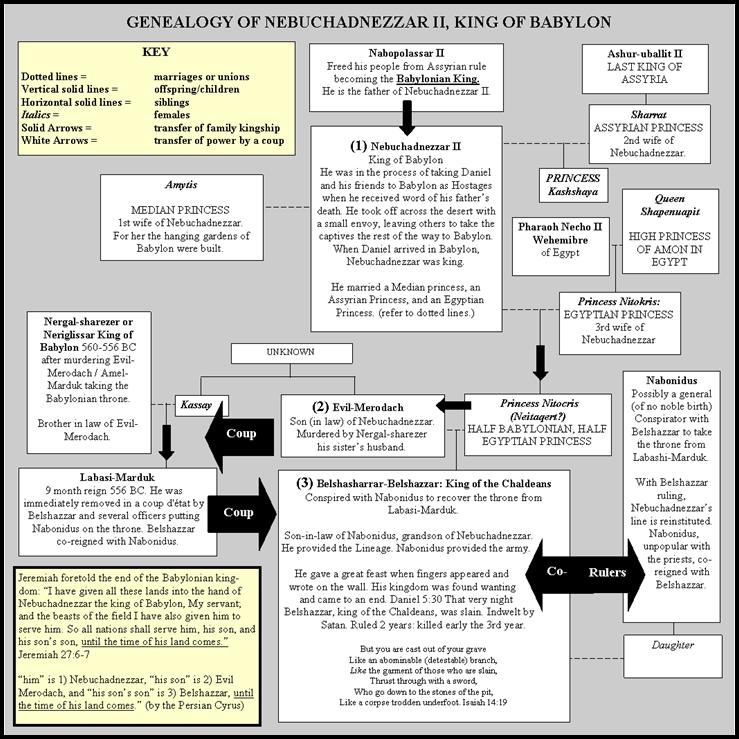
- ►Note: See Genealogy Chart of Nebuchadnezzar towards the bottom of this page for Evil-Merodach and Nergal Sharezer.
- ►At Nebuchadnezzer’s death, Evil Merodach takes the throne as Nebuchadnezzar’s son (in-law) having married his daughter. He only reigned two years before being murdered by Nergal-Sharezer, who then took the throne.
- ►Nergal-Sharezer was the brother-in-law of Evil Merodach.
Jeremiah 39:4 So it was, when Zedekiah the king of Judah and all the men of war saw them, that they fled and went out of the city by night, by way of the king’s garden, by the gate between the two walls. And he went out by way of the plain (Or Arabah; the Jordan Valley).
Jeremiah 39:5 But the Chaldean army pursued them and overtook Zedekiah in the plains of Jericho. And when they had captured him, they brought him up to Nebuchadnezzar king of Babylon, to Riblah in the land of Hamath, where he pronounced judgment on him.
Jeremiah 39:6 Then the king of Babylon killed the sons of Zedekiah before his eyes in Riblah; the king of Babylon also killed all the nobles of Judah.
Jeremiah 39:7 Moreover he put out Zedekiah’s eyes, and bound him with bronze fetters (chains) to carry him off to Babylon.
Jeremiah 39:8 And the Chaldeans burned the king’s house and the houses of the people with fire, and broke down the walls of Jerusalem.
Jeremiah 39:9 Then Nebuzaradan the captain of the guard carried away captive to Babylon the remnant of the people who remained in the city and those who defected to him, with the rest of the people who remained.
Jeremiah 39:10 But Nebuzaradan the captain of the guard left in the land of Judah the poor people, who had nothing, and gave them vineyards and fields at the same time (Lit. on that day).
Jeremiah Goes Free
Jeremiah 39:11 Now Nebuchadnezzar king of Babylon gave charge concerning Jeremiah to Nebuzaradan the captain of the guard, saying,
Jeremiah 39:12 “Take him and look after him, and do him no harm; but do to him just as he says to you.”
Jeremiah 39:13 So Nebuzaradan the captain of the guard sent Nebushasban, Rabsaris, Nergal-Sharezer, Rabmag, and all the king of Babylon’s chief officers;
- Note: It was Nergal-Sharezer who murdered his brother-in-law, Evil-Merodach, the King of Babylon, following Nebuchadnezzar’s death.
Jeremiah 39:14 then they sent someone to take Jeremiah from the court of the prison, and committed him to Gedaliah the son of Ahikam, the son of Shaphan, that he should take him home. So he dwelt among the people.
- Note: In Jeremiah 36 (Quantum Study Bible’s: Who’s Who): There is a Gemariah who is listed as the son of Shaphan. (Is there a connection?)
- According to a Babylonian edict, Jeremiah went to Mizpah in Benjamin with Gedaliah, who had been made governor of Judea. (Jeremiah 40:5-6) Gedaliah was assassinated, historically replaced with Johanan, who fled to Egypt with Jeremiah, Baruch, and King Zedikiah’s daughters.
- Jeremiah is credited with hiding the Ark, incense altar, and tabernacle on the mountain of Moses. (II Maccabees 2:4ff)
Jeremiah 39:15 Meanwhile the word of the Lord (yᵊhōvâ) had come to Jeremiah while he was shut up in the court of the prison, saying,
Jeremiah 39:16 “Go and speak to Ebed-Melech the Ethiopian, saying, ‘Thus says the Lord of hosts (yᵊhōvâ ṣāḇā’), the God (‘ĕlōhîm) of Israel: “Behold, I will bring My words upon this city for adversity and not for good, and they shall be performed in that day before you.
Jeremiah 39:17 But I will deliver you in that day,” says the Lord (yᵊhōvâ) “and you shall not be given into the hand of the men of whom you are afraid.
Jeremiah 39:18 For I will surely deliver you, and you shall not fall by the sword; but your life shall be as a prize to you, because you have put your trust in Me,” says the Lord (yᵊhōvâ).’ ”
SIXTH PROOF OF GOD AND SCRIPTURE: Historical Proof of Jeremiah’s Tablet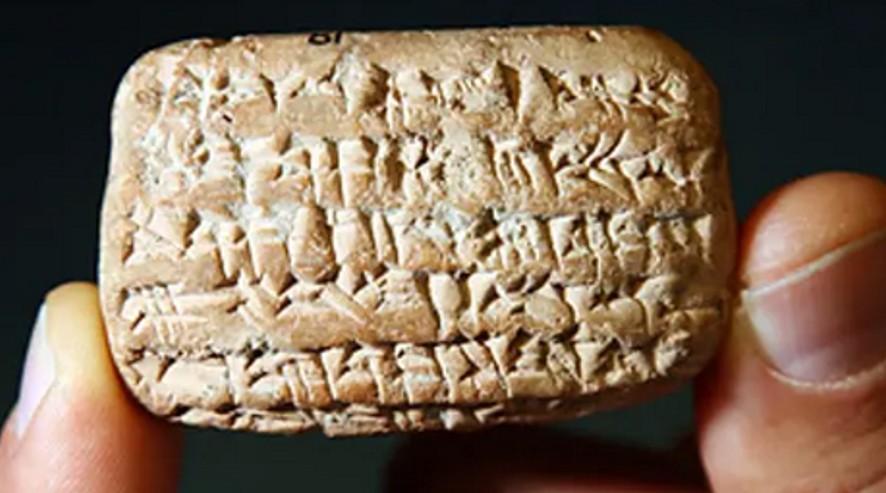
ARCHEALOGY: “A WORLD-CLASS FIND” Matching Names in the book of Jeremiah:
A Boost for the Book of Jeremiah
By David Van Biema Saturday, Jul. 21, 2007
By confirming the historical accuracy of a tiny detail, a two-inch clay tablet long in the possession of the British Museum has given ammunition to those who believe that the Bible — specifically, in this case, the book of the prophet Jeremiah — is history. That, at least, is what the believers are claiming.
The tablet itself is certainly genuine. On July 10 the Museum announced that a Viennese expert working his way through thousands of similar clay documents in its possession translated one dating from 595 BC that described a gift of 1.7 lbs. of gold to a Babylonian temple by a “chief eunuch” named Nabu-sharrussu-ukin.
A museum official called it “a world-class find.” What makes the ancient but seemingly mundane receipt significant is that the book of Jeremiah in the Hebrew Bible (or Old Testament) mentions the exact same official — though under a different transliteration, Nebo-Sarsekim, and a different title, chief officer, as accompanying the Babylonian King Nebuchadnezzar when he marched against Jerusalem in 587. According to some experts, that proves that whoever wrote Jeremiah wasn’t making it up.
It’s another chapter in a larger debate between scholars known as biblical “minimalists” and “maximalists.” Maximalists, who include most conservative Christian experts, tend to accept that those parts of the Bible that include prolific historical detail are probably historically accurate. Minimalists tend to think that they were completed centuries after their alleged dates as propaganda for a later Jewish government.
Jeremiah’s story is one of the most vividly rendered lives in the Old Testament. His biography is accepted as fact by pious Jews and Christians, as are the book’s details regarding the sack of Jerusalem, in which Nebo-Sarsekim reportedly participated, and the subsequent Jewish exile “by the rivers of Babylon,” commemorated by the Book of Psalms…
Minimalists tend to regard it as a polemic, until proven otherwise.
[Note: Polemics (pel-lee-mics) is the practice of disputing … religious, philosophical, political, or scientific matters. As such, a polemic text on a topic is often written specifically to dispute or refute a position or theory that is widely viewed to be beyond reproach. The word is derived from the Greek word polemikos which means “warlike,” “hostile”. http://en.wikipedia.org/wiki/Polemic%5D
Conservatives are calling the Nebo-Sarsekim tablet, stamped in cuneiform script, such a proof. Lawson Stone, a professor of Old Testament at Asbury Theological Seminary in Wilmore, Kentucky, describes Nebo-Sarsekim’s rank as roughly equivalent to Deputy Undersecretary of the Interior. “The logical assumption,” he contends, “is that Jeremiah wasn’t written by a later writer, but a person writing at the time. I don’t know why a later writer trying to create a legendary basis for [a later Jewish regime] would want to make reference to a third-ranked Babylonian clerk. This argues that the document is accurate in its references to the world around it.”
However, Robert Coote, an Old Testament professor at the more liberal San Francisco Theological Seminary, disagrees. Most academics who regard Jeremiah as a polemic, he claims, would concede that it makes use of materials originally written in Nebuchadnezzar’s age, so there is no reason for it not to include the name of a minor figure in his court. “The logical fallacy,” says Coote, “is to say that this one corroboration makes the whole narrative true and accurate.”
It will take a lot more cuneiform tablets to convince him. But then, the British Museum still has a lot left to look through.
http://www.time.com/time/world/article/0,8599,1645738,00.html?xid=feed-cnn-topics
Archaeology Series #25: The Jeremiah Tablet
BRIEF NOTES
Nebo-Sarsekim Tablet also called the Jeremiah tablet is a clay cuneiform inscription (2.13 inches) in the collection of the British Museum dated to circa 595 BC, referring to an official at the court of Nebuchadnezzar II, king of Babylon.
Archaeologists unearthed the tablet in the ancient city of Sippar (about a mile from modern Baghdad) in the 1870s. The museum acquired it in 1920, but it had remained in storage unpublished until Michael Jursa (associate professor at the University of Vienna) made the discovery in 2007 with the following translation of the inscription:
INSCRIPTION
[Regarding] 1.5 minas (0.75 kg) of gold, the property of Nabu-sharrussu-ukin, the chief eunuch, which he sent via Arad-Banitu the eunuch to [the temple] Esangila: Arad-Banitu has delivered [it] to Esangila. In the presence of Bel-usat, son of Alpaya, the royal bodyguard, [and of] Nadin, son of Marduk-zer-ibni. Month XI, day 18, year 10 [of] Nebuchadnezzar, king of Babylon.
NOTE THE JEREMIAH REFERENCE
Jeremiah 39:3 And all the princes of the king of Babylon proceeded to come in and sit down in the Middle Gate, [namely,]
Ner´gal-shar·e´zer, Sam´gar, ne´bo Sar´se·chim Rab´sa·ris, Ner´gal-shar·e´zer the Rab´mag and all the rest of the princes of the king of Babylon.
http://bibleresources.blogspot.com/
SEVENTH PROOF OF GOD AND SCRIPTURE: Historical Proof of the first temple period.
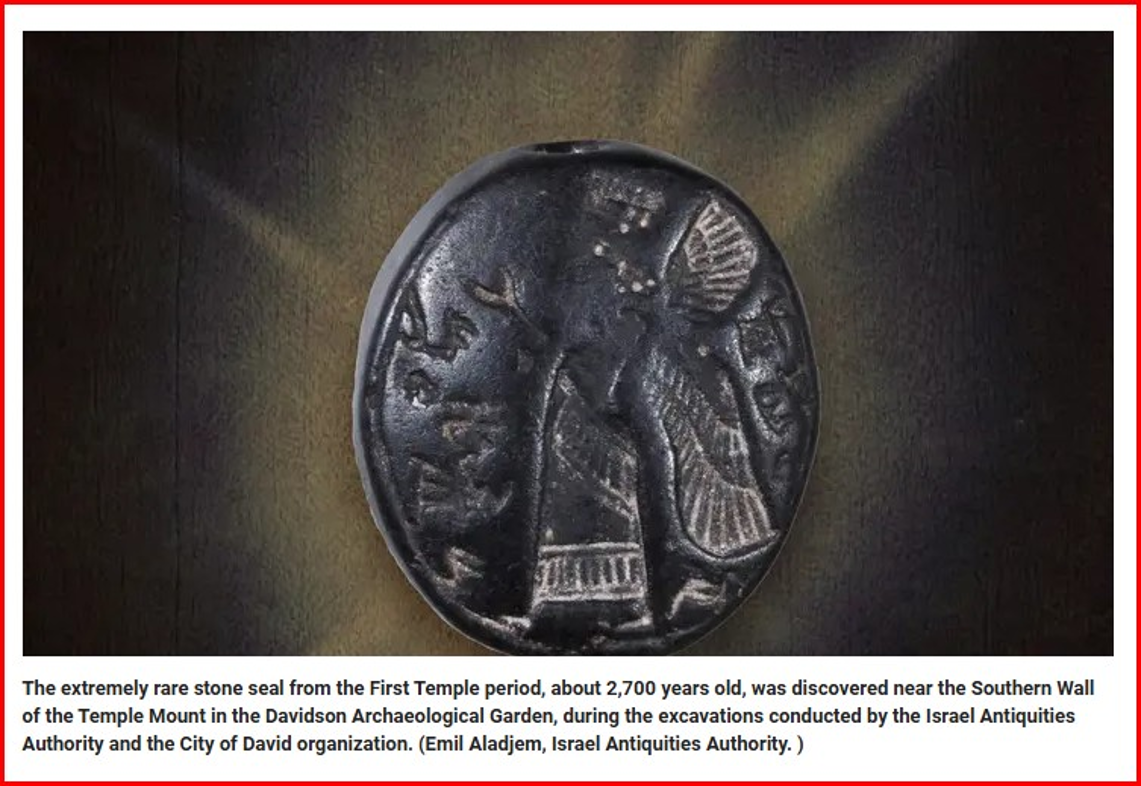
The extremely rare stone seal from the First Temple period, about 2,700 years old, was discovered near the Southern Wall of the Temple Mount in the Davidson Archeological Garden, during the excavations conducted by the Israel Antiquities Authority and the City of David organization. (Emil Aladjem, Israel Antiquities Authority.)
An archeological find in August, 2024 of a stone, probably worn around the neck inscribed with the Hebrew name in the paleo-Hebrew script. (Eliyahu Yanai, City of David) with a picture of Assyrian influence ~2,700 years old. On both sides of the figure an inscription is engraved in paleo-Hebrew script – “LeYehoʼezer ben (son of) Hoshʼayahu.” aka Azariah ben Hoshʼaya.
“The name Yehoʼezer is familiar to us from the Bible (Chron. I 12:7) in its abbreviated form – Yoʼezer, one of King David’s fighters,” while also stating that “in the book of Jeremiah 43:2, describing the events of this very period, a person is mentioned with a parallel name, ʼAzariah ben Hoshʼaya. The two parts of his first name are written in reverse order to the seal owner’s name, and his second name is the same, appearing in its abbreviated form. This writing form in the text fits the name on the newly discovered seal and it is thus appropriate for this time period.”
{1 of 4} Jeremiah 39 – “Seven Proofs of God and Scripture” [Nebuchadnezzar’s Line]
{2 of 4} Jeremiah 39 – “Seven Proofs of God and Scripture” [Historical Narrative]
{3 of 4} Jeremiah 39 – “Seven Proofs of God and Scripture” [Prophesies for Babylon]
{4 of 4} Jeremiah 39 – “Seven Proofs of God and Scripture” [Names and Archeology]

