
Words in italic type have been added for clarity. They are not found in the original Hebrew or Aramaic.
About the title: In Hebrew, Kadesh means “Holy”, Barnea means “Staggering, or Fugitive”.
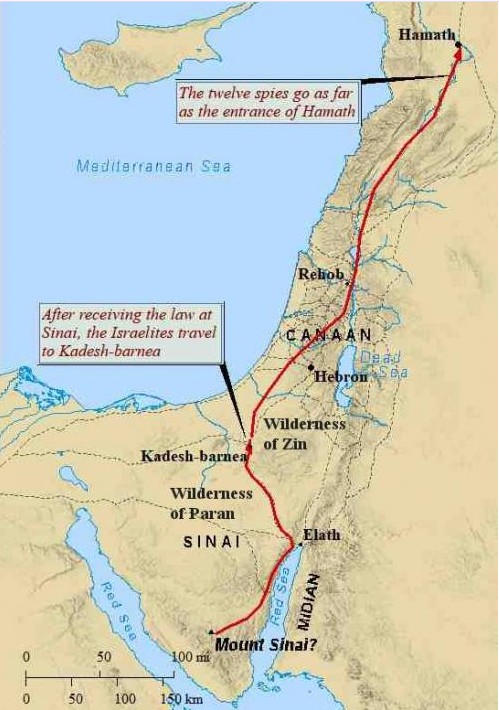
The Previous Command to Enter Canaan
Deuteronomy 1:1 These are the words which Moses spoke to all Israel on this side of the Jordan in the wilderness, in the plain (Heb. Arabah) opposite Suph (Red Sea), between Paran, Tophel, Laban, Hazeroth, and Dizahab.
Deuteronomy 1:2 It is eleven days’ journey from Horeb by way of Mount Seir to Kadesh Barnea.
Deuteronomy 1:3 Now it came to pass in the fortieth year, in the eleventh month (“Shevat” which lasts thirty days), on the first day of the month, that Moses spoke to the children of Israel according to all that the Lord (yᵊhōvâ) had given him as commandments to them,
MOSES LIFE TIMELINE“
THE THREE FORTY YEAR PERIOD’S OF MOSES’S LIFE
First 40 Years (Prince in Egypt):
Moses grew up in Pharaoh’s palace as an educated, privileged Egyptian prince with status, political influence, and military training (Acts 7:22). After trying to defend an Israelite by killing an Egyptian, he fled to the wilderness of Midian (Acts 7:23–29).
Second 40 Years (Shepherd in Midian):
Moses lived in exile as a shepherd for his father-in-law, Jethro (Exodus 3:1). This quiet, isolated period humbled him, stripped away his self-reliance, and prepared him to lead. At age 80, God called him from the burning bush (Exodus 7:7).
Third 40 Years (Leader of the Exodus):
Moses led the Israelites out of slavery in Egypt and through the wilderness toward the Promised Land until his death at age 120 (Deuteronomy 34:7).
Deuteronomy 1:4 after he had killed Sihon king of the Amorites, who dwelt in Heshbon, and Og king of Bashan, who dwelt at Ashtaroth in Edrei (and; cf. Josh. 12:4).
Deuteronomy 1:5 On this side of the Jordan in the land of Moab, Moses began to explain this law, saying,
Deuteronomy 1:6 “The Lord our God (yᵊhōvâ ‘ĕlōhîm) spoke to us in Horeb, saying: ‘You have dwelt long enough at this mountain.
Deuteronomy 1:7 Turn and take your journey, and go to the mountains of the Amorites, to all the neighboring places in the plain (Heb. Arabah), in the mountains and in the lowland, in the South and on the seacoast, to the land of the Canaanites and to Lebanon, as far as the great river, the River Euphrates (as far as modern day Iraq).
Deuteronomy 1:8 See, I have set the land before you; go in and possess the land which the Lord (yᵊhōvâ) swore (promised) to your fathers—to Abraham, Isaac, and Jacob—to give to them and their descendants after them.’
Tribal Leaders Appointed
Deuteronomy 1:9 “And I spoke to you at that time, saying: ‘I alone am not able to bear you (I am not able to bear you by myself).
Deuteronomy 1:10 The Lord your God (yᵊhōvâ ‘ĕlōhîm) has multiplied you, and here you are today, as the stars of heaven in multitude.
- Reference: Genesis 22:17 blessing I will bless you (Abraham), and multiplying I will multiply your descendants as the stars of the heaven and as the sand which is on the seashore; and your descendants shall possess the gate of their enemies.
Deuteronomy 1:11 May the Lord God (yᵊhōvâ ‘ĕlōhîm) of your fathers make you a thousand times more numerous than you are, and bless you as He has promised you!
Deuteronomy 1:12 How can I alone bear your problems and your burdens and your complaints?
Deuteronomy 1:13 Choose wise, understanding, and knowledgeable men from among your tribes, and I will make them heads (rulers) over you.’
Deuteronomy 1:14 And you answered me and said, ‘The thing which you have told us to do is good.’
Deuteronomy 1:15 So I took the heads of your tribes, wise and knowledgeable men, and made (appointed) them heads over you, leaders of thousands, leaders of hundreds, leaders of fifties, leaders of tens, and officers for your tribes.
Deuteronomy 1:16 “Then I commanded your judges at that time, saying, ‘Hear the cases between your brethren, and judge righteously between a man and his brother or the stranger who is with him.
Deuteronomy 1:17 You shall not show partiality in judgment; you shall hear the small as well as the great; you shall not be afraid in any man’s presence, for the judgment is God’s (‘ĕlōhîm). The case that is too hard for you, bring to me, and I will hear it.’
Deuteronomy 1:18 And I commanded you at that time all the things which you should do.
Israel’s Refusal to Enter the Land
Deuteronomy 1:19 “So we departed from Horeb, and went through all that great and terrible wilderness which you saw on the way to the mountains of the Amorites, as the Lord our God (yᵊhōvâ ‘ĕlōhîm) had commanded us. Then we came to Kadesh Barnea.
Deuteronomy 1:20 And I said to you, ‘You have come to the mountains of the Amorites, which the Lord our God (yᵊhōvâ ‘ĕlōhîm) is giving us.
Deuteronomy 1:21 Look, the Lord your God (yᵊhōvâ ‘ĕlōhîm) has set the land before you; go up and possess it, as the Lord God (yᵊhōvâ ‘ĕlōhîm) of your fathers (Abraham, Isaac, and Jacob) has spoken to you; do not fear or be discouraged.’
Deuteronomy 1:22 “And every one of you came near to me and said, ‘Let us send men before us, and let them search out the land for us, and bring back word to us of the way by which we should go up, and of the cities into which we shall come.’
Deuteronomy 1:23 “The plan pleased me well; so I took twelve of your men, one man from each tribe.
Deuteronomy 1:24 And they departed and went up into the mountains, and came to the Valley of Eshcol, and spied it out.
Deuteronomy 1:25 They also took some of the fruit of the land in their hands and brought it down to us; and they brought back word to us, saying, ‘It is a good land which the Lord our God (yᵊhōvâ ‘ĕlōhîm) is giving us.’
Deuteronomy 1:26 “Nevertheless you would not go up, but rebelled against the command of the Lord your God (yᵊhōvâ ‘ĕlōhîm);
Deuteronomy 1:27 and you complained in your tents, and said, ‘Because the Lord (yᵊhōvâ) hates us, He has brought us out of the land of Egypt to deliver us into the hand of the Amorites, to destroy us.
Deuteronomy 1:28 Where can we go up? Our brethren have discouraged (Lit. melted) our hearts, saying, “The people are greater and taller than we; the cities are great and fortified up to heaven; moreover we have seen the sons of the Anakim there.” ’
Deuteronomy 1:29 “Then I said to you, ‘Do not be terrified, or afraid of them.
Deuteronomy 1:30 The Lord your God (yᵊhōvâ ‘ĕlōhîm), who goes before you, He will fight for you, according to all He did for you in Egypt before your eyes,
Deuteronomy 1:31 and in the wilderness where you saw how the Lord your God (yᵊhōvâ ‘ĕlōhîm) carried you, as a man carries his son, in all the way that you went until you came to this place.’
Deuteronomy 1:32 Yet, for all that, you did not believe the Lord your God (yᵊhōvâ ‘ĕlōhîm),
- They did not remember God’s plan to empty the land at Kadesh Barnea:
Exodus 23:28 And I will send hornets (an insect that pierces) before you, which shall drive out the Hivite, the Canaanite, and the Hittite from before you. 29 I will not drive them out from before you in one year, lest the land become desolate and the beasts of the field become too numerous for you. 30 Little by little I will drive them out from before you, until you have increased, and you inherit the land. 31 And I will set your bounds (boundaries) from the Red Sea to the sea, Philistia, and from the desert to the River (Heb. Nahar, the Euphrates). For I will deliver the inhabitants of the land into your hand, and you shall drive them out before you.
Deuteronomy 1:33 who went in the way before you to search out a place for you to pitch your tents, to show you the way you should go, in the fire by night and in the cloud by day.
The Penalty for Israel’s Rebellion
Deuteronomy 1:34 “And the Lord (yᵊhōvâ) heard the sound of your words, and was angry, and took an oath, saying,
Deuteronomy 1:35 ‘Surely not one of these men of this evil generation shall see that good land of which I swore (promised) to give to your fathers,
Deuteronomy 1:36 except Caleb the son of Jephunneh; he shall see it, and to him and his children I am giving the land on which he walked, because he wholly (fully) followed the Lord (yᵊhōvâ).’
Deuteronomy 1:37 The Lord (yᵊhōvâ) was also angry with me (Moses) for your sakes, saying, ‘Even you (Moses) shall not go in there.
- Moses was angry. Because of them, he was not allowed to go into the promised land.
Deuteronomy 1:38 Joshua the son of Nun, who stands before you, he shall go in there. Encourage him, for he shall cause Israel to inherit it.
Deuteronomy 1:39 ‘Moreover your little ones and your children, who you say will be victims, who today have no knowledge of good and evil, they shall go in there; to them I will give it, and they shall possess it.
Deuteronomy 1:40 But as for you, turn and take your journey into the wilderness by the Way of the Red Sea.’
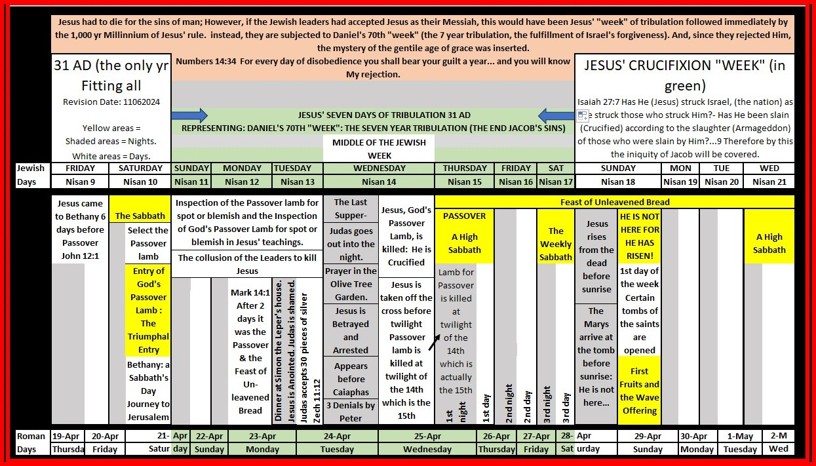
- The consequences of disobedience: Numbers 14:34 According to the number of the days in which you spied out the land, forty days, for each day you shall bear your guilt (iniquity) one year, namely forty years, and you shall know My rejection (opposition).35 I the Lord have spoken this. I will surely do so to all this evil congregation who are gathered together against Me. In this wilderness they shall be consumed, and there they shall die.’ ” (only the innocent children will grow and be able to enter the land, they and Joshua and Caleb) … 37 those very men who brought the evil report about the land, died by the plague before the Lord. 38 But Joshua the son of Nun and Caleb the son of Jephunneh remained alive, of the men who went to spy out the land.
- What sin would be worse than disobeying God by refusing to go in and take the land? What about crucifying Jesus, the Son of God? When the Leaders of the Jews refused to accept Jesus as their king on His “Triumphal Entry” into Jerusalem, there followed three days Jesus taught in the temple knowing the leaders were plotting His death, on the forth day He was crucified, and He was in the grave for three days before His resurrection. In short, there were seven days (one week) of affliction.
The last “week” in Daniel’s “Seventy Weeks” is a “Seven-Year Tribulation” focusing on the Jews. In other words, one Year for each day of disobedience. The “Seven-Year Tribulation” is the consequence of the Jewish leaders rejecting Jesus as their Messiah and King, with the entire globe turning against the Jews, desiring their annihilation. Only the return of Jesus will save them.
Deuteronomy 1:41 “Then you answered and said to me, ‘We have sinned against the Lord (yᵊhōvâ); we will go up and fight, just as the Lord our God (yᵊhōvâ ‘ĕlōhîm) commanded us.’ And when everyone of you had girded on his weapons of war, you were ready to go up into the mountain.
Deuteronomy 1:42 “And the Lord (yᵊhōvâ) said to me, ‘Tell them, “Do not go up nor fight, for I am not among you; lest you be defeated before your enemies.” ’
Deuteronomy 1:43 So I spoke to you; yet you would not listen, but rebelled against the command of the Lord (yᵊhōvâ), and presumptuously (willfully, root meaning: pride) went up into the mountain.
Deuteronomy 1:44 And the Amorites who dwelt in that mountain came out against you and chased you as bees do, and drove you back from Seir to Hormah.
Deuteronomy 1:45 Then you returned and wept before the Lord (yᵊhōvâ), but the Lord (yᵊhōvâ) would not listen to your voice nor give ear to you.
Deuteronomy 1:46 “So you remained in Kadesh many days, according to the days that you spent there.
NUMBER SYMBOLISM
| ELEVEN | Deut. 1:2 Eleven days, Deut. 1:3 Eleventh month | Disorder, chaos, imperfection, interruption, and judgment |
| FORTY | Deut. 1:3 Fortieth Year | Time for a change |
| ONE | Deut. 1:3 First | First |
| TWELVE | Deut. 1:23 Twelve Tribes | Full governmental perfection or divine order |

