
Words in italic type have been added for clarity. They are not found in the original Hebrew or Aramaic.
John 19
The Crucifixion in Other Gospels:
Matthew Chapter 27
Mark Chapter 15
Luke Chapter 23
The Soldiers Mock Jesus
John 19:1 So then Pilate took Jesus and scourged Him.
John 19:2 And the soldiers twisted a crown of thorns and put it on His head, and they put on Him a purple robe.
John 19:3 Then (they came up to Him and) they said, “Hail, King of the Jews!” And they struck Him with their hands.
John 19:4 Pilate then went out again, and said to them, “Behold, I am bringing Him out to you, that you may know that I find no fault in Him.”
Pilate’s Decision
John 19:5 Then Jesus came out, wearing the crown of thorns and the purple robe. And Pilate said to them, “Behold the Man!”
- “Behold the Man!
Pilate seemingly is trying to assuage the anger of the Leaders of the Jews by referring to Jesus as nothing more than just a “man”. - “Behold the Man!
Phillipians 2:5 … Christ Jesus, 6 who, being in the form of God, did not consider it robbery to be equal with God, 7 but made Himself of no reputation, taking the form of a bondservant, and coming in the likeness of men. 8 And being found in appearance as a man, He humbled Himself and became obedient to the point of death, even the death of the cross.
John 19:6 Therefore, when the chief priests and officers saw Him, they cried out, saying, “Crucify Him, crucify Him!”
Pilate said to them, “You take Him and crucify Him, for I find no fault in Him.”
John 19:7 The Jews answered him, “We have a law, and according to our law He ought to die, because He made Himself the Son of God.”
- Was this the first time Pilate heard Jesus claimed to be the Son of God?
John 19:8 Therefore, when Pilate heard that saying, he was the more afraid,
- Note: Pilate feared that Jesus WAS the son of a Roman god.
John 19:9 and went again into the Praetorium, and said to Jesus, “Where are You from?” But Jesus gave him no answer.
- “Where are You from?” What a strange question. Was he concerned that armies from the Roman god’s kingdom might be on their way to fight on behalf of Jesus?
John 19:10 Then Pilate said to Him, “Are You not speaking to me? Do You not know that I have power (authority) to crucify You, and power to release You?”
- Isaiah 53:7 He was oppressed and He was afflicted, Yet He opened not His mouth; He was led as a lamb to the slaughter, And as a sheep (like a Passover Lamb) before its shearers is silent, So He opened not His mouth.
- Someday in the future, at the Great White Throne Judgment, Pilate will be standing before Jesus who has all power and all authority to send him to the lake of fire or to a heavenly eternity. At that time Pilate will thoroughly see the “Kingdom of God” and know who Jesus is: not just a king but the King of Kings, not just a man, but the redeemer of men, not, as Pilate imagined, another Roman “god”, but the one and the only Son of the true God.
- History notes that Pilate and Herod Antipas were not on good terms (Luke 23:12), but after Jesus death, they became friends.
John 19:11 Jesus answered, “You could have no power at all against Me unless it had been given you from above. Therefore, the one who delivered Me to you has the greater sin.”
- At the Great White Throne Judgment will Jesus say of Pilate, “I find no fault with him”? I don’t think so. Jesus said Pilate has the lesser sin than those who delivered Him over to Pilate. Pilate was not without his own sin, and his friendship with Herod would indicate there was no repentance after the fact.
John 19:12 From then on, Pilate sought to release Him, but the Jews cried out, saying, “If you let this Man go, you are not Caesar’s friend. Whoever makes himself a king speaks against Caesar.”
John 19:13 When Pilate therefore heard that saying, he brought Jesus out and sat down in the judgment seat in a place that is called The Pavement, but in Hebrew, Gabbatha.
John 19:14 Now it was the Preparation Day of the Passover (Nisan 14) and about the sixth hour. And he said to the Jews, “Behold your King!”
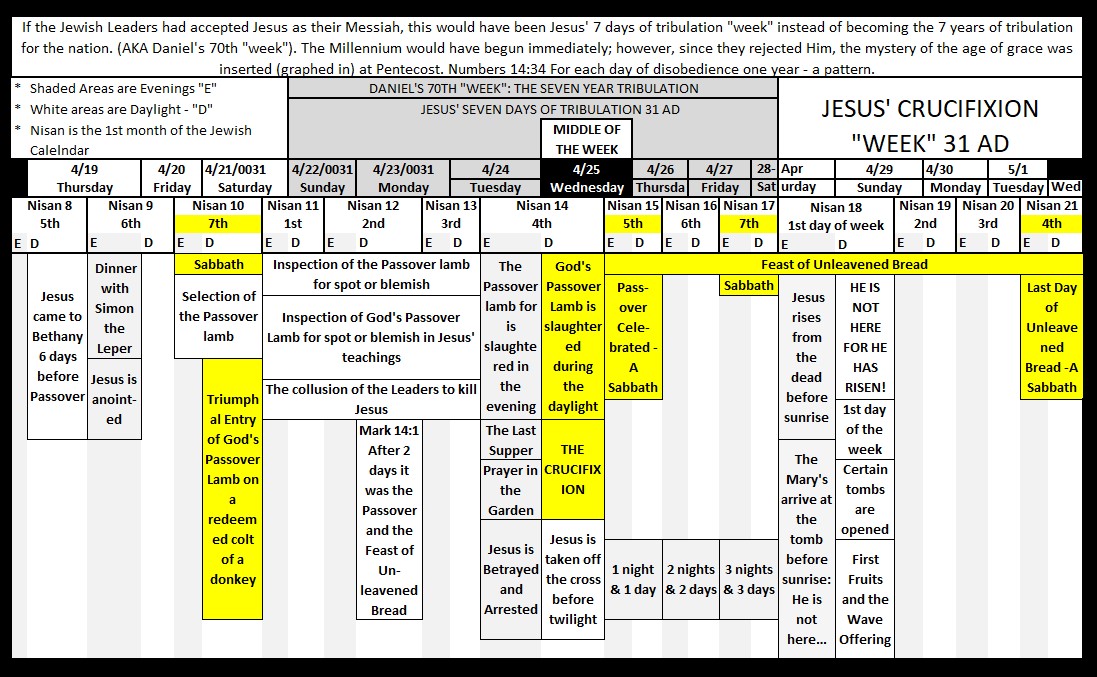
- Leviticus 23:6 And on the fifteenth day of the same month is the Feast of Unleavened Bread to the Lord; seven days you must eat unleavened bread.
- Matthew 26:17 Now on the first at (literally: before) the Unleavened Bread the disciples came to Jesus, saying to Him, “Where do You want us to prepare for You to eat the Passover?”
John 19:15 But they cried out, “Away with Him, away with Him! Crucify Him!”
Pilate said to them, “Shall I crucify your King?”
The chief priests answered, “We have no king but Caesar!”
John 19:16 Then he (Pilate) delivered Him to them to be crucified. Then they took Jesus and led Him away.
NOTE:
There were three Jewish Trials and three Roman Trials.
Jesus was declared guilty at all of the Jewish Trials.
Jesus was declared innocent at all the Roman Trials.
The King on a Cross
John 19:17 And He, bearing His cross, went out to a place called the Place of a Skull, which is called in Hebrew, Golgotha,
- When God brought the Hebrews out of Egypt there is a little verse which seems to be prophetic of Jesus’ crucifixion, then again at Jesus’ return, when the tables are turned. They pierced Him, they wanted to break His bones, now He is going to have His vengeance:
- Numbers 24:8 “God brings him out of Egypt (Jesus’ family went to Egypt when he was under 2 years of age); He has strength like a wild ox (the root of this Jewish word for ox means to “rise” or “rise up” or “high” and it is only used in Zechariah 14:10 concerning the return of Jesus); He shall consume the nations (the gentiles), his enemies; He shall break THEIR bones And pierce THEM with His arrows.
John 19:18 where they crucified Him, and two others with Him, one on either side, and Jesus in the center.
- There were two thieves (sinners) crucified with Jesus, one on each side.
- The mother of James and John had asked Jesus, when you come into your kingdom…allow one son to sit on Your right hand and one at Your left hand. If Jesus had granted her request, they would have been crucified in the place of the two thieves.
- Instead, Jesus answered her with a question. Would they be able to be baptized with the same baptism He was to be baptized with (Referring to the crucifixion)?
- But they did not understand what He was saying, so they responded that they could indeed.
- All believers are told to die to themselves. This is the baptism of death to self; to serve God instead of one’s own selfish desires.
John 19:19 Now Pilate wrote a title and put it on the cross. And the writing was:
JESUS OF NAZARETH, THE KING OF THE JEWS.
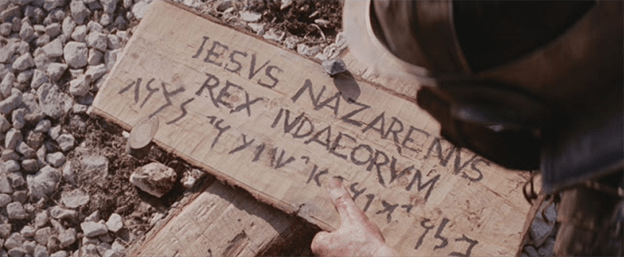
John 19:20 Then many of the Jews read this title, for the place where Jesus was crucified was near the city (Jerusalem); and it was written in Hebrew, Greek, and Latin.
- GIVE US A SIGN!
- NOTE: It is claimed “Criminals had their crime posted on their crosses for all to see.” Since Jesus was innocent of any crime, Pilate posted not a crime, but a truth. Pilate posted a prophecy.
- There is no evidence crimes were posted on those crucified, although it would make sense that the Romans would do so in order to post a warning for others.
- Jesus did not present Himself as a wealthy man or a landowner. But he DID present Himself as the Son of God. Social status was a predominant factor in who was crucified, and this severe type of punishment was often used for servants who were accused of stealing. Jesus presented Himself to His disciples as a “servant,” washing their feet and stating that the most prestigious position in His Kingdom is the servant of all.
- “The real truth about Roman crucifixion is that it was commonly used as punishment for all types of crimes committed by slaves and the lower classes. According to Crucifixion in the Mediterranean World, it was the primary punishment used on slaves. Jeffrey Ross agrees, writing:
In the writings of most Roman authors, crucifixion appears to be reported as the normal punishment for disobedient slaves.
Crucifixion was regularly used on liberti (former slaves) and peregrini (non-citizens), and not just for major crimes. Crucifixion was occasionally used on citizens as well.
In Against Verres, Cicero describes a farm owner who, upon discovering the fraud of the farm manager, should inflict summum supplicium (extreme punishment), a phrase Cicero clearly ties to crucifixion in the same work. A farm manager would generally be a position held by a freedman or slave. Similarly, in Digesta seu Pandectae (in English usually called simply Digest), the compendium of Roman legal code, Pomponius describes a night prefect being properly punished with summum supplicium for theft. Elsewhere in Digest, the penalty for grave robbing is given as summum supplicium for the humilioris, a term used for all lower class persons (e.g. anyone who didn’t own property).
Although there is no formal definition of the term in Roman legal code, Garnsey investigated its usage and concluded it refers to “crucifixion, burning alive, and perhaps condemnation to the beasts.”
In the play Bacchides, the main character, a slave who has stolen some gold, imagines himself in the future, carrying not the gold, but rather a cross.
A fragment of a legal code known as lex Puteolana says that a salve owner has the right to have the state crucify a slave for any crime whatsoever, as long as the owner pays the cost of the execution.
In Digest, the jurist Callistratus describes certain thieves being subject to crucifixion:
The practice which has been approved by most authorities has been to fasten (or nail) notorious brigands to the cross in the place they used to haunt.
There is no indication of the punishment applying only to some social groups. In the Lex Fabia, a legal code concerning run away slaves, crucifixion is listed as a possible penalty for aiding the slave (and thus “stealing” the master’s property), among the humiliores Severus Alexander is said to have had a disgraced public official (so an upper class citizen) crucified after being convicted of theft: the kings were asked what penalty thieves suffered at their hands, and they replied “the cross,” and at this reply the man was crucified.
~ Christianity Stack Exchange – Survey of Roman law
https://christianity.stackexchange.com/questions/22725/what-crime-was-committed-by-the-thieves-crucified-with-jesus
- “The real truth about Roman crucifixion is that it was commonly used as punishment for all types of crimes committed by slaves and the lower classes. According to Crucifixion in the Mediterranean World, it was the primary punishment used on slaves. Jeffrey Ross agrees, writing:
- “During the Passover time, a sign hung on each lamb’s neck, bearing the name of the owner of the lamb. Jesus was crucified with a sign hung over His head with the name of His Father.” ~Bible Holidays by Robin Scarlata & Linda Pierce, Pg. 131.
- “An I.D. tag on the Passover Lambs would only seem to make sense if some of the lambs were returned to their owners if they were found to have a spot or blemish.” I am not a Jewish Scholar and list this only for the reader to do their own research or until a Jewish Scholar answers this question.
- “The Phrase ‘Jesus of Nazareth and King of the Jews” was written in three languages on a sign … The Hebrew initials (as an acronym) … (would be) …YHWH.” ~Bible Holidays by Robin Scarlata & Linda Pierce, Pg. 131.
- According to one writer the only way to get YHVH out of the inscription on the cross is from the book of John 19 as “Jesus of Nazareth and King of the Jews where the “and” is added”: Yeshua Ha-Notzri U‘Melekh Ha-Yehudim” which relies on using the first letters of “Ha-” as the words “The” and “U’ ” as “And”.
He argues the phrase means “Jesus of Nazareth and A king of the Jews” – NOT “Jesus of Nazareth and THE kings of the Jews” thus disqualifying it.
However: - The argument above centers around the word “u’Melekh” where Melekh means “King”, and u’Melekh (with the u’ or “vav”) means “And King”.
- (The Vav is one of a handful of Hebrew letters that has its own meaning. When attached to the beginning of a word, the Vav has the meaning “and.”)
- Note: In scripture, there is no indication of either “a” King or “the” King.
It is an assumption that without the “ha”, which means “the”, then Jesus is only “a” king.
The question then is, does the absence of an “a” necessarily mean the “a” should be included by default, or that He is not the singular King of the Jews? - According to Strong’s G3588 the Greek word “ho”is the word “the” and IS included in the next verse John 19:21. (“The”= “ha” in Hebrew and “ho” in Greek.)
- Therefore; it seems that the assumption of translating “a king” where the “a” is not translated does not seem to hold water.
- See verse below:
- According to one writer the only way to get YHVH out of the inscription on the cross is from the book of John 19 as “Jesus of Nazareth and King of the Jews where the “and” is added”: Yeshua Ha-Notzri U‘Melekh Ha-Yehudim” which relies on using the first letters of “Ha-” as the words “The” and “U’ ” as “And”.
John 19:21 Therefore the chief priests of the Jews said to Pilate, “Do not write, ‘The (“ho” in Greek, “ha” in Hebrew) King of the Jews,’ but, ‘He said, “I am The King of the Jews.” ’ ”
- This verse is explicit that they are NOT saying “A King of the Jews” but “THE King of the Jews”; therefore, the Acronym may indeed be accurate.
John 19:22 Pilate answered, “What I have written, I have written.”
John 19:23 Then the soldiers, when they had crucified Jesus, took His garments and made four parts, to each soldier a part, and also the tunic. Now the tunic was without seam, woven from the top in one piece.
- To each soldier a part … and the tunic. This suggests the company of four soldiers gambling for his clothing.
John 19:24 They said therefore among themselves, “Let us not tear it, but cast lots for it, whose it shall be,” that the Scripture might be fulfilled which says:
“They divided My garments among them,
And for My clothing they cast lots.”
- Psalm 22:18 They divide My garments among them, And for My clothing they cast lots.
Therefore the soldiers did these things.
- There was a garrison of soldiers, but four soldiers who gambled for His tunic; only one of them took possession of Jesus’ tunic. Which one? Was it the soldier who pierced his side with a spear? Were they the same soldiers who had mocked and beat Him? How will they feel and what will they think when they discover Jesus IS the Son of God?
Behold Your Mother
John 19:25 Now there stood by the cross of Jesus 1) His mother, and 2) His mother’s sister, 3) Mary the wife of Clopas, and 4) Mary Magdalene.
John 19:26 When Jesus therefore saw His mother, and the disciple whom He loved (John, the author of this gospel) standing by, He said to His mother, “Woman, behold your son!”
John 19:27 Then He said to the disciple (John), “Behold your mother!” And from that hour that disciple (John) took her to his own home.
It Is Finished
John 19:28 After this, Jesus, knowing (seeing) that all things were now accomplished, that the Scripture might be fulfilled, said, “I thirst!”
John 19:29 Now a vessel full of sour wine was sitting there; and they filled a sponge with sour wine, put it on hyssop, and put it to His mouth.
John 19:30 So when Jesus had received the sour wine, He said, “It is finished!” And bowing His head, He gave up His spirit.
Jesus’ Side Is Pierced
John 19:31 Therefore, because it was the Preparation Day, that the bodies should not remain on the cross on the Sabbath (for that Sabbath was a high day), the Jews asked Pilate that their legs might be broken, and that they might be taken away.
John 19:32 Then the soldiers came and broke the legs of the first and of the other who was crucified with Him.
John 19:33 But when they came to Jesus and saw that He was already dead, they did not break His legs.
John 19:34 But one of the soldiers pierced His side with a spear, and immediately blood and water came out.
- Jesus’ baptism was a baptism of death (not the baptism of repentance). Jesus allowed a baptism of water with John the baptizer signifying his death to self (obedience to the Father) by His own blood. Life comes through the water and the blood
- I John 5:6 [The Certainty of God’s Witness] This is He who came by water and blood—Jesus Christ; not only by water, but by water and blood. And it is the Spirit who bears witness, because the Spirit is truth.
- I John 5:8 And there are three that bear witness on earth: The Spirit, the water, and the blood; and these three agree as one.
John 19:35 And he who has seen has testified, and his testimony is true; and he knows that he is telling the truth, so that you may believe.
John 19:36 For these things were done that the Scripture should be fulfilled, “Not one of His bones shall be broken.”
John 19:37 And again another Scripture says, “They shall look on Him whom they pierced.”
Jesus Buried in Joseph’s Tomb
John 19:38 After this, Joseph of Arimathea, being a disciple of Jesus, but secretly, for fear of the Jews, asked Pilate that he might take away the body of Jesus; and Pilate gave him permission. So he came and took the body of Jesus.
John 19:39 And Nicodemus, who at first came to Jesus by night, also came, bringing a mixture of myrrh and aloes, about a hundred pounds.
John 19:40 Then they took the body of Jesus, and bound it in strips of linen with the spices, as the custom of the Jews is to bury.
John 19:41 Now in the place where He was crucified there was a garden, and in the garden a new tomb in which no one had yet been laid.
He who Created the Garden was Buried in It
John 19:42 So there they laid Jesus, because of the Jews’ Preparation Day, for the tomb was nearby.
- The tomb was nearby the place of crucifixion. To find the tomb also look for Golgotha.
- Since Joseph of Arimathea was a metal merchant (he owned tin mines) in England, after Jesus’ death he is reputed for being responsible in the spreading of the gospel to England.
{1 of 7} John 19 – “Jewish Leaders Blackmail Roman Legate Forcing Execution of Innocent Man”
{2 of 7} John 19 – “Stand By Me” [v25-26]
{3 of 7} John 19 – “Cross-Examined” [The Crucifixion]
{4 of 7} John 19 – “Twisted, Coiled, Cursed” [Symbolism & Hebrew Meanings]
{5 of 7} John 19 – “The Wonder of the Wandering Future” [Prophecy & Patterns]
{6 of 7} John 19 – “Four Swords and a Spear” [Archeology]
{7 of 7} John 19 -“It is Finished!” [v28,30]
{8 of 8} John 19 – “No King But Caesar” [v15]
 Quantum Study Bible