
Words in italic type have been added for clarity. They are not found in the original Hebrew or Aramaic.
John 19
The Crucifixion in Other Gospels:
Matthew Chapter 27
Mark Chapter 15
Luke Chapter 23
Prelude:
- Jesus rode into Jerusalem on the same day the chief priests were selecting a Passover lamb to sacrifice for the sins of the nation. Today, this is called His “Triumphal Entry”.
- For three days the lamb was examined for a spot or a blemish to be an acceptable sacrifice. For three days Jesus was examined by the chief priests and the elders for a spot or blemish in His teachings (for they sought to trap Him with His words) but they could not.
- Jesus was arrested and cross-examined by the Sanhedrin (illegally) in the middle of the night.
- He told them He was the Son of God, claiming to be equal with God. Although it was Truth with a capital “T”, it was all they needed to deliver Him over for death for blasphemy. The capital “T” was the Cross.
- When the rooster crowed three times in the early morning they took him to Pilate.
- Pilate wanted to release him but the crowd chooses Barabbas, a murderer.
John 19
The Soldiers Mock Jesus
John 19:1 So then Pilate took Jesus and scourged Him.
John 19:2 And the soldiers twisted a crown of thorns and put it on His head, and they put on Him a purple robe.
John 19:3 Then (they came up to Him and) they said, “Hail, King of the Jews!” And they struck Him with their hands.
John 19:4 Pilate then went out again, and said to them, “Behold, I am bringing Him out to you, that you may know that I find no fault in Him.”
Pilate’s Decision
John 19:5 Then Jesus came out, wearing the crown of thorns and the purple robe. And Pilate said to them, “Behold the Man!”
John 19:6 Therefore, when the chief priests and officers saw Him, they cried out, saying, “Crucify Him, crucify Him!”
Pilate said to them, “You take Him and crucify Him, for I find no fault in Him.”
John 19:7 The Jews answered him, “We have a law, and according to our law He ought to die, because He made Himself the Son of God.”
John 19:8 Therefore, when Pilate heard that saying, he was the more afraid,
John 19:9 and went again into the Praetorium, and said to Jesus, “Where are You from?” But Jesus gave him no answer.
- The Praetorium: https://www.biblestudytools.com/encyclopedias/isbe/praetorium.html
- The Greek word (praitorion) rendered in Mark 15:16 is “common hall” (Matthew 27:27 , marg., “governor’s house”), “judgment hall,” (John 18:28, John 18:33, marg., “Pilate’s house”, John 19:9 ; Acts 23:35), “palace” (Phil 1:13). This is properly a military word. It denotes
- 1) The general’s tent or headquarters;
- 2) The governor’s residence, as in Acts 23:35 (RSV, “palace”); and
- 3) The praetorian guard (See PALACE), or the camp or quarters of the praetorian cohorts (Acts 28:16), the imperial guards in immediate attendance on the emperor, who was “praetor” or commander-in-chief.
- The Greek word (praitorion) rendered in Mark 15:16 is “common hall” (Matthew 27:27 , marg., “governor’s house”), “judgment hall,” (John 18:28, John 18:33, marg., “Pilate’s house”, John 19:9 ; Acts 23:35), “palace” (Phil 1:13). This is properly a military word. It denotes
John 19:10 Then Pilate said to Him, “Are You not speaking to me? Do You not know that I have power (authority) to crucify You, and power to release You?”
John 19:11 Jesus answered, “You could have no power at all against Me unless it had been given you from above. Therefore the one who delivered Me to you has the greater sin.”
John 19:12 From then on Pilate sought to release Him, but the Jews cried out, saying, “If you let this Man go, you are not Caesar’s friend. Whoever makes himself a king speaks against Caesar.”
- The leaders of the Jews have now chosen Caesar to be their king, an abomination against the God of Abraham, Isaac, and Jacob. They chose Caesar, their Roman enemy, over Jesus.
- The leaders included the priests and the High Priest who knew scripture:
- Deuteronomy 17:15 you shall surely set a king over you whom the Lord your God chooses; one from among your brethren you shall set as king over you; you may not set a foreigner over you, who is not your brother.
- A foreigner is a gentile, a non-Jewish person. Herod also was not Jewish but a descendant of Esau. Yet, the Herodians supported him, believing he was the promised Messiah because he built their temple on a more magnificent scale. Even today there are Jews who believe that the man who builds the third temple will be their Messiah, – that man -will be the coming Antichrist.
John 19:13 When Pilate therefore heard that saying, he brought Jesus out and sat down in the judgment seat in a place that is called The Pavement, but in Hebrew, Gabbatha.
John 19:14 Now it was the Preparation Day of the Passover (Nisan 14), and about the sixth hour. And he said to the Jews, “Behold your King!” (Jesus was taken down before twilight when the next Jewish day began – Passover, Nisan 15, A Holy Convocation, A High Sabbath).
- ►What Is The Sixth Hour In John?
https://thebiblemadeplain.com/what-is-the-sixth-hour-in-john-1914/
The phrase “and about the sixth hour” does not refer to the time of day, but rather to the amount of time that had passed from the initial arrest of Jesus till the time the Jews cried out, “crucify him”.

- ►It was the Preparation Day of the Passover, the same day the Passover lamb is slaughtered. Therefore Passover begins at twilight which is Nisan 15 Passover is considered a Sabbath, a Holy Convocation. Nisan is the first month on the Jewish Calendar.
[The following day was not a “Saturday Sabbath”]
- ►-Leviticus 23:6 And on the fifteenth day of the same month is the Feast of Unleavened Bread to the Lord; seven days you must eat unleavened bread.
- ►-Matthew 26:17 Now on the first at (literally: before) the Unleavened Bread the disciples came to Jesus, saying to Him, “Where do You want us to prepare for You to eat the Passover?”
John 19:15 But they cried out, “Away with Him, away with Him! Crucify Him!”
Pilate said to them, “Shall I crucify your King?”
The chief priests answered, “We have no king but Caesar!”
| THE SEVEN TRIALS OF JESUS | |
| FIRST TRIAL | At Annas’ Residence |
| Time | 2:00 am |
| Type | Jewish preliminary examination |
| Authority | Annas, ex-high priest of the Jews. (Father-In-Law of Caiaphas.) |
| Scripture | John 18:13-23 |
| Accusations | Pre-trial trumped-up charges. General questions, nothing specific |
| Legality | Illegal because it was an unauthorized inquiry held at night at the residence of Annas. Prejudice. No specific charges. Violent. |
| Results | Purpose was to gain evidence for the trial. “Guilty” of irreverence. Taken to Caiaphas |
| SECOND TRIAL | At Caiaphas’ Residence |
| Time | 3:30 am |
| Type | Jewish |
| Authority | Caiaphas, current high priest with members of the Sanhedrin |
| Scripture | Matt 26-56-68, Mk 14:53-65, John 18:24 |
| Accusations | Blasphemy, claimed to be the Messiah and the Son of God. |
| Legality | Illegal because it was held at night at the residence of Caiaphas. Perjured witnesses could not agree. Violence. |
| Results | Guilty of blasphemy by common consent. Sent to the Sanhedrin. |
| THIRD TRIAL | At The Sanhedrin |
| Time | 6:00 am |
| Type | Jewish |
| Authority | Sanhedrin (Jewish ruling authorities) |
| Scripture | Luke 22:66-71 |
| Accusations | Charged with blasphemy; claimed to be the Son of God. Rome is not interested in blasphemy. |
| Legality | Formal trial to confirm capital sentence of the illegal night trial. Put Jesus under oath. Caiaphas made each member of Sanhedrin accredited witnesses. |
| Results | Declared guilty of blasphemy by Sanhedrin. Sent to Roman Governor Pilate for legal sentence of death. |
| FOURTH TRIAL | At The Praetorium |
| Time | 6:30 am |
| Type | Roman civil trial |
| Authority | Pilate, Governor of Judea at official residence (first time) |
| Scripture | Matt 27:1-2, 11-14, Mark 15:2-5, Luke 23:1-7, John 18:28-38 |
| Accusations | Accused Him of treason, a capital offense in Rome |
| Legality | Illegal, yet held even though found innocent by Pilate. No defense attorney. Violent. |
| Results | Innocent, John 18:38. It should have ended the trial, but sent to Herod Antipas. Mob overruled Pilate. |
| FIFTH TRIAL | At Herod Antipas |
| Time | 7:00 am |
| Type | Roman Civil Trial |
| Authority | Herod Antipas, Governor of Galilee |
| Scripture | Luke 23:8-12 |
| Accusations | No accusation. Mock trial. Mob violence |
| Legality | Illegal because there are no grounds. Mockery in courtroom. Violence. No defense attorney. |
| Results | Mistreated and mocked, returned to Pilate without decision by Herod. |
| SIXTH TRIAL | Returned to the Praetorium |
| Time | 7:30 am |
| Type | Roman civil trial |
| Authority | Pilate, Governor of Judea (second time) |
| Scripture | Matt 27:15-26, Mark 15:6-15, Luke 23:13-25, John 18:39, 19:16 |
| Accusations | Treason, Bargain with mob, put on trial with Barabbas. |
| Legality | Illegal because Pilate had no proof of guilt, allowed innocent man to be condemned. |
| Results | Found innocent, but Pilate bowed to political pressure of the Jewish leaders. |
| SEVENTH TRIAL | FOR EVERYONE |
| Time | Today |
| Type | Universal |
| Authority | Free Will given by the Creator. |
| Scripture | The entire bible |
| Accusations | Jesus Christ is Son of God, Lord and Savior. Born of a Virgin by the Holy Spirit. You are a sinner and only Jesus’ blood can make you innocent by believing He is who He says He is. |
| Legality | The decision is legal and eternally binding |
| Results | What will you do with Jesus? |
NOTE: There were three Jewish Trials and three Roman Trials. Jesus was declared guilty at all of the Jewish Trials. Jesus was declared innocent at all of the Roman Trials.
SEVEN DAYS YOU SHALL WORK, BUT ON THE SEVENTH DAY YOU SHALL REST.
At the End of the Sixth Trial, the verdict was finished, the trials of “work” were done. Jesus was crucified and buried. He rested in the grave as He appealed to the Supreme Judge of All Men. Then the Father’s verdict countermanded all six trials – Jesus was declared innocent and released from the grave at Jesus’ Seventh Trial.
Psalm 2:1 Why do the nations rage,
And the people plot a vain (impossible) thing (keeping Jesus in the grave)?
2 The (Gentile) kings of the earth set themselves,
And the (Jewish) rulers take counsel together,
Against the Lord and against His Anointed, saying,
3 “Let us break Their bonds (of authority) in pieces
And cast away Their cords from us.” …
Isaiah 46:10 Declaring the end from the beginning, And from ancient times things that are not yet done, Saying, ‘MY counsel shall stand, And I WILL DO all My pleasure
Proverbs 19:21 There are many plans in a man’s heart; Nevertheless, (it is) the Lord’s counsel — that will stand.
AT THE SEVENTH TRIAL WHERE GOD IS THE JUDGE, Which side will you take?
Was Jesus born of a virgin, proving He was the Son of God?
Did He rise from the dead?
Will you?
John 19:16 Then he (Pilate) delivered Him to them to be crucified. Then they took Jesus and led Him away.
The King on a Cross
John 19:17 And He, bearing His cross, went out to a place called the Place of a Skull, which is called in Hebrew, Golgotha,
John 19:18 where they crucified Him, and two others with Him, one on either side, and Jesus in the center.
John 19:19 Now Pilate wrote a title and put it on the cross. And the writing was:
JESUS OF NAZARETH, THE KING OF THE JEWS.
John 19:20 Then many of the Jews read this title, for the place where Jesus was crucified was near the city (Jerusalem); and it was written in Hebrew, Greek, and Latin.
John 19:21 Therefore the chief priests of the Jews said to Pilate, “Do not write, ‘The King of the Jews,’ but, ‘He said, “I am the King of the Jews.” ’ ”
John 19:22 Pilate answered, “What I have written, I have written.”
John 19:23 Then the soldiers, when they had crucified Jesus, took His garments and made four parts, to each soldier a part, and also the tunic. Now the tunic was without seam, woven from the top in one piece.
John 19:24 They said therefore among themselves, “Let us not tear it, but cast lots for it, whose it shall be,” that the Scripture might be fulfilled which says:
“They divided My garments among them,
And for My clothing they cast lots.”
Therefore the soldiers did these things.
Behold Your Mother
John 19:25 Now there stood by the cross of Jesus His mother, and His mother’s sister, Mary the wife of Clopas, and Mary Magdalene.
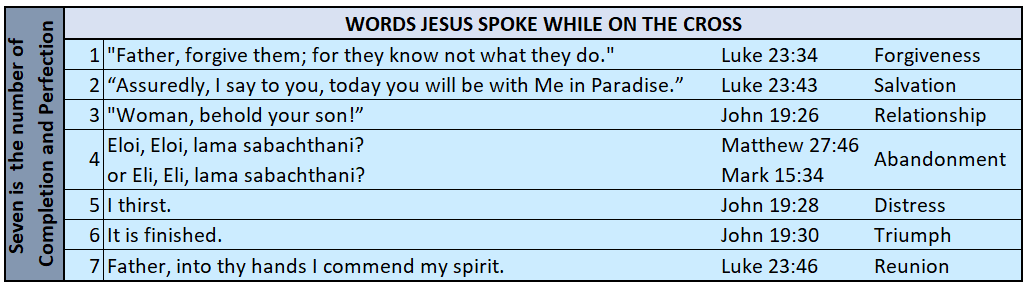
John 19:26 When Jesus therefore saw His mother, and the disciple whom He loved (John, the author of this gospel) standing by, He said to His mother, “Woman, behold your son!”
John 19:27 Then He said to the disciple (John), “Behold your mother!” And from that hour that disciple (John) took her to his own home.
It Is Finished
John 19:28 After this, Jesus, knowing (seeing) that all things were now accomplished, that the Scripture might be fulfilled, said, “I thirst!”
John 19:29 Now a vessel full of sour wine was sitting there; and they filled a sponge with sour wine, put it on hyssop, and put it to His mouth.
- Didn’t Jesus refuse to drink sour wine a few hours earlier? “And when they had come to a place called Golgotha, that is to say, Place of a Skull, they gave Him sour wine mingled with gall to drink. But when He had tasted it, He would not drink” (Matthew 27:33-34).
- Why did Jesus drink the latter sour wine but not the former? He refused the former sour wine because it contained “gall,” intended as a crude anesthetic for the spikes the Romans were about to drive through His wrists and feet. This time, however, they dipped it in hyssop even as Moses instructed for the Passover lamb in Egypt:
“Then Moses called for all the elders of Israel and said to them, “Pick out and take lambs for yourselves according to your families, and kill the Passover lamb. And you shall take a bunch of hyssop, dip it in the blood that is in the basin, and strike the lintel and the two doorposts with the blood that is in the basin. And none of you shall go out of the door of his house until morning. For the LORD will pass through to strike the Egyptians; and when He sees the blood on the lintel and on the two doorposts, the LORD will pass over the door and not allow the destroyer to come into your houses to strike you” (Exodus 12:21-23).
- Every detail of Jesus’ crucifixion was prophesied in the Old Testament among the books of scripture ranging from ~1400 BC to ~400 BC.
John 19:30 So when Jesus had received the sour wine, He said, “It is finished!” And bowing His head, He gave up His spirit.
- ►It is finished, the Judgment is over, nothing is left but ashes; the ashes of the Red Heifer.
- ►It started at the third hour and ended at the ninth hour for a total of six hours. Jesus “worked” for six hours, declared “It is finished” and then He rested in the grave.
- The crucifixion began at the third hour (9:00 am) and ended at the ninth hour (3:00 pm)
- Mark 15:25 Now it was the third hour (9:00 am), and they crucified Him.
- Mark 15:33 Now when the sixth hour (noon) had come, there was darkness over the whole land until the ninth hour. 34 And at the ninth hour Jesus cried out with a loud voice, saying, “Eloi, Eloi, lama sabachthani?” which is translated, “My God, My God, why have You forsaken Me?”
John 19:31 Therefore, because it was the Preparation Day, that the bodies should not remain on the cross on the Sabbath (for that Sabbath was a high day), the Jews asked Pilate that their legs might be broken, and that they might be taken away.
John 19:32 Then the soldiers came and broke the legs of the first and of the other who was crucified with Him.
- The thieves had to hurry up and die.
John 19:33 But when they came to Jesus and saw that He was already dead, they did not break His legs.
John 19:34 But one of the soldiers pierced His side with a spear, and immediately blood and water came out.
John 19:35 And he who has seen has testified, and his testimony is true; and he knows that he is telling the truth, so that you may believe.
John 19:36 For these things were done that the Scripture should be fulfilled, “Not one of His bones shall be broken.”
John 19:37 And again another Scripture says, “They shall look on Him whom they pierced.”
John 19:38 After this, Joseph of Arimathea, being a disciple of Jesus, but secretly, for fear of the Jews, asked Pilate that he might take away the body of Jesus; and Pilate gave him permission. So he came and took the body of Jesus.
John 19:39 And Nicodemus, who at first came to Jesus by night, also came, bringing a mixture of myrrh and aloes, about a hundred pounds.
John 19:40 Then they took the body of Jesus, and bound it in strips of linen with the spices, as the custom of the Jews is to bury.
John 19:41 Now in the place where He was crucified there was a garden, and in the garden a new tomb in which no one had yet been laid.
John 19:42 So there they laid Jesus, because of the Jews’ Preparation Day, for the tomb was nearby.
- This was Joseph of Arimathea’s tomb. He gave it to Jesus – but got it back in three days.
{1 of 7} John 19 – “Jewish Leaders Blackmail Roman Legate Forcing Execution of Innocent Man”
{2 of 7} John 19 – “Stand By Me” [v25-26]
{3 of 7} John 19 – “Cross-Examined” [The Crucifixion]
{4 of 7} John 19 – “Twisted, Coiled, Cursed” [Symbolism & Hebrew Meanings]
{5 of 7} John 19 – “The Wonder of the Wandering Future” [Prophecy & Patterns]
{6 of 7} John 19 – “Four Swords and a Spear” [Archeology]
{7 of 7} John 19 -“It is Finished!” [v28,30]
{8 of 8} John 19 – “No King But Caesar” [v15]
 Quantum Study Bible