
Words in italic type have been added for clarity. They are not found in the original Hebrew or Aramaic.
II Kings 16 {1 of 7} Type, Prophecy
II Kings 16 {2 of 7} History
II Kings 16 {3 of 7} Meanings and Symbolism
II Kings 16 {4 of 7} Child Sacrifice
II Kings 16 {5 of 7} Places with Prophetic Meanings
II Kings 16 {6 of 7} Very Punny
II Kings 16 {7 of 7} Urijah the Priest
See: TIMELINE: 501 BC – 770 BC (Then Scroll down to 740 BC)
Below: KINGS OF JUDAH AND ISRAEL Chart:
* Provides the inclusion of mothers.
* Provides the inclusion of prophets.
* Provides a smattering of historical notes.
* Numbered Kings/Queens which ruled in the divided kingdom of Israel and Judah for identification: especially for kings with the same names ruling at the same time from these two kingdoms dealing with the same kings from other nations.

II Kings 16
Ahaz Reigns in Judah
II Kings 16:1 In the seventeenth year of Pekah (#37) the son of Remaliah, Ahaz (#11) the son of Jotham (#10), king of Judah, began to reign.
II Kings 16:2 Ahaz was twenty years old when he became king, and he reigned sixteen years in Jerusalem; and he did not do what was right in the sight of the Lord his God (Yᵊhōvâ ‘ĕlōhîm), as his father David had done.
II Kings 16:3 But he walked in the way of the kings of Israel; indeed he made his son pass through the fire (Hezekiah’s brother), according to the abominations of the nations whom the Lord (Yᵊhōvâ) had cast out from before the children of Israel.
- Jeremiah 19:5
(they have also built the high places of Baal, to burn their sons with fire for burnt offerings to Baal, which I did not command or speak, nor did it come into My mind)
- Jeremiah 32:35
And they built the high places of Baal which are in the Valley of the Son of Hinnom, to cause their sons and their daughters to pass through the fire to Molech, which I did not command them, nor did it come into My mind that they should do this abomination, to cause Judah to sin.’
- The Jewish Midrash elaborates on this disturbing service:
(Tanchuma (Buber) addition to Va’etchanan, section 2)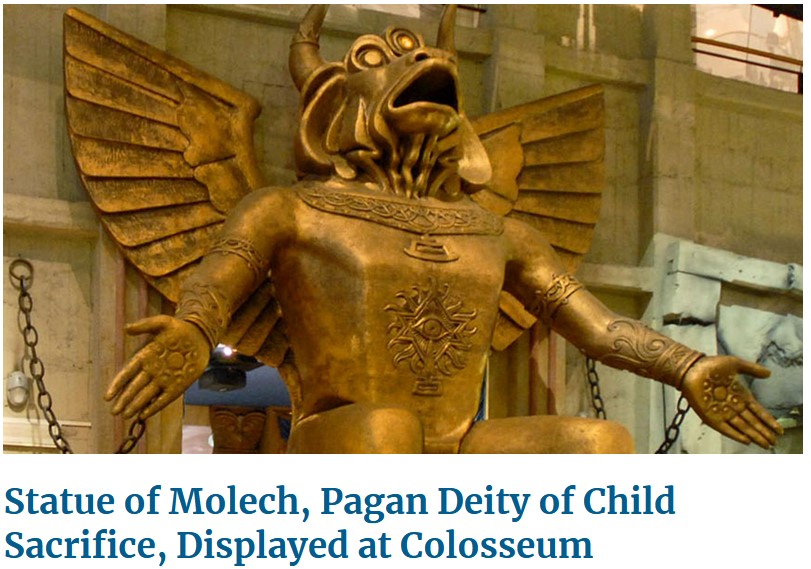
How did the Molech work in the valley of Ben-Hinnom? It was built outside of Jerusalem. It was an idol with the face of a calf and open hands like someone who wants to take something from another. They would light this idol on fire until his hands were scorching. There were seven chambers before him and according to the quality of the sacrifice that is how close one could come to him. If one came with a bird, then chamber one; goat, chamber two; sheep, chamber three; calf, chamber four; cow, chamber five; and ox, chamber six.
He who brought his child, the priests would say that he is offering the greatest sacrifice. He would enter the innermost chamber (God’s sacred number Seven) and go kiss the Molech . . .
The priests would then take the child and place it near the Molech. They would then bang with drums to drown out the cries.
II Kings 16:4 And he sacrificed and burned incense on the high places (places of idols), on the hills, and under every green tree.
II Kings 16:5 Then Rezin king of Syria and Pekah the son of Remaliah, king of Israel, came up to Jerusalem to make war; and they besieged Ahaz but could not overcome him.
II Kings 16:6 At that time Rezin king of Aram Damascus (Syria) captured Elath (Lit. Large Tree; sing. of Eloth) for Syria, and drove the men of Judah from Elath. Then the Edomites (A few ancient mss. translate it as Syrians) went to Elath, and dwell there to this day.
II Kings 16:7 So Ahaz sent messengers to Tiglath-Pileser (A later name of Pul, 2 Kin. 15:19) king of Assyria, saying, “I am your servant and your son. Come up and save me from the hand of the king of Syria (Rezin) and from the hand of the king of Israel (Pekah), who rise up against me.”
II Kings 16:8 And Ahaz took the silver and gold that was found in the house of the Lord (Yᵊhōvâ), and in the treasuries of the king’s house, and sent it as a present to the king of Assyria.
II Kings 16:9 So the king of Assyria heeded him; for the king of Assyria went up against Damascus and took it, carried its people captive to Kir, and killed Rezin.
II Kings 16:10 Now King Ahaz went to Damascus to meet Tiglath-Pileser king of Assyria, and saw an altar that was at Damascus; and King Ahaz sent to Urijah the priest the design of the altar and its pattern, according to all its workmanship.
II Kings 16:11 Then Urijah the priest built an altar according to all that King Ahaz had sent from Damascus. So Urijah the priest made it before King Ahaz came back from Damascus.
II Kings 16:12 And when the king came back from Damascus, the king saw the altar; and the king approached the altar and made offerings on it.
II Kings 16:13 So he burned his burnt offering and his grain offering; and he poured his drink offering and sprinkled the blood of his peace offerings on the altar.
II Kings 16:14 He also brought the bronze altar which was before the Lord (Yᵊhōvâ), from the front of the temple (Lit. house)—from between the new altar and the house of the Lord (Yᵊhōvâ)—and put it on the north (H6828 ṣāp̄ôn gloomy, dark, hidden) side of the new altar.
II Kings 16:15 Then King Ahaz commanded Urijah the priest, saying, “On the great new altar burn the morning burnt offering, the evening grain offering, the king’s burnt sacrifice, and his grain offering, with the burnt offering of all the people of the land, their grain offering, and their drink offerings; and sprinkle on it all the blood of the burnt offering and all the blood of the sacrifice. And the bronze altar shall be for me to inquire by.”
II Kings 16:16 Thus did Urijah the priest, according to all that King Ahaz commanded.
II Kings 16:17 And King Ahaz cut off the panels of the carts, and removed the lavers from them; and he took down the Sea from the bronze oxen that were under it, and put it on a pavement of stones.
II Kings 16:18 Also he removed the Sabbath pavilion which they had built in the temple, and he removed the king’s outer entrance from the house of the Lord (Yᵊhōvâ), on account of the king of Assyria.
II Kings 16:19 Now the rest of the acts of Ahaz which he did, are they not written in the book of the chronicles of the kings of Judah?
II Kings 16:20 So Ahaz rested with his fathers, and was buried with his fathers in the City of David. Then Hezekiah his son (#12 in chart) reigned in his place.
PREVIOUS: II Kings Chapter 15
NEXT: II Kings Chapter 17
 Quantum Study Bible