
Words in italic type have been added for clarity. They are not found in the original Hebrew or Aramaic.
II Kings 16 {1 of 7} Type, Prophecy
II Kings 16 {2 of 7} History
II Kings 16 {3 of 7} Meanings and Symbolism
II Kings 16 {4 of 7} Child Sacrifice
II Kings 16 {5 of 7} Places with Prophetic Meanings
II Kings 16 {6 of 7} Very Punny
II Kings 16 {7 of 7} Urijah the Priest
See: TIMELINE: 501 BC – 770 BC (Then Scroll down to 740 BC)

ARCHEOLOGY:
- King Ahaz’s seal is a bulla (impressed piece of clay). The seal contains an ancient Hebrew inscription mentioning the name of Ahaz of Judah, as well as the name of his father, Jotham (Jotham), identifying Ahaz as the “king of Judah”. The bulla contains a fingerprint which may belong to Ahaz himself.
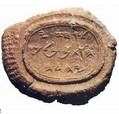
- Ushna seal mentions the historicity of Ahaz from Tiglath-Pileser III.
- See: SEALS found in Israel
II Kings 16
Ahaz Reigns in Judah
II Kings 16:1 In the seventeenth year of Pekah (#37) the son of Remaliah, Ahaz (#11) the son of Jotham (#10), king of Judah, began to reign.
- Pekah (#37 was the murderer and usurper of king Pekahiah of Israel (II Kings 15:25). Pekah, son of Remaliah, was a royal officer of unspecified duties, who conspired with Argob and Arieh and fifty Gileadites and killed Pekahiah (#36) in his palace in Samaria.
II Kings 16:2 Ahaz was twenty years old when he became king, and he reigned sixteen years in Jerusalem; and he did not do what was right in the sight of the Lord his God (Yᵊhōvâ ‘ĕlōhîm), as his father (ancestor) David had done.
II Kings 16:3 But he walked in the way of the kings of Israel; indeed he made his son pass through the fire (Hezekiah’s brother), according to the abominations of the nations whom the Lord (Yᵊhōvâ) had cast out from before the children of Israel.
II Kings 16:4 And he sacrificed and burned incense on the high places (places of idols), on the hills, and under every green tree.
II Kings 16:5 Then Rezin king of Syria and Pekah the son of Remaliah, king of Israel, came up to Jerusalem to make war; and they besieged Ahaz but could not overcome him.
II Kings 16:6 At that time Rezin king of Aram Damascus (Syria) captured Elath (Lit. Large Tree; sing. of Eloth) for Syria, and drove the men of Judah from Elath. Then the Edomites (A few ancient mss. translate it as Syrians) went to Elath, and dwell there to this day.
- The old city of Damascus is considered to be among the oldest continually inhabited cities in the world.
- Acts Chapter 9
It was on the Damascus Road that Paul was Converted and became the apostle to the Gentiles. - And yet, according to Isaiah 17:1 Damascus is destined to become a ruinous heap. Given current events and the attack on Israel on October 7, 2023, the Iranian embassy in Damascus has been the target of Israeli bombing during the current war with terror sponsored terrorists by Iran.
- Isaiah 17:1
Proclamation Against Syria and Israel
The burden against Damascus. “Behold, Damascus will cease from being a city, And it will be a ruinous heap.
- Isaiah 17:1
- “Iran has expanded its military presence in Syria in recent years and has a foothold in most state-controlled areas, with thousands of members of militias and local paramilitary groups under its command, Western intelligence sources say.” NBC News Feb. 19, 2023
II Kings 16:7 So Ahaz sent messengers to Tiglath-Pileser (A later name of Pul, 2 Kin. 15:19) king of Assyria, saying, “I am your servant and your son. Come up and save me from the hand of the king of Syria (Rezin) and from the hand of the king of Israel (Pekah), who rise up against me.”
II Kings 16:8 And Ahaz took the silver and gold that was found in the house of the Lord (Yᵊhōvâ), and in the treasuries of the king’s house, and sent it as a present to the king of Assyria.
II Kings 16:9 So the king of Assyria heeded him; for the king of Assyria went up against Damascus and took it, carried its people captive to Kir, and killed Rezin.
- “In order to save his life, he (Raḫiānu aka Rezin) fled alone and entered the gate of his city [like] a mongoose. I [im]paled his foremost men alive while making (the people of) his land watch. For forty-five days I set up my camp [aro]und his city and confined him (there) like a bird in a cage. I cut down his plantations, […] …, (and) orchards, which were without number; I did not leave a single one (standing). I surrounded (and) captured [the city …]ḫādara, the ancestral home of Raḫiānu (Rezin) of the land Damascus, [the pl]ace where he was born. I carried off 800 people, with their possessions, their oxen, (and) their sheep and goats. I carried off 750 captives from the cities Kuruṣṣâ (and) Samāya, (as well as) 550 captives from the city Metuna. Like tell(s) after the Deluge, I destroyed 591 cities of 16 districts of the land Damascus.”
(RINAP 1, Tiglath-Pileser III 20, l. 8’-17’)
Hayim Tadmor and Shigeo Yamada, The Royal Inscriptions of Tiglath-pileser III (744-727 BC) and Shalmaneser V (726-722 BC), Kings of Assyria. (The Royal Inscriptions of the Neo-Assyrian Period 1; Winona Lake, IN: Eisenbrauns, 2011).
II Kings 16:10 Now King Ahaz went to Damascus to meet Tiglath-Pileser king of Assyria, and saw an altar that was at Damascus; and King Ahaz sent to Urijah the priest the design of the altar and its pattern, according to all its workmanship.
- Remember Ahaz words: “I am your servant and your son”.
Ahaz felt he needed help from the king of Assyria while pushing God aside. God asks “What about ME?” In vernacular terms Ahaz kicked God to the curb.
II Kings 16:11 Then Urijah the priest built an altar according to all that King Ahaz had sent from Damascus. So Urijah the priest made it before King Ahaz came back from Damascus.
II Kings 16:12 And when the king came back from Damascus, the king saw the altar; and the king approached the altar and made offerings on it.
II Kings 16:13 So he burned his burnt offering and his grain offering; and he poured his drink offering and sprinkled the blood of his peace offerings on the altar.
II Kings 16:14 He also brought the bronze altar which was before the Lord (Yᵊhōvâ), from the front of the temple (Lit. house)—from between the new altar and the house of the Lord (Yᵊhōvâ)—and put it on the north (H6828 ṣāp̄ôn gloomy, dark, hidden) side of the new altar.
II Kings 16:15 Then King Ahaz commanded Urijah the priest, saying, “On the great new altar burn the morning burnt offering, the evening grain offering, the king’s burnt sacrifice, and his grain offering, with the burnt offering of all the people of the land, their grain offering, and their drink offerings; and sprinkle on it all the blood of the burnt offering and all the blood of the sacrifice. And the bronze altar shall be for me to inquire by.”
II Kings 16:16 Thus did Urijah the priest, according to all that King Ahaz commanded.
II Kings 16:17 And King Ahaz cut off the panels of the carts, and removed the lavers from them; and he took down the Sea from the bronze oxen that were under it, and put it on a pavement of stones.
II Kings 16:18 Also he removed the Sabbath pavilion which they had built in the temple, and he removed the king’s outer entrance from the house of the Lord (Yᵊhōvâ), on account of the king of Assyria.
II Kings 16:19 Now the rest of the acts of Ahaz which he did, are they not written in the book of the chronicles of the kings of Judah?
II Kings 16:20 So Ahaz rested with his fathers, and was buried with his fathers in the City of David. Then Hezekiah his son (#12 in chart) reigned in his place.
- Ahaz was so hated by his people that at his death he was buried in the city of David but not in the royal tombs reserved for the kings.
PREVIOUS: II Kings Chapter 15
NEXT: II Kings Chapter 17
 Quantum Study Bible